Why Container Loading Matters
Ocean freight is one of the largest cost components in stone importing — typically 10-25% of the total landed cost, depending on origin and destination. Loading a container efficiently can save $500-2,000 per shipment, while poor loading leads to breakage, wasted space, and costly insurance claims. For importers bringing in 10-20 containers per year, optimization can mean $10,000-40,000 in annual savings.
★ Key Takeaways
- Ocean freight is one of the largest cost components in stone importing — typically 10-25% of the total landed cost, depending on origin and destination. Loading a container efficiently can save $500-2,000 per shipment, while poor loading leads to bre
- At Phoenix Power Stone, we have shipped thousands of containers to 50+ countries. This guide distills our loading expertise into practical, actionable information for stone importers.
- Key insight for stone:Weight is almost always the limiting factor, not volume. A 20ft container loaded with granite slabs reaches its 28-ton weight limit long before it fills the 33m³ space. This is normal and expected — you pay for the container, no
- Slabs are loaded vertically in A-frame wooden crates. Each slab is separated by protective material (plastic sheet or thin foam). Crate weight accounts for approximately 5-8% of the total payload.
- Steps are typically loaded in strong wooden crates. A 20ft container holds approximately 250-400 linear steps (1.0-1.5m width), depending on step dimensions. Weight is the constraint — calculate at approximately 80 kg per linear meter of step (2cm th
At Phoenix Power Stone, we have shipped thousands of containers to 50+ countries. This guide distills our loading expertise into practical, actionable information for stone importers.
Container Types and Specifications
Standard Dry Containers
| Specification | 20ft Container | 40ft Container | 40ft High Cube |
|---|---|---|---|
| Internal Length | 5.90 m (19'4") | 12.03 m (39'5") | 12.03 m (39'5") |
| Internal Width | 2.35 m (7'8") | 2.35 m (7'8") | 2.35 m (7'8") |
| Internal Height | 2.39 m (7'10") | 2.39 m (7'10") | 2.70 m (8'10") |
| Door Opening | 2.34 × 2.28 m | 2.34 × 2.28 m | 2.34 × 2.58 m |
| Max Payload | 28,200 kg | 26,600 kg | 26,500 kg |
| Internal Volume | 33.2 m³ | 67.7 m³ | 76.3 m³ |
Key insight for stone: Weight is almost always the limiting factor, not volume. A 20ft container loaded with granite slabs reaches its 28-ton weight limit long before it fills the 33m³ space. This is normal and expected — you pay for the container, not just the space you use.
Loading Capacity by Stone Product Type
Granite & Marble Slabs (2cm Thick)
| Container | Approx. Sq Meters | Approx. Weight | Typical Slab Count |
|---|---|---|---|
| 20ft | 400-500 m² | 24-28 tons | 60-90 slabs (depending on slab dimensions) |
| 40ft | 800-950 m² | 26-28 tons | 120-180 slabs |
| 40ft HC | 850-1,000 m² | 26-28 tons | 130-190 slabs |
Slabs are loaded vertically in A-frame wooden crates. Each slab is separated by protective material (plastic sheet or thin foam). Crate weight accounts for approximately 5-8% of the total payload.
Granite & Marble Tiles (1cm / 2cm Thick, Standard 60×60cm)
| Container | Thickness | Approx. Sq Meters | Packing |
|---|---|---|---|
| 20ft | 1cm | 900-1,100 m² | Cartons on pallets, approx. 22 pallets |
| 20ft | 2cm | 500-600 m² | Cartons on pallets, approx. 22 pallets |
| 40ft | 1cm | 1,800-2,200 m² | Cartons on pallets, approx. 22-24 pallets |
| 40ft | 2cm | 1,000-1,200 m² | Cartons on pallets, approx. 22-24 pallets |
Stone Steps / Stairs
Steps are typically loaded in strong wooden crates. A 20ft container holds approximately 250-400 linear steps (1.0-1.5m width), depending on step dimensions. Weight is the constraint — calculate at approximately 80 kg per linear meter of step (2cm thick).
Stone Paving / Cobblestones
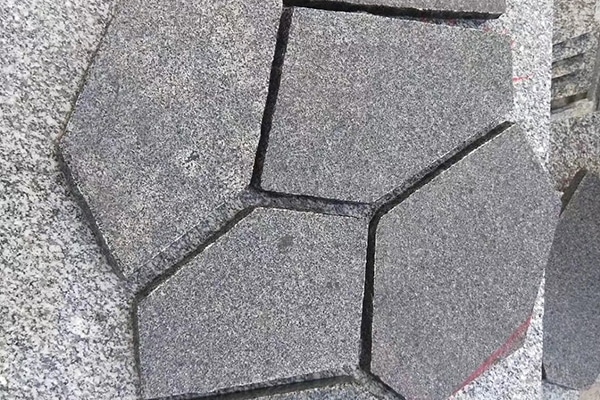
Cobblestones and setts are loaded in bulk bags or on pallets. A 20ft container holds 25-27 tons (approx. 450-550 m² for standard 10×10cm cubes). Pavers of irregular shapes reduce the area per container by 10-15%.
Tombstones / Monuments
Finished monuments vary enormously in size and weight. As a guide, a 20ft container holds 25-350 finished headstones depending on design complexity and size. Monuments are individually crated; complex carvings require specially reinforced crates.
Properly crated granite slabs ready for container loading at Phoenix Power Stone.
Packaging Standards and Requirements
ISPM-15 (International Standards for Phytosanitary Measures)
All wooden packaging material (crates, pallets, dunnage) used in international shipping must be ISPM-15 compliant. This means the wood has been either:
- Heat treated to a core temperature of 56°C for at least 30 minutes, OR
- Fumigated with methyl bromide
The packaging must bear the official ISPM-15 stamp showing the treatment method and facility code. Non-compliant packaging can result in your container being quarantined, re-exported, or destroyed at destination — at your expense.
Slab Packaging Standards
- Crate construction: Solid wood frames (not plywood) with cross-bracing. Minimum 12mm thickness for frame members.
- Interleaving: Plastic sheet or thin foam between each polished slab face. Without this, vibration during transit causes scratching.
- Slab orientation: Vertical in A-frames, never flat (flat-loaded slabs crack under their own weight during vessel movement).
- Bottom protection: Rubber or wood strips at the base to absorb vibration.
- Strapping: Steel straps (not plastic) securing slabs within frames. Minimum 2 straps per slab bundle.
Tile Packaging Standards
- Carton quality: Double-wall corrugated cartons, minimum 32 ECT (Edge Crush Test) rating.
- Internal packing: Tiles stacked face-to-face with protective paper between faces. Plastic corner protectors on all four corners of each stack.
- Pallet specifications: ISPM-15 treated wooden pallets, stretch-wrapped, with corner boards. Maximum pallet height: 1.1m (standard) or 1.5m (if double-stacked, requires custom container loading).
- Spacing: Pallets should have 5-10cm gaps between each other and container walls to allow forklift access and absorb movement.
Cost Optimization Strategies
1. Mix Products for Maximum Utilization
Pure slab containers often leave 5-10% of weight capacity unused. Fill the remaining weight allowance with tiles, cut-to-size pieces, or smaller items that can be packed into gaps. Example: 24 tons of granite slabs + 2 tons of matching tiles in the remaining space = 100% utilization.
2. Choose the Right Port Pair
Freight rates vary far by port pair. For US West Coast destinations, shipping from Qingdao (near Shandong stone factories) is typically cheaper than from Xiamen (Fujian). For US East Coast, the difference is smaller. Always get quotes for multiple origin port options.
3. Plan for Seasonal Rate Fluctuations
Ocean freight rates typically rise 20-40% from August through October (peak season for holiday retail goods) and spike again before Chinese New Year (January/February). If your project timeline is flexible, shipping during March-May or November-December usually offers the best rates.
4. Full Container Load (FCL) vs. Less than Container Load (LCL)
For stone, FCL is almost always more economical than LCL. A single pallet shipped LCL costs disproportionately more per square meter and is far more likely to be damaged through multiple handling. The LCL/FCL breakeven point is typically around 15-18 tons or 300-400 m² of tiles — below this, consider consolidating with another importer or ordering complementary products to fill the container.
5. Insurance — Don't Skip It
Marine cargo insurance costs 0.3-0.5% of the declared cargo value. For a $30,000 container, that is $90-150. A single broken slab of exotic marble can cost $1,000+. Always insure. Ensure your policy covers:
- Theft, pilferage, and non-delivery
- Rough handling and breakage
- Water damage (seawater and freshwater)
- General average (a maritime law principle where all cargo owners share losses if the vessel is in distress)
Request a Container Loading Quote See Our Packaging Standards
Further Reading
Related articles: Marble Tiles: Complete Selection, Installation & MaintenanceGuide · Designing with Black Granite: Tips and Inspiration forYour Home · The Natural and Unique Patterns of BlackGranite
External references: ASTM C615 Granite Standard · ASTM C503 Marble Standard
Frequently Asked Questions
What should I know about why container loading matters?
The "Why Container Loading Matters" section above covers this topic in detail with specifications and practical guidance for B2B stone buyers.
What should I know about container types and specifications?
The "Container Types and Specifications" section above covers this topic in detail with specifications and practical guidance for B2B stone buyers.
What should I know about loading capacity by stone product type?
The "Loading Capacity by Stone Product Type" section above covers this topic in detail with specifications and practical guidance for B2B stone buyers.
What should I know about packaging standards and requirements?
The "Packaging Standards and Requirements" section above covers this topic in detail with specifications and practical guidance for B2B stone buyers.