Quality is Not an Add-On
In the stone business, quality problems cannot be fixed after the fact. A crack in a slab, a color mismatch between batches, a thickness variation across tiles — these are permanent. The only solution is to catch them before they leave the factory. That is how we operate.
Our quality system is built on three pillars: testing to international standards, inspection at every production stage, and packaging that ensures the stone arrives in the same condition it left our factory.
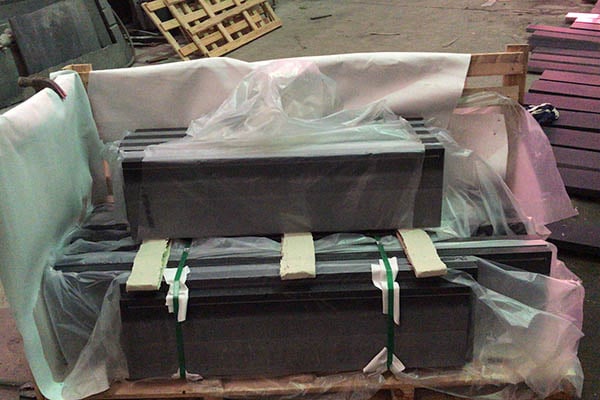
Every batch undergoes dimensional, visual, and physical testing before release.
Testing Standards
We test to both ASTM (American) and EN (European) standards. Different markets require different certifications — we maintain dual compliance so our stone can be specified with confidence anywhere in the world.
| Standard | Test | What It Measures | Why It Matters |
|---|---|---|---|
| ASTM C97 | Absorption & Bulk Density | Water absorption rate and density of stone | Lower absorption = better freeze-thaw resistance and stain resistance |
| ASTM C99 | Modulus of Rupture | Flexural (bending) strength | Critical for cladding panels, stair treads, and long spans subject to wind or weight loads |
| ASTM C170 | Compressive Strength | Maximum load the stone can bear before crushing | Essential for load-bearing columns, foundations, and heavy-traffic paving |
| ASTM C241 | Abrasion Resistance | Surface wear under foot traffic | Determines how long a polished or honed surface retains its finish in high-traffic areas |
| ASTM C880 | Flexural Strength (Panels) | Bending strength of dimension stone panels | Required for exterior cladding and facade engineering calculations |
| EN 1926 | Compressive Strength (EU) | European equivalent of ASTM C170 | Mandatory for CE-marked stone products sold in the European Union |
| EN 1936 | Density & Porosity (EU) | Apparent density and open porosity | Used with EN 1926 for CE marking compliance |
| EN 13755 | Water Absorption (EU) | Water absorption at atmospheric pressure | Required for CE marking; key indicator of outdoor durability |
Quality Control Process
Inspection happens at every stage of production. We do not inspect quality in at the end — we build it in from the beginning.
Raw Block Inspection
Before a block enters our factory, our quarry team evaluates it for color consistency, visible fractures, and mineral inclusions. Blocks that do not meet our standard are rejected at the quarry — they never reach the saw.
In-Process Inspection
During cutting and polishing, operators check every slab for dimensional accuracy, surface finish uniformity, and edge condition. Problems caught at this stage can be corrected. Problems caught later cannot.
Dimensional Check
Every finished piece is measured against the order specification. Our standard tolerance is ±1mm for thickness and ±1.5mm for length/width. Tighter tolerances are available on request.
Surface & Color Match
Polished surfaces are inspected under standardized lighting for scratches, pits, and uneven gloss. Color consistency is checked batch-to-batch against a reference sample. For multi-container orders, we maintain a master reference sample to ensure consistency across the entire production run.
Packaging Inspection
Each crate is inspected before sealing: internal foam padding placement, stone-to-stone separation, crate structural integrity, and ISPM-15 fumigation mark. If it would not survive a 30-day ocean voyage, it does not leave.
Pre-Shipment Inspection
Before the balance payment is released, we welcome third-party inspection by SGS, Bureau Veritas, Intertek, or your own representative. We will uncrate and present any randomly selected pieces for inspection. No exceptions, no excuses.
Packaging That Protects
Natural stone is heavy and brittle. Poor packaging is the single biggest cause of damage in transit — and it is entirely preventable. Our packaging standards include:
- ISPM-15 certified fumigated wooden crates: Required by customs in virtually every country. All our crates carry the official IPPC stamp.
- Internal foam padding: High-density polyethylene foam (10mm minimum) between stone surface and crate walls. Stone-to-stone separation with foam spacers.
- Reinforced crate bottoms: 18mm plywood bases with cross-bracing for forklift handling. Crates are designed to be stacked two-high in containers without transferring load to the stone.
- Weather protection: Crates are wrapped in polyethylene film before sealing, protecting against rain during port handling.
- Clear labeling: Each crate is labeled with contents, weight, handling instructions, and destination. No mystery boxes.
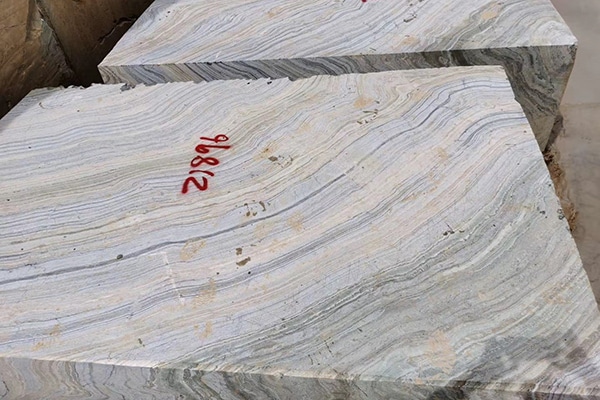
Every crate is inspected and photographed before container loading.
Certifications & Compliance
- ISO 9001:2015 — Quality management system certification, audited annually.
- CE Marking — Available for stone products destined for the European Union market (per EN 1926, EN 1936, EN 13755).
- ASTM Test Reports — We provide mill test certificates with each order, documenting actual test results (not generic data sheets) for your specific production batch.
- ISPM-15 — All wooden packaging materials comply with international phytosanitary standards.
Our Quality Commitment
If a quality issue is identified after delivery and confirmed to be our responsibility, we will replace the affected material or issue a credit — whichever works better for your project. This has been our policy for over 20 years. It has cost us money on occasion, but it has earned us customers who have been ordering from us for a decade or more.
Need Test Reports or Samples?
We provide free material samples and can supply ASTM/EN test reports for any stone in our inventory. Tell us what you need tested.
Request Samples & Test Reports