Detailed Specifications
A quarry block is the raw material, and it is the last point at which the whole stone can be seen. Everything decided downstream — slab size, vein continuity, bookmatch pairs, how much sellable area comes out of the block — is fixed in the block and in how it is squared. That matters more for Portoro-type stone than for most marbles, because the deposit is intensely fractured: the calcite veins that give the stone its value are healed fractures, and the deposit also carries unhealed ones.
The name covers more than one rock. The original Portoro is the black limestone of the La Spezia province in Liguria, Italy, around 92–94% calcium carbonate, historically quarried on the islands of Palmaria and Tino — all now abandoned, the last quarry having closed in 1983, with the ground now a regional natural park and a UNESCO World Heritage Site. Chinese 銀白龙 (Silver White Dragon), also exported as Silver Portoro and China Nero Portoro, is quarried in Guangxi; Vietnamese material is sold under the name as well. The price gap between the Italian and the Asian stone is roughly tenfold, and a block is where that gap is either real or concealed.
Key Takeaways
- Block standard: JC/T 202—2001 requires a right-angled hexahedron, three size classes and grades I / II — density ≥2.60 g/cm³, water absorption ≤0.75%, compressive ≥20.0 MPa, flexural ≥7.0 MPa
- Typical export sizes: about 2.0–4.0 m long, 0.55–1.90 m wide, 0.80–2.80 m high for Chinese 銀白龙; Italian Portoro blocks are much smaller, often around 1 m³. Measure against your own gang saw before buying
- Yield: 1000 ÷ (thickness + kerf) — about 40 m²/m³ at 20 mm, less after squaring and defect removal
- Container: a 20ft heavy-duty container takes about 25–28 t, roughly 9–10 m³ of marble block
Specifications
| Specification | Value |
|---|---|
| Material | Natural Marble |
| Origin | La Spezia province, Liguria, Italy (Portovenere / La Spezia) — or Chinese 银白龙 from Guangxi. The mine is stated on the order. |
| Geological Type | Black limestone, about 92-94% calcium carbonate — sold commercially as marble; not metamorphic |
| Block Sizes | Typical export blocks approx. 2.0-4.0 m long × 0.55-1.90 m wide × 0.80-2.80 m high. Selected to suit the buyer's saw capacity. |
| Block Standard | JC/T 202-2001: right-angled hexahedron, three size classes, grades I / II; density ≥2.60 g/cm³, absorption ≤0.75%, dry compressive ≥20.0 MPa, flexural ≥7.0 MPa |
| Slab Yield | 1000 ÷ (thickness + 5 mm kerf) → about 40 m²/m³ at 20 mm; lower after squaring and defect removal. Recovery assumption stated with each quotation. |
| HS Code | 2515.11 — marble, crude or roughly trimmed (blocks). Sawn rectangular pieces fall under 2515.12. |
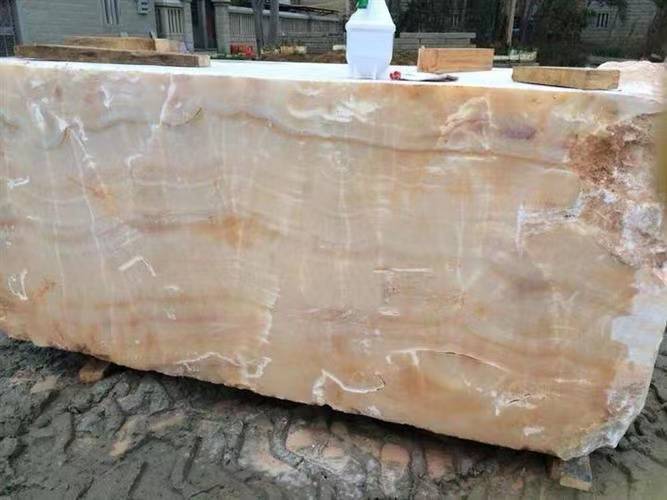
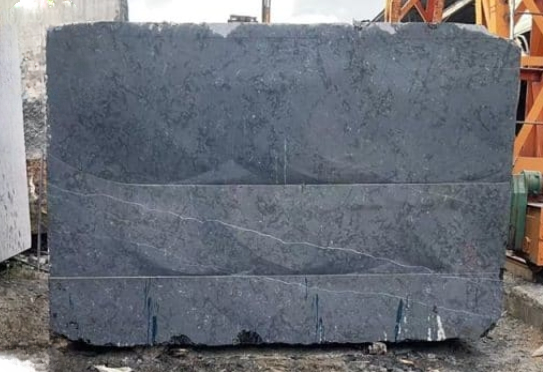
| Color | As shown — each slab features unique natural veining |
| Standard Sizes | Slabs: 2400×1200mm to 3000×2000mm | Tiles: 305×305mm to 600×600mm (custom available) |
| Thickness | 10mm / 12mm / 15mm / 18mm / 20mm / 30mm (custom on request) |
| Thickness Tolerance | ±1mm (standard), ±0.5mm (premium, specify in order) |
| Surface Finish | Polished, Honed, Brushed, Tumbled, Sandblasted |
| Water Absorption | Block standard limit is 0.75% (JC/T 202-2001). Portoro-type material is published at 0.09-0.3% depending on origin. Confirm with a batch test to ASTM C97. |
| Compressive Strength | Block standard floor is 20.0 MPa dry (JC/T 202-2001). Finished material published at 80-120 MPa (Chinese Silver Dragon) and 90-183 MPa (Italian Portoro). |
| Packing | ISPM-15 fumigated wooden crates. Polished slabs interleaved with protective foam. |
| MOQ | 1 × 20ft container of block — approximately 25-28 t, or about 9-10 m³ of marble |
| Delivery Time | 15-25 days after deposit confirmation |
| Payment Terms | T/T (30% deposit, 70% before shipment), L/C at sight |
What a Portoro Block Is — and What the Name Does Not Tell You
A quarry block is the raw material, and it is the only point in the chain where you can still see the whole stone. Everything downstream — slab size, vein continuity, bookmatch pairs, recovery — is decided by what is inside the block when it leaves the face, and by how it is squared. That matters more for Portoro-type material than for most marbles, because the deposit is intensely fractured: the calcite veins that give the stone its value are healed fractures, and the deposit also carries unhealed ones. The trade's own position is that this stone is delicate, expensive and unsuited to heavy use, which is a description of the block as much as of the finished floor.
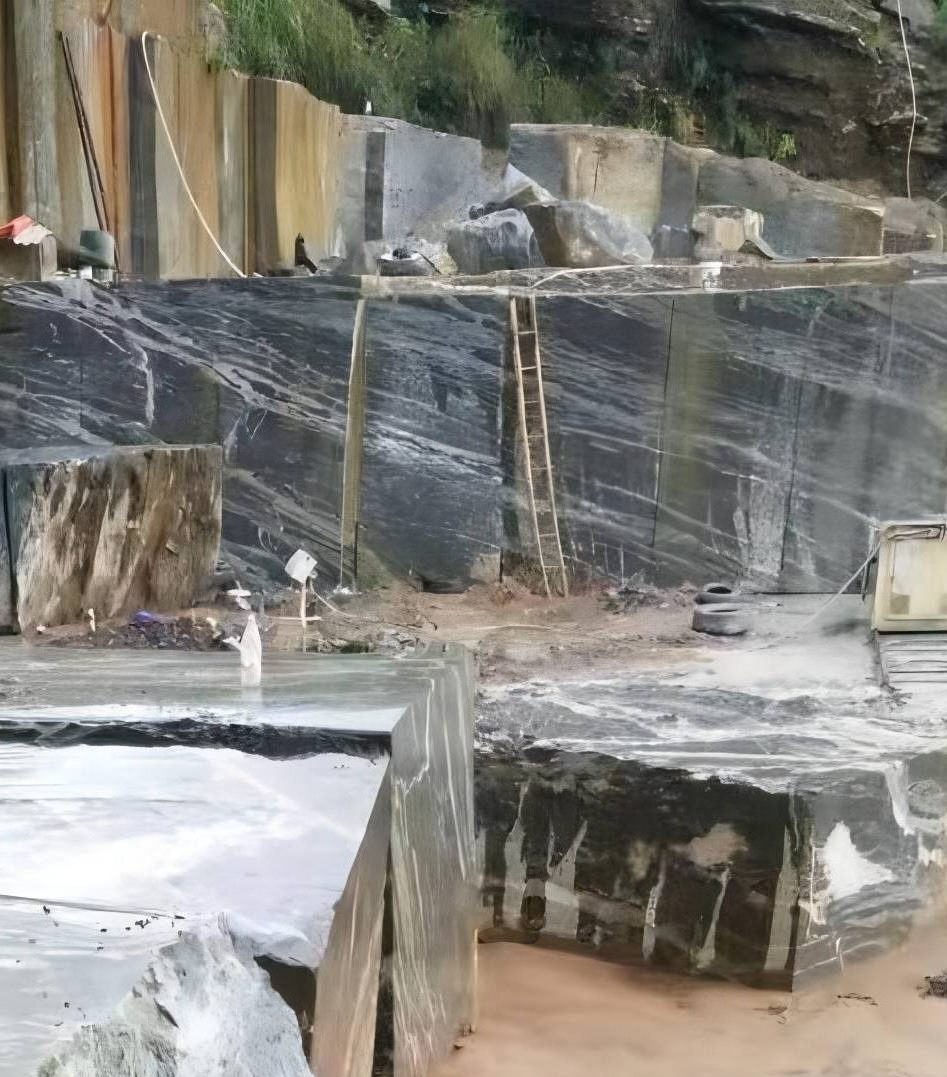
The name is the second thing to settle, because "Portoro" is applied to at least three different rocks. The original is the black limestone of the La Spezia province in Liguria, Italy — around 92–94% calcium carbonate, quarried historically on the islands of Palmaria and Tino, where every quarry is now abandoned and the last closed in 1983; the ground is a regional natural park and a UNESCO World Heritage Site. Italian extraction today comes from a very small number of mainland quarries, increasingly worked underground in pillar-supported chambers. A peer-reviewed survey of the deposit counted five quarries still active near La Spezia in 2015 and current trade sources put it at two or three; the most recent concession award, Monte Santa Croce above the city, was made in November 2023 with an annual fee payable even when the quarry is idle and had still not moved past the exploration-permit stage by mid-2025. Chinese 銀白龙 — Silver White Dragon, also sold as Silver Portoro and China Nero Portoro — is quarried in Guangxi, with English listings pointing to Hezhou, Guilin and Wuzhou and Chinese supplier pages pointing to Xincheng county in Laibin, chiefly the Silian and Datang districts, and to Guanyang near Guilin; Xincheng is the best-documented locality but the sub-locality is contested, so name the mine, not the province. Vietnamese material is also sold under the name, and other black marbles enter the same conversation: Iranian stone marketed as Persian Nero Marquina or Najafabad Black ships from Bandar Abbas in blocks of around 24 t and 280×180×160 cm, and Turkish black-and-gold material sold as Portoro Antalya is a different rock again. All of these are legitimate purchases when the label matches the stone. The price gap between the Italian and the Asian stones is roughly tenfold, and a block is where that gap is either real or concealed.
If you want the Italian material in block form, three practical facts matter. First, the blocks are small: the trade describes Italian Portoro as small to medium, and the deposit's heavy fracturing is reported to limit many pieces to around a cubic metre — consistent with the Italian slab trade settling on 20 mm thickness and smaller-than-normal formats — so check the format you will actually be able to saw, not the one in the catalogue. Second, the producers are few and specific: Venere Marmo Portoro at La Spezia, established in 1966, works the south-east flank of Monte Muzzerone, now underground, and offers Grade A blocks at 300×200×150 cm on a 20-tonne minimum, while Carrara-based Furrer sells Silver Portoro specifically, in medium-to-small blocks. Third, none of them publishes a block price — the listings carry a minimum quantity and price on application — which tells you how thin and how negotiated this market is. An offer of large, steady volumes of Italian Portoro blocks at a published price is a reason to check the paperwork twice.
Reading a Block: Size Classes, the Chinese Block Standard and the Fracture Question
China has a national industry standard for marble blocks, JC/T 202—2001 «Natural Marble Quarry Blocks», and it is worth quoting in a supply contract because it turns adjectives into measurements. It requires the block to be a right-angled hexahedron — square, not a potato — sorts blocks into three size classes, and grades them first class (I) and second class (II) on dimensional deviation and appearance. It also sets material floors: volume density not less than 2.60 g/cm³, water absorption not more than 0.75%, dry compressive strength not less than 20.0 MPa and flexural strength not less than 7.0 MPa. Blocks are marked with a code, dimensions and grade — the standard's own example is M1101 250×125×100 I, in centimetres.
Real export dimensions are wider than any single standard. Chinese customs declarations for marble blocks show single pieces such as 300×160×140 cm and declared ranges running from about 2.0 to 4.0 m in length, 0.55 to 1.90 m in width and 0.80 to 2.80 m in height, with shipments declared by volume — 13.1 m³, 26.4 m³ and 39.6 m³ appear in the public data. Blocks in this trade are classified by the customs code 2515.11 for crude or roughly trimmed stone; once a block has been sawn into rectangular slabs or pieces it falls under 2515.12, which is a different declaration and a different duty treatment in some markets.
The inspection that matters most is the one for fractures, and it is done with eyes, water and a hammer. Look at all six faces in daylight, wet the block down and watch where the water is taken up quickly — that is where the fissures are. A ring from a hammer on a sound block is clear; a dull thud marks a cracked zone. Check that the block is square, because a block out of square loses more than its dimensional error in trimming. Look specifically for repaired corners and filled cracks, because resin and cement repair on the block face is where a cheap price comes from. And measure the piece against your own saw before you buy it: gang saws have a maximum block length and height, and an oversized block has to be trimmed or wire-sawn before it will go on the line.
Yield: The Number That Decides Whether the Block Was Cheap
Blocks are sold by volume or by weight, and slabs are sold by area, so the conversion between the two is where the money is. The industry formula for theoretical recovery is simple: square metres per cubic metre equals 1000 divided by (slab thickness + saw kerf). Marble is normally worked with a kerf around 5 mm, which gives 40 m²/m³ for 20 mm slabs, about 45.5 m²/m³ at 18 mm and about 29.4 m²/m³ at 30 mm. Thinner slabs yield more area from the same block — that is the whole arithmetic behind the trend to 18 mm and 20 mm material.
Nobody recovers the theoretical figure. Squaring the block, trimming the edges of every slab and cutting out the fractured zones takes a bite, and on a highly fractured deposit like Portoro-type stone the bite is larger than on a sound one. Take an illustrative block of 6.0 m³ quoted at US$800/m³, so US$4,800 for the block. Theoretical recovery at 20 mm is 240 m². At 70% realised recovery that is 168 m², which puts the stone at about US$29/m² of slab before sawing, resin and mesh backing, polishing, packing and freight are added — those usually add a similar order again. At 50% recovery the same block yields 120 m² and the block cost alone is US$40/m². The block price did not change; the block got 38% more expensive per square metre of sellable slab. That is why a quotation per cubic metre is meaningless without the expected recovery, and why you should ask any supplier quoting blocks for the recovery figure they are assuming and how they arrived at it.
Two further yield notes specific to this stone. Vein continuity is what bookmatching is sold on, so a block whose veins run as continuous healed planes is worth more than a block of the same size whose veins are broken into patches — the slab area is the same, the usable bookmatch pairs are not. And thin slabs of a veined black marble normally need resin and fibreglass mesh backing to survive handling, so factor backing into the landed cost of 10–12 mm material rather than comparing it to 20 mm on the block price alone.
Shipping and Inspecting Blocks Before They Leave the Yard
Blocks ship loose, not crated. A 20ft heavy-duty container takes roughly 25–28 tonnes, and marble runs about 2.6–2.7 t/m³, so a container carries on the order of 9–10 m³ of solid block — two to three typical pieces, sometimes a single large one. That is the practical ceiling on a container order, and it is why large blocks are usually shipped break bulk while containerised blocks are chosen to fit the weight limit. Blocks are secured with timber chocks and steel lashing and must be distributed so the container is not unbalanced; ask for the loading photographs, because a badly chocked block moves and a moved block arrives cracked.
Inspect before loading, not after arrival. Require each block to be numbered on the face in paint, photographed from all six sides with a tape measure in frame, and weighed or measured so that the declared volume can be checked. Ask for both dry and wetted photographs of the two faces that will be sawn first, since the wet photograph is what reveals fissures. Confirm the grade and size class against the standard, confirm whether the block has been repaired and with what, and confirm the squareness. Finally, match the block to the project: if the slabs are destined for a bookmatched wall, the two or more blocks for that wall should come from the same bench and be cut in one campaign, because blocks from different parts of the deposit will not mirror each other in tone or vein character.
On price, the honest position is that block pricing is quotation-based and depends on grade, weight, size, vein quality, total tonnage, Incoterms and destination. Published reference prices for marble blocks in the trade range from around US$150/m³ for common white material to US$200–450 per tonne for better grades — roughly US$540–1,230/m³ at typical marble densities — and black veined material sits toward the upper end of that because recovery is lower. Treat every published block number as a reference rather than a quotation, and compare offers on the cost per square metre of sellable slab, not per cubic metre of rock. For Italian Portoro specifically there is no published block price to reference at all — the active producers quote on application against a minimum tonnage — so any per-cubic-metre figure you are given for that stone is negotiated, indicative or invented. The Marble Price Guide walks through that comparison, and the Container Loading Guide covers how loading affects what arrives intact. If you are weighing blocks against finished material, the same stone is specified in slab form on our Silver Portoro marble slab page, and the sibling block trade is described on the Carrara Grey quarry blocks page.
Further Reading
Related guides: Marble Tiles Buying Guide · Chinese Granite Vs Italian Marble
Standards & references: ASTM C503 Marble Standard · EN 1469 Natural Stone Cladding
Frequently Asked Questions
What is a Silver Portoro quarry block, and what actually determines its price?
It is the raw block as it comes off the bench, before sawing — the last point at which you can see the whole stone. The name covers the white-veined horizon of the Italian Portoro bed in the La Spezia province of Liguria, and also Chinese 银白龙 (Silver White Dragon) from Guangxi, which is exported under the same name at roughly a tenth of the price. Block pricing is quotation-based and depends on grade, weight, size, vein quality, total tonnage, Incoterms and destination. Because the deposit is intensely fractured and recovery is low, this stone sits toward the upper end of block prices for marble.
How do I tell whether a block is genuine Italian Portoro or Chinese material?
By documentation and the mine name, not by the block face. Genuine Italian Portoro comes from a very small number of active quarries in the municipalities of Portovenere and La Spezia, worked increasingly underground in pillar-supported chambers since the historic island quarries on Palmaria and Tino were abandoned — the last closed in 1983 and the area is now a regional park and UNESCO World Heritage Site. Chinese 银白龙 comes from Guangxi, with English listings citing Hezhou, Guilin and Wuzhou and Chinese supplier pages citing Xincheng county in Laibin and Guanyang near Guilin; Xincheng is the best-documented locality but the sub-locality is contested, so require the mine and the province in writing, ask for photographs of the block at the face, and treat any offer of "Italian Portoro" at an Asian block price as mislabelled.
What sizes do marble blocks come in, and what standard applies?
China's industry standard for marble blocks, JC/T 202—2001, requires a right-angled hexahedron, sorts blocks into three size classes and grades them first class (I) and second class (II) on dimensional deviation and appearance. It also sets floors: density not less than 2.60 g/cm³, water absorption not more than 0.75%, dry compressive strength not less than 20.0 MPa, flexural strength not less than 7.0 MPa. Blocks are marked with a code, dimensions and grade, for example M1101 250×125×100 I in centimetres. In practice, Chinese export declarations show single blocks such as 300×160×140 cm and ranges running from about 2.0 to 4.0 m long, 0.55 to 1.90 m wide and 0.80 to 2.80 m high. Measure the block against your own gang saw's maximum length and height before you commit, because an oversized block must be trimmed or wire-sawn.
How many blocks fit in a 20ft container?
A 20ft heavy-duty container takes roughly 25–28 tonnes, and marble runs about 2.6–2.7 tonnes per cubic metre, so a container carries on the order of 9–10 m³ of solid block — two to three typical pieces, and sometimes a single large one. Blocks ship loose with timber chocks and steel lashing rather than in crates, and weight distribution matters as much as weight: ask for loading photographs, because a badly chocked block moves in transit and a moved block arrives cracked. Very large blocks are normally shipped break bulk instead.
How much slab area will a block yield?
The trade formula is square metres per cubic metre equals 1000 divided by (slab thickness + saw kerf). With marble's usual kerf of about 5 mm, that is 40 m²/m³ for 20 mm slabs, about 45.5 m²/m³ at 18 mm and about 29.4 m²/m³ at 30 mm. Real recovery is lower: squaring the block, trimming slab edges and cutting out fractured zones all take a share, and on a highly fractured deposit that share is larger than usual. Worked illustratively, a 6.0 m³ block at US$800/m³ costs US$4,800; at 70% realised recovery it yields 168 m² of 20 mm slab, putting the block at about US$29/m² before sawing, backing, polishing and freight. At 50% recovery the same block is US$40/m². Always ask a supplier quoting blocks what recovery they are assuming.
How should I inspect a block before buying?
In daylight, on all six faces, with the stone wet down. Water is taken up quickly where fissures run, so wetted photographs of the first faces to be sawn are the most useful thing a supplier can send you. A hammer gives a clear ring on sound stone and a dull thud over a cracked zone. Check squareness, because an out-of-square block loses more than its dimensional error in trimming, and look specifically for repaired corners and filled cracks — resin and cement repair on the block face is where a cheap price comes from. Require each block to be numbered on the face in paint, photographed from all six sides with a tape measure in frame, and measured or weighed so the declared volume can be checked.
What should the purchase order and shipping documents cover?
The mine and province; the block numbers with measured dimensions and volume, and grade and size class against the standard; whether the block has been repaired and with what; the volume basis for pricing (per m³ or per tonne) and the Incoterms; and the declaration details, since crude or roughly trimmed marble blocks fall under HS 2515.11 while sawn rectangular pieces fall under 2515.12. For a bookmatched project, specify that the blocks for that wall come from one bench and are cut in a single campaign — blocks from different parts of the deposit will not match in tone or vein character. Approve the blocks from the pre-loading photographs and inspect before the container is sealed.
What is the minimum order, lead time and sample policy?
Quarry blocks are normally sold by the container or by the cubic metre, with one 20ft container of roughly 9–10 m³ as the practical minimum for a shipment that makes sense on freight; smaller trial lots can be arranged on request. Lead time is normally 15–25 days after deposit, longer if blocks have to be selected from a specific bench. Because a block cannot be sampled the way a tile can, we supply sawn slabs from the same bench as the reference sample, plus photographs and measured dimensions of the blocks offered, and we credit sample costs against the production order.
Related Resources
- Quality Control Standards — ASTM / EN testing and 6-stage inspection process
- Container Loading Guide — Maximize your shipment efficiency
- Request a Quote — Get pricing and availability for this product
Related Products
Inquire About This Product
Contact us for pricing, samples, or custom specifications.
Get a Quote