The Art of Stone Staircases
A stone staircase is more than a means of moving between floors — it is a defining architectural element. From the sweeping marble staircases of grand hotels to the rugged granite steps of a terraced garden, stone stairs combine sculptural presence with structural permanence. Done well, they are the most memorable feature in a building. Done badly, they are a trip hazard and an expensive regret.
★ Key Takeaways
- Indoor stone stairs are typically constructed with stone treads (the horizontal walking surface) and risers (the vertical face) installed over a concrete or steel structural core. The stone is decorative cladding — the structural support comes from t
- Outdoor stone stairs face rain, freeze-thaw, UV, and debris accumulation. Material selection narrows far. Granite, bluestone, and dense sandstone are the proven performers. Outdoor stairs can be constructed as solid stone block steps for lo
- Key specifications:Minimum 3cm tread thickness. Honed or leathered finish for slip resistance — never polished on stair treads. Anti-slip inserts mandatory. Marble stairs are not suitable for exterior use — acid rain and freeze-thaw will rapidly dete
- For durability without compromise, granite stairs are the definitive choice. Their exceptional hardness means granite treads show virtually no wear even after decades of heavy use. For outdoor applications, a flamed finish provides grip in all weathe
Indoor Stone Stairs
Indoor stone stairs are typically constructed with stone treads (the horizontal walking surface) and risers (the vertical face) installed over a concrete or steel structural core. The stone is decorative cladding — the structural support comes from the underlying construction. Marble and granite are the two dominant indoor stone stair materials. Treads should be minimum 3cm (1-1/4 inch) thick. Each tread should include an anti-slip insert or treatment near the nosing — this is mandatory for commercial staircases and strongly recommended for residential ones.
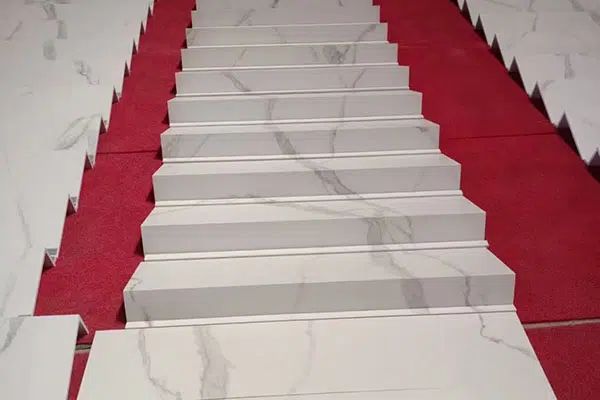
Calacatta White marble stair treads with honed finish — indoor stone staircase supplied by Phoenix Power Stone.
Outdoor Stone Stairs
Outdoor stone stairs face rain, freeze-thaw, UV, and debris accumulation. Material selection narrows far. Granite, bluestone, and dense sandstone are the proven performers. Outdoor stairs can be constructed as solid stone block steps for low-height applications or stone-tread-over-concrete for larger runs. A flamed or thermal finish is essential for outdoor stairs — it provides grip in wet conditions. The surface must slope slightly (1-2%) to shed water. Never install polished stone outdoors on stairs. Ever.
Marble Stairs
Marble stairs are the pinnacle of residential and hospitality luxury. The luminous depth of polished marble, especially when book-matched across adjacent treads, creates a staircase experienced as much as it is used. Carrara white marble is the classic choice for traditional elegance. Darker marbles like Nero Marquina create dramatic contrast in contemporary interiors.
Key specifications: Minimum 3cm tread thickness. Honed or leathered finish for slip resistance — never polished on stair treads. Anti-slip inserts mandatory. Marble stairs are not suitable for exterior use — acid rain and freeze-thaw will rapidly deteriorate the surface. Budget for professional repolishing every 5-7 years in high-traffic locations.
Granite Stairs
For durability without compromise, granite stairs are the definitive choice. Their exceptional hardness means granite treads show virtually no wear even after decades of heavy use. For outdoor applications, a flamed finish provides grip in all weather. Popular granite colours for stairs: Absolute Black (dramatic contrast with white risers), G654 Sesame Grey (subtle, practical, the most common commercial choice), and G684 Pearl Black (dark, formal, hides wear).
Standard Stair Dimensions
- Tread depth: Minimum 280mm (11 inches) for residential; 280-355mm (11-14 inches) preferred for comfort.
- Riser height: Maximum 197mm (7-3/4 inches) for residential; 100-178mm (4-7 inches) ideal. Consistent riser height is critical — variation over 10mm (3/8 inch) is a trip hazard.
- Tread thickness: 3cm (1-1/4 inch) minimum for stone treads; 5cm (2 inches) preferred for unsupported spans.
- Nosing overhang: 25-32mm (1-1-1/4 inches) over the riser below.
- Handrail height: 864-965mm (34-38 inches) above stair nosing.
- Anti-slip inserts: Carborundum or metal strips embedded near the tread front edge. Mandatory for commercial. Recommended for all residential.
For contractors, importers, and developers, factory-direct stone stairs from China cut material costs 30-50% versus domestic wholesale. Chinese factories in Shandong (Laizhou) and Fujian (Shuitou) fabricate complete precut sets: treads, risers, landings, and stringer covers cut to your exact stair plan, with anti-slip inserts and nosing grooves pre-machined. Standard B2B ordering process: send your stair plan (PDF or CAD) → factory provides a cutting layout for approval → production in 15-25 days → FOB Qingdao or Xiamen → container shipment (a 20ft container holds roughly 60-90 treads depending on size). Always request batch-specific ASTM C97/C170 test reports and a dry-lay photo review before shipment. Sample treads (30×30cm) are available for color approval. See our Stone Import Guide for the full procurement process, and import duty rates by market to calculate landed cost.
Sourcing Stone Stairs from China (B2B)
The handrail and lighting complete the staircase. Popular balustrade materials with stone stairs: stainless steel (most common, pairs with every stone), glass panels (modern, keeps the stone as the visual star), wood (traditional, warms marble stairs), and stone balusters (classic, in matching or contrasting stone). Integrated LED lighting in the tread nosing is now standard in hotels and growing in residential — a 5-8mm groove is cut in the nosing edge at the factory, with a continuous LED strip installed on site. Under-tread accent lighting highlights floating designs. When specifying lighting, confirm the groove depth with the LED supplier before fabrication; common groove sizes are 10×10mm for flexible strip LEDs.
Railing, Balustrade, and Lighting Options
Stone stairs are a 50-year-plus investment, but only with a basic maintenance routine. Granite stairs need almost nothing: annual sealing, weekly sweeping or damp-mopping, and immediate cleanup of oil spills. Marble stairs need more care — reseal every 6-12 months, use pH-neutral cleaner only (never vinegar or citrus-based products, which etch), and expect professional repolishing every 5-7 years in high-traffic installations. Exterior granite stairs: check the flamed surface yearly for moss growth in shaded areas (treat with stone-safe biocide), keep joints free of weeds, and reseal every 12-18 months. Repair strategy: keep spare treads from the original order — matching a single tread later is difficult because quarry blocks vary. Order 5-8% extra at the initial purchase.
Stone Stair Maintenance and Longevity
Key code references: US IBC 1011 (stairs), IRC R311.7; UK Building Regulations Part K; EU EN 14076. Handrails: 864-965mm above the nosing line, continuous on open sides, with graspable profiles. Guard height on open stair sides: minimum 900mm (US residential) to 1100mm (EU). When a stone tread overhangs an open side, the guard must be designed so the rail post mounts through or beside the stone — plan the anchor points with the fabricator before cutting.
- Riser + Tread ratio: Most codes require 2R + G to fall between 550mm and 700mm (US) or 600-630mm (UK/EU), where R = riser height and G = going (tread depth). Example: 175mm riser + 280mm tread = 630mm — compliant.
- Consistent risers: Maximum variation between risers is 5mm (US IBC) or 10mm (UK). Inconsistent risers are the leading cause of stair falls.
Stone stair design must satisfy building codes before aesthetics. The two formulas that matter most:
Building Codes and Stair Geometry
Installation cost is typically $50-$100 per tread for experienced masons. Poor substrate prep and inconsistent riser heights are the two most common installation failures — both are visible immediately and dangerous long-term.
- Survey and template: Measure the exact flight geometry, including any out-of-square walls. Templates are made for every tread and riser; deviations over 3mm are noted for fabrication.
- Prepare the substrate: Concrete cores are cleaned and primed. Steel stringers get a levelling screed. Wood stringers are lined with cement backer board — never install stone directly on wood.
- Set the risers first: Risers are installed from the bottom up, plumbed and leveled, with a flexible polymer-modified adhesive. A 2-3mm gap is left at the bottom for the tread to overlap.
- Set the treads: Treads are buttered with polymer-modified thin-set and set with the correct 25-32mm nosing overhang. Each tread is leveled across both directions — a 2mm fall toward the nosing sheds water on exterior stairs.
- Install nosings and inserts: Anti-slip inserts are set into the pre-cut groove with epoxy. The insert surface must sit flush or slightly below the tread surface — proud inserts are a trip hazard.
- Grout and seal: Joints are grouted with color-matched grout (2-4mm joints for interiors, 5-8mm for exterior thermal movement). The entire staircase is sealed with impregnating sealer 24 hours after grouting.
- Protect and finish: Freshly installed treads are covered until the project handover. For polished stone, a final machine polish restores the factory gloss after any site damage.
Stone stairs are installed over a structural core (concrete, steel, or wood stringers). The stone is cladding, not structure — get the core right and the stone installation is straightforward. Here is the standard sequence used by professional stone masons:
Stone Stair Installation: Step-by-Step
Slip resistance is measured by the pendulum test (PTV) or the coefficient of friction (COF). A PTV of 36+ (wet) is the UK standard for stair treads; US projects commonly require COF ≥ 0.6 wet for commercial stairs. Ask your stone supplier for the PTV/COF report for the specific finish you plan to use — flamed granite typically tests PTV 55-70, while polished marble tests PTV 15-25 and is not approved for stairs.
- Finish-based grip: Flamed, bush-hammered, and sandblasted finishes create micro-roughness that grips shoe soles. Flamed is the strongest for outdoor granite; bush-hammered suits both granite and marble interiors. Never use polished finish on treads.
- Embedded anti-slip inserts: Carborundum (silicon carbide) or brass/aluminum strips set into a groove near the tread nosing. Inserts give a visible visual cue at each step edge plus physical grip — mandatory in commercial buildings and strongly recommended in residences.
- Grooved or brushed nosings: Parallel grooves cut across the nosing radius (5-8mm wide, 3-5mm deep) increase grip exactly where feet leave the tread. Factory-cut grooves are cleaner than site-cut ones.
Slip resistance is the most important safety specification for any stone staircase. Surface treatments fall into three categories, and commercial projects should combine at least two of them:
Anti-Slip Treatments for Stone Stairs
Marble treads are an interior-only material. Carrara White is the classic choice: bright, traditional, and forgiving of minor etching thanks to its busy grey veining. Nero Marquina offers high-contrast drama with its black base and white veins. Calacatta (especially Calacatta Gold) is the premium statement — book-matched pairs across treads create a continuous mirror pattern that is the signature of five-star hospitality. All marble treads need honed or leathered finish for slip resistance — polished marble on stairs is a maintenance and safety liability.
Marble Stair Treads in Detail
Granite is the default choice for 70%+ of commercial stone staircases. G654 Sesame Grey is the most specified color — its mid-grey tone hides scuffs, matches most interiors, and stays slip-resistant when flamed. Absolute Black creates drama against light risers and walls. G684 Pearl Black is denser and shows less wear in the heaviest traffic. For exterior stairs, always specify flamed or bush-hammered finish — polished granite outdoors is dangerously slippery when wet, regardless of how attractive it looks.
Granite Stair Treads in Detail
| Stone | Mohs | Outdoor Use | Wear Resistance | Typical Price (per tread) |
|---|---|---|---|---|
| Granite (G654, Absolute Black) | 6-7 | Yes — best outdoor choice | Excellent | $50-$150 |
| Marble (Carrara, Nero Marquina) | 3-4 | No — etches and frost-damages | Good (indoor) | $80-$250+ |
| Quartzite | 7 | Yes — with sealing | Excellent | $90-$220 |
| Bluestone (dense sandstone) | 6-7 | Yes | Very good | $40-$110 |
| Limestone | 3-4 | Limited | Moderate | $45-$120 |
| Slate | 3-4 | Yes (split face) | Good — splits on impact | $35-$90 |
Beyond the marble-versus-granite decision, the full stone palette for stairs includes several options with distinct trade-offs. This table summarizes the practical differences for stair treads:
Choosing the Right Stone for Your Stairs
For gardens and sloped sites, outdoor stone stairs often take the form of step-and-terrace runs: solid granite blocks 150-200mm thick, laid directly on compacted base, sometimes with risers integrated into retaining walls. This is the most economical outdoor stone stair — no structural concrete needed for low heights.
Outdoor Step-and-Terraces
Split staircases divide into two flights at a landing, branching left and right. Common in entry foyers, they make a strong first impression and allow each branch to serve a different zone. Stone is typically granite or marble with matching landing slabs.
Split Staircases
Curved staircases sweep continuously without landings — the most expensive and dramatic stone design, used in grand hotel lobbies and luxury homes. Treads must be individually cut to the curve radius; book-matching across curved treads is a signature technique. U-shaped stairs (two parallel flights joined by a landing) are more affordable than full curves while keeping a grand presence.
Curved and U-Shaped Stairs
Straight flights are the most economical stone staircase: identical rectangular treads, minimal fabrication, fast installation. L-shaped stairs (one landing turning 90 degrees) add a mid-flight landing — the landing is usually one oversized tread slab. For budget-conscious projects, straight and L-shaped designs with standard granite treads offer the best stone value.
Straight and L-Shaped Stairs
Distinct from floating stairs, cantilevered stairs have one visible stringer (the side beam) with treads cantilevered from it. This design shows the stone's edge thickness — which is why 5cm treads are preferred here, giving a substantial visual edge. Absolute Black granite with white risers is a classic cantilevered combination in commercial lobbies.
Cantilevered (Open-Stringer) Stairs
Spiral stone staircases wrap around a central column, typically with 12-16 treads per full revolution. Treads are trapezoidal — wider at the outer edge, narrower at the center column — which makes them expensive to fabricate because every piece is a unique shape. Stone spiral stairs are most common in towers, attics, and outdoor garden settings. Granite is the practical choice outdoors; marble spirals are reserved for luxury interiors and hotel lobbies.
Spiral Stairs
Floating stairs — where treads appear to hang from the wall with no visible risers or stringers — remain the most requested premium design in 2026. Each stone tread is typically 1200-1600mm long, 300-350mm deep, and 30-50mm thick, anchored into a concealed steel stringer or wall pocket. The open look between treads makes floating stairs ideal for modern interiors, but they require structural engineering approval and the thickest, most carefully selected stone. Marble (Carrara, Calacatta) and quartzite are the standard materials; granite works for a more industrial feel.
Floating (Cantilevered) Stairs
The style of your staircase is the single biggest design decision. Each configuration has different stone requirements, cost implications, and space needs. These are the nine most common stone staircase designs in residential and hospitality projects:
Stone Staircase Design Styles
The best prevention is specification: dense stone, correct thickness for the span, flexible adhesives, proper expansion joints, and annual maintenance inspections. A well-specified and maintained stone staircase outlasts the building itself — many of our customers' granite staircases are still in service 20+ years after installation.
- Loose or hollow-sounding treads: Usually a failed adhesive bond or substrate movement. Catch it early — a hollow sound when tapped is the warning sign. Solution: professional re-bedding of the affected tread.
- Spalling on exterior treads: Surface flaking from freeze-thaw cycles, usually because water penetrated through unsealed joints or the wrong stone was used. Solution: replace with dense granite (absorption below 0.3%), ensure proper drainage slope, and maintain sealant.
- Etching on marble treads: White dull spots from acidic spills (wine, juice, vinegar). Unlike stains, etching cannot be wiped away — it requires professional honing and repolishing of the affected area.
- Nosing chips: Impact damage on tread edges, common where heavy objects are carried up. Solution: professional stone repair with color-matched resin; prevent with corner guards during renovations.
- Worn finish in traffic lines: The center of each tread wears faster than the edges. Solution: periodic machine honing and resealing returns the surface; budget this every 3-5 years for commercial stairs.
- Riser cracking: Usually from substrate movement or thermal stress. Solution: flexible polymer adhesive at installation prevents most cases; cracked risers should be replaced rather than patched.
Even well-built stone stairs develop issues over decades. Knowing the common failure modes helps owners plan maintenance and avoid expensive repairs:
Common Stone Stair Problems and Solutions
Outdoor stone stairs face the toughest conditions: freeze-thaw cycling, rain, UV, and vegetation growth. Granite is the dominant choice — G654 and G684 with flamed or bush-hammered finish. Bluestone and dense sandstone are excellent alternatives with a softer appearance. All outdoor treads should slope 1-2% forward, have 5-8mm open or wide joints for drainage, and sit on a compacted gravel base or concrete footing depending on frost depth. In cold climates, frost-resistant installation is critical: a 150-200mm concrete footing below frost line prevents heaving. Outdoor stairs should never be polished — wet polished stone is a serious slip hazard.
Outdoor and Garden Stairs
Office and retail staircases see continuous foot traffic. Granite with flamed or bush-hammered finish is the workhorse — it wears slowly and cleans easily. Fire-escape and service stairs use non-slip granite treads with open risers or concrete infill. For corporate lobbies, many projects combine granite treads with stainless steel glass balustrades for a modern, durable statement. Public-building stairs must meet accessibility standards: tactile warning strips at the top of each flight are required in many jurisdictions for visually impaired users.
Commercial and Office Stairs
Home staircases allow more design freedom. Popular residential stone stair ideas: floating marble treads with glass balustrades in modern homes; traditional granite with wooden handrails in classic interiors; and stone treads with carpet runner strips in family homes — a practical hybrid that keeps the stone aesthetic while adding warmth and reducing noise. For second homes and rental properties, honed granite is the low-maintenance choice. Family safety: rounded (half-bullnose) nosings, anti-slip inserts, and consistent risers matter most when children and elderly use the stairs daily.
Residential Stairs
Hotel staircases are among the most heavily used and photographed architectural elements in the building. Standard hospitality specification: marble or granite treads with honed finish, anti-slip inserts at every nosing, and LED nosing lighting for late-night guest safety. Lobby staircases get book-matched marble (Calacatta, Carrara, Nero Marquina) with polished finish on risers and honed on treads. Corridor stairs use granite (G654 or Absolute Black) for 24/7 durability. Hotel stairs must be designed for continuous traffic: specify 20mm risers, 30-50mm treads, and plan for quarterly professional maintenance. The hospitality standard requires the stair to be slip-resistant when wet — guests arrive in all weather.
Hotel and Hospitality Stairs
Different building types call for different stone stair solutions. These are the practical specifications used across major project categories:
Stone Staircase Ideas by Application
Further Reading
Related articles: Marble Tiles: Complete Selection, Installation & MaintenanceGuide · Designing with Black Granite: Tips and Inspiration forYour Home · The Natural and Unique Patterns of BlackGranite
External references: ASTM C615 Granite Standard · ASTM C503 Marble Standard
Stone Staircase Design Trends 2026
Floating stone staircases — where treads appear to hover with no visible risers — remain the most requested style in luxury residential and hospitality projects for 2026. Book-matched marble treads are the signature detail: adjacent slabs cut to mirror their veining create a continuous pattern across the flight. Warm neutrals (Carrara, Crema Marfil, and beige travertine) lead residential demand, while bold statement stones — Nero Marquina, Calacatta Gold, and onyx — dominate hotel and commercial installations. LED lighting integrated into stair nosing is now standard in both categories.
For outdoor stairs, the 2026 shift is toward larger-format treads (600-900mm deep) with flamed or bush-hammered finishes and pre-drilled holes for railing posts. Contractors increasingly order precut sets — treads, risers, and landing pieces cut to their exact stair plan at the factory — which reduces on-site cutting waste by up to 30%.
Frequently Asked Questions
What is the best stone for indoor stairs?
Marble and granite are the two dominant indoor stone stair materials. Marble — particularly Carrara White and Nero Marquina — offers outstanding luxury aesthetics for residential and hospitality projects. Granite — especially Absolute Black and G654 Sesame Grey — provides superior durability with virtually no visible wear even after decades of heavy foot traffic. Indoor treads should be minimum 3cm thick with anti-slip treatment near the nosing.
Can stone stairs be used outdoors?
Yes, but only specific stones are suitable. Granite, bluestone, and dense sandstone are the proven outdoor performers — they resist freeze-thaw cycles, rain, and UV exposure without deteriorating. A flamed or thermal finish is essential for wet-condition slip resistance. Marble must never be used outdoors on stairs — acid rain, temperature swings, and moisture will rapidly degrade the surface. Outdoor treads should include a 1-2% slope to shed standing water.
What are standard stone stair dimensions?
Residential tread depth is minimum 280mm (11 inches), with 280-355mm preferred for comfort. Riser height is maximum 197mm (7-3/4 inches), with 100-178mm ideal. Stone tread thickness should be minimum 3cm (1-1/4 inches), or 5cm for unsupported spans. Nosing overhang is 25-32mm (1-1-1/4 inches). Consistent riser height across the entire staircase is critical — variation over 10mm (3/8 inch) is a trip hazard and code violation in most jurisdictions.
How much do stone stairs cost to install?
Stone stair costs vary far by material and complexity. Granite treads range from $50-$150 per tread for standard sizes; marble treads from $80-$250+. Professional stone mason installation adds $50-$100 per tread. A full staircase of 15 treads typically budgets $3,000-$8,000 installed for granite, and $5,000-$12,000+ for marble. Additional costs include anti-slip insert installation, custom edge profiles, and structural reinforcement for cantilevered designs. For bulk B2B orders, factory-direct FOB pricing from China can reduce material costs by 30-50%.
What is the most popular stone staircase design?
The floating staircase with book-matched marble treads is the most requested design in 2026, particularly in luxury residential and hotel projects. For the treads themselves, Carrara White marble leads residential demand while Nero Marquina and Calacatta Gold dominate commercial installations. Outdoor staircases most often use G654 flamed granite — its slip-resistant surface and dark grey tone suit exterior environments year-round.
How much does a stone staircase cost per step?
Granite treads cost $50-$150 per tread for standard sizes; marble treads range $80-$250+. Installation adds $50-$100 per tread for professional masonry. A full 15-step flight typically runs $3,000-$8,000 installed in granite, $5,000-$12,000+ in marble. For B2B buyers importing from China, factory-direct FOB pricing cuts material costs 30-50% — a 15-tread set of G654 granite costs roughly $750-$2,250 FOB Qingdao.