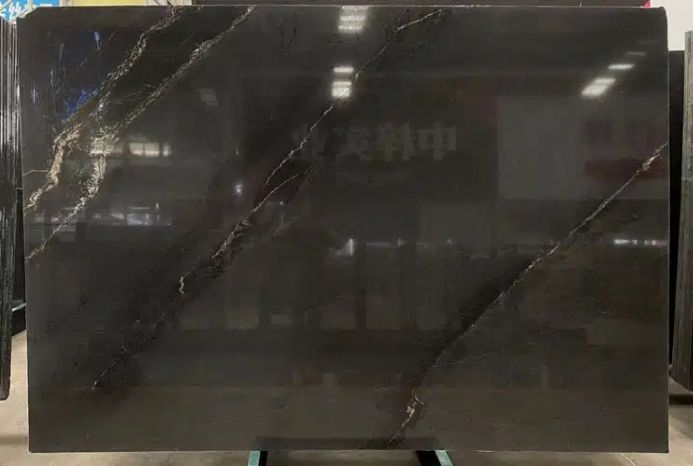
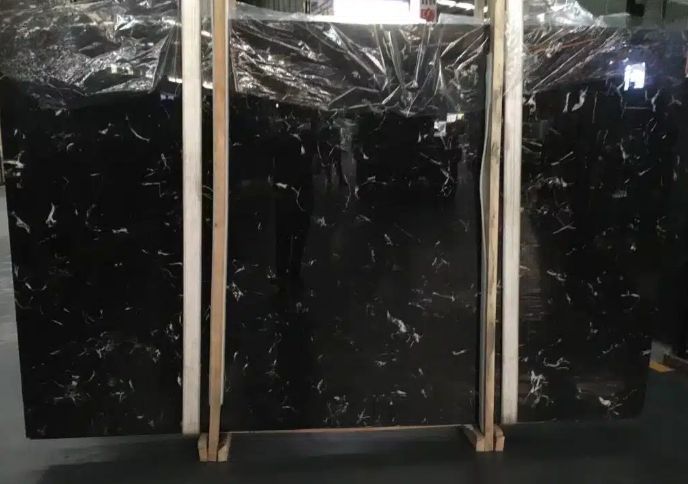
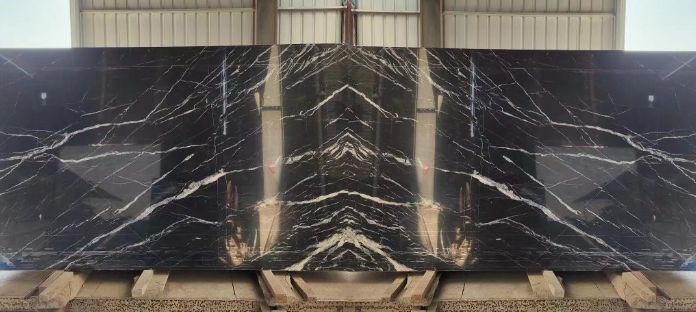
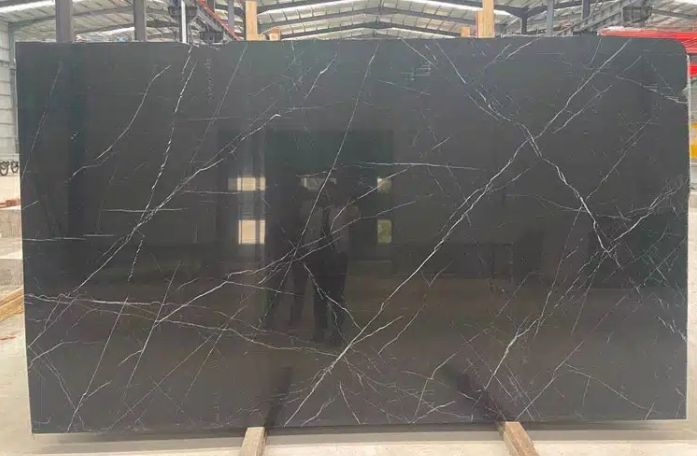
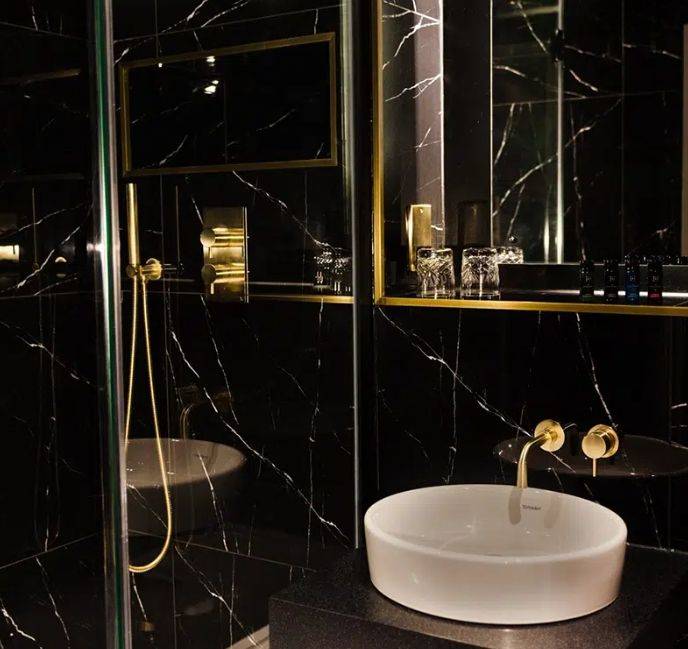
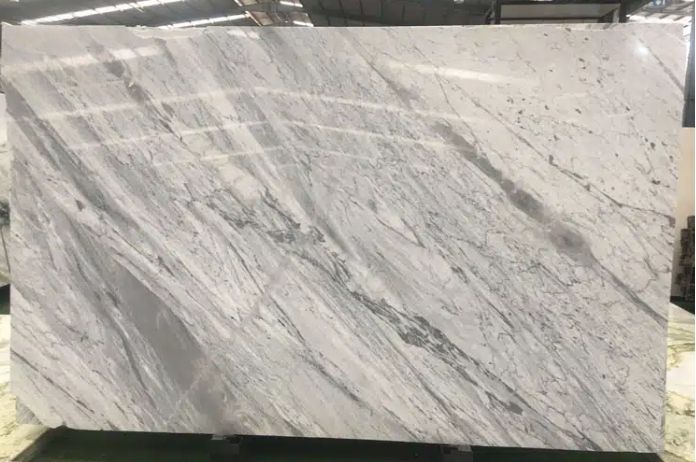

Detailed Specifications
Nero Marquina is a black stone from the Basque Country of northern Spain, quarried at Markina-Xemein in the province of Bizkaia. Geologically it is not a metamorphic marble but a fine-grained bituminous limestone, classified petrographically as a dark, compact biomicrite with irregular white veins. The black comes from bitumen and carbonaceous matter dispersed through a calcitic matrix that was laid down in a low-oxygen marine basin; the white markings are later recrystallised calcite that filled tectonic fissures, which is why they form a criss-crossing network rather than the parallel bands of a wood-grain marble, and why fossil traces occasionally appear in the face. Most trade and academic sources place the deposit in the Cretaceous; some supplier pages say Jurassic or Carboniferous, so treat the exact age as unsettled.
That composition sets the rules for using it. It is a carbonate stone, so it etches on contact with acid, and its calcite-dominated mineralogy makes it etch faster than a dolomitic marble. Its flexural strength — the figure that governs how it behaves as a thin tile or a long span — is modest, so thickness and support matter. In exchange it is dense, takes a very high polish, and is one of the few black stones whose veining is genuinely white rather than grey.
Key Takeaways
- Geology: fine-grained bituminous limestone (not metamorphic), calcite-dominant with bitumen as the black pigment — a carbonate stone that etches on acid contact
- Spanish reference data: density 2,680 kg/m³, water absorption 0.1–0.2%, open porosity about 0.2%, flexural strength 12.0–14.4 MPa. Compressive strength is reported in two irreconcilable ranges (61.7–62.9 MPa and about 107–121 MPa) — test the batch
- Grading axis: three vein-density varieties (low / medium / high) plus a First Selection vs Commercial split — not just "A" or "B"
- Watch for: Chinese and other lookalike material sold under the same name — confirm the block source in writing
Specifications
| Specification | Value |
|---|---|
| Material | Natural Marble |
| Origin | Markina-Xemein, Bizkaia, Basque Country, Spain — or Chinese equivalent (黑白根) from Guangxi / Hubei. Stated on the order. |
| Geological Type | Bituminous limestone (Cretaceous, per most sources); dark compact biomicrite, calcite-dominant with bitumen pigment |
| Flexural Strength | 12.0-14.4 MPa dry (published reference data); approx. 9.8-11.9 MPa after freeze-thaw cycling |
| Vein Grade | Low / medium / high vein density (heaviest sold as "Florido"); First Selection or Commercial. Specify. |
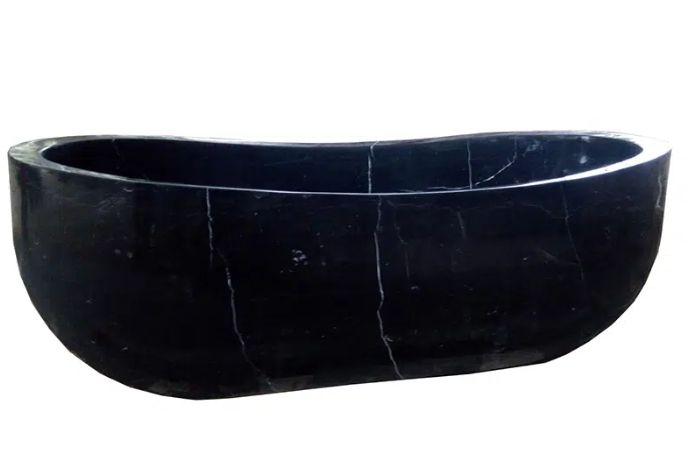
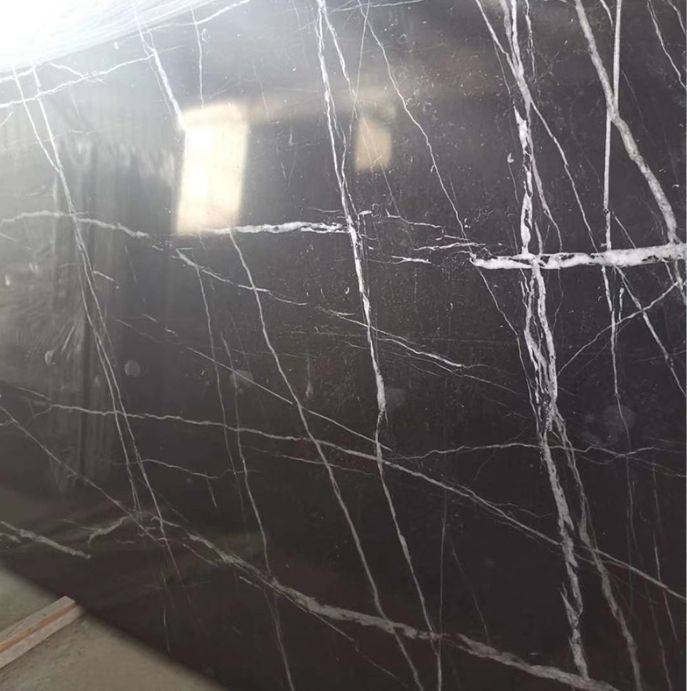
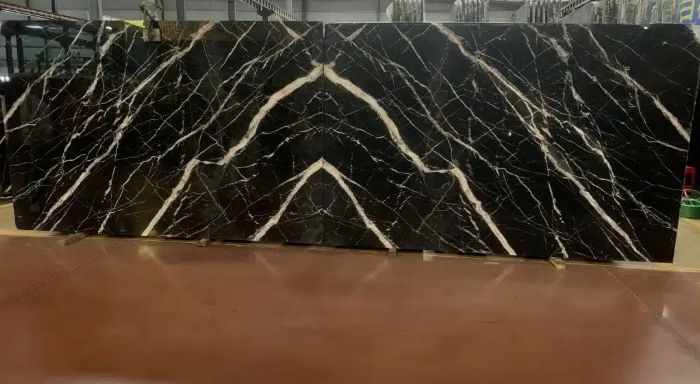
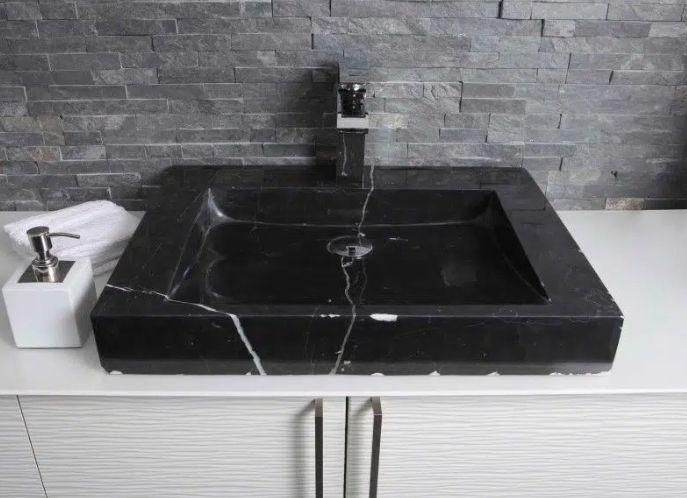
| Color | As shown — each slab features unique natural veining |
| Standard Sizes | Slabs: 2400×1200mm to 3000×2000mm | Tiles: 305×305mm to 600×600mm (custom available) |
| Thickness | 10mm / 12mm / 15mm / 18mm / 20mm / 30mm (custom on request) |
| Thickness Tolerance | ±1mm (standard), ±0.5mm (premium, specify in order) |
| Surface Finish | Polished, Honed, Brushed, Tumbled, Sandblasted |
| Water Absorption | 0.1-0.2% for Spanish material (published reference data). Confirm with a batch test to ASTM C97 — Chinese equivalent material is published at 0.14-0.17%. |
| Compressive Strength | Published values conflict: 61.7-62.9 MPa (UNE-EN 1926) against roughly 107-121 MPa in other datasheets. Test the batch. |
| Packing | ISPM-15 fumigated wooden crates. Polished slabs interleaved with protective foam. |
| MOQ | 1 × 20ft container (approx. 400-500 m² slabs or 500-900 m² tiles) |
| Delivery Time | 15-25 days after deposit confirmation |
| Payment Terms | T/T (30% deposit, 70% before shipment), L/C at sight |
A Limestone Sold as Marble — and Where Your Blocks Come From
Nero Marquina is not a metamorphic marble. Its own quarry operator calls it la caliza ornamental conocida como Mármol Negro Marquina — the ornamental limestone known as Black Marquina marble — and petrographic work to UNE EN 12407 classifies it as a dark, compact, fine-grained biomicrite with irregular white veins. The black comes from bitumen and carbonaceous matter dispersed through a calcitic matrix laid down in a low-oxygen marine basin; the white markings are calcite that later filled tectonic fissures, which is why they criss-cross rather than running in the parallel bands of a wood-grain marble. Most academic and trade sources place the deposit in the Cretaceous; some supplier pages say Jurassic or Carboniferous, so treat the age as unsettled and "bituminous limestone" as the reliable description. The distinction is commercial: a specification calling for a metamorphic marble can fail on a laboratory report, and no supplier can claim metamorphic hardness for this stone.
The quarry is at Markina-Xemein in Bizkaia, in the Basque Country of northern Spain, on the ridge it shares with Aulesti. Production is concentrated in a handful of operations dominated by two names, Marnemar and Canteras Olaspe, whose Monte Zapola concession dates from 1988 — and the deposit is small enough for supply to be genuinely exposed: Canteras Olaspe's working face collapsed in September 2017 and took about three years to return to normal production. One operator states that its quarries produce 80% of the Negro Marquina sold worldwide, with reserves of roughly 80 years; that is the operator's own marketing figure, and one 2016 trade estimate put output of the genuine Spanish stone near 10,000 m² of slabs a month. Few faces, one dominant producer, limited tonnage — book the lot early on large projects.
Similar-looking black marble with white veining is also quarried in Morocco, Mexico and Iran under the same name, and the name travels further than the stone: Black Marquina, Black Marquinia, Negro Bilbao, Nero Markina, Noir Marquina — and in Chinese, 黑白根, "black-white root". Mislabelling is endemic, with public listings showing Markina, Spain in the description and China in the origin field. Make origin a written term, name the country and province (and quarry where known), require photographs or video of the actual lot rather than catalogue images, and obtain an origin certificate for Spanish material.
Reading the Veins: How This Stone Is Really Graded
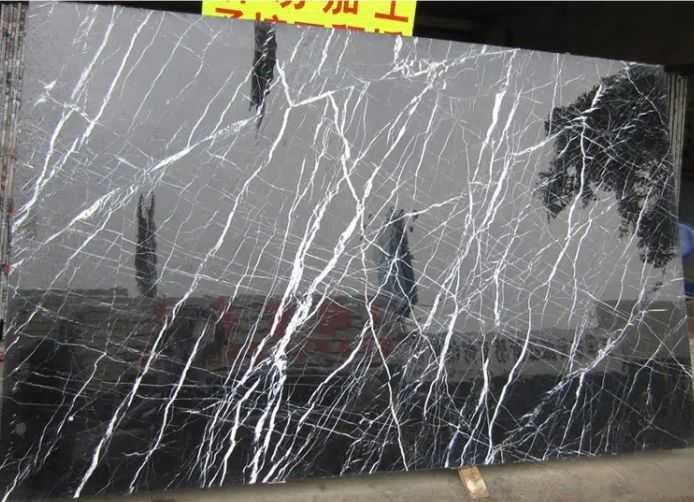
The white veining is also the grading axis. The Spanish material is traded in three varieties defined by calcite vein density — low, medium and high, the heaviest sold separately as Negro Marquina Florido — and on top of that sits a two-tier quality split that buyers meet constantly. First Selection is deep, uniform black with sparse, clean veins and few fossils, in limited supply at a premium. Commercial Selection has a less deep and less uniform background, shade variation across the slab, more fossil content, and veining that trade sources describe as often covering more than half the slab face. Same stone, same deposit, very different appearance and price. Ask which one is being quoted, in writing, and approve the actual lot rather than a catalogue image of the top grade.
Because the veins are calcite-filled fractures, they are planes of weakness rather than decoration: cutting and profiling chip or open along them, so the trade works this stone in several light passes and hones wet rather than dry, since dry honing gouges the softer vein material and leaves veins sitting below the polished face. The same geology explains mesh backing — factories vacuum-epoxy resin and apply fibreglass mesh to the back to stabilise micro-fissures so the stone survives sawing and shipping. Check background tone in daylight, where charcoal grey reads as black under factory lighting. No universal grading standard exists, so require the grade designation in writing; China's GB/T 19766-2016 does set measurable limits and is worth quoting in a Chinese supply contract, as set out on our Black Zebra marble page.
Fabrication, Finish and Where Black Marquina Fails in Service
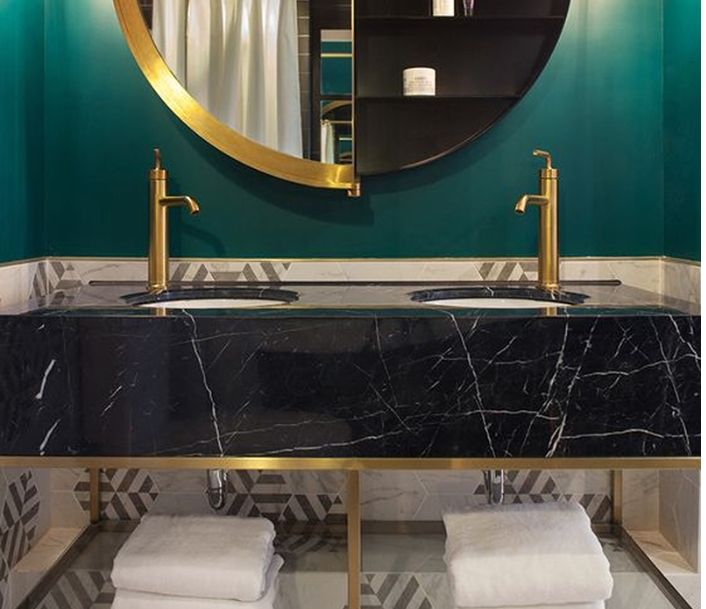
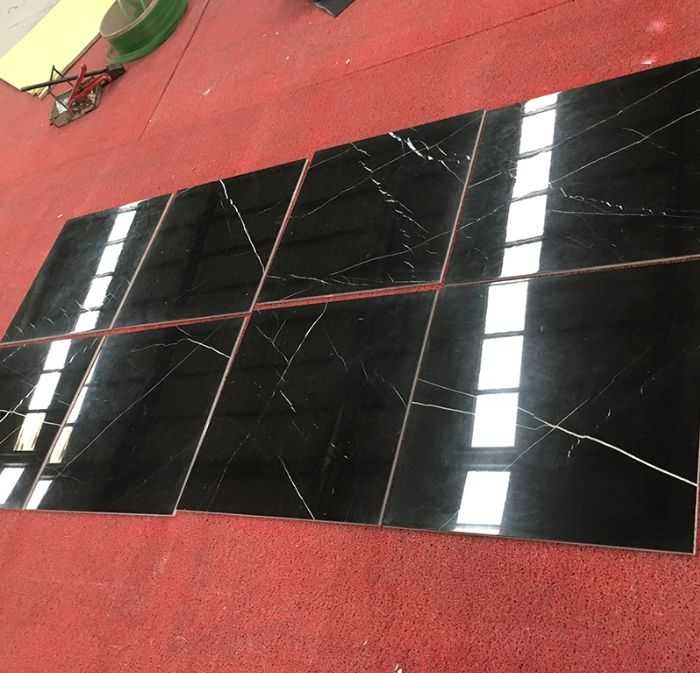
Finish decides how much maintenance the stone will demand. A polished black face is a mirror, and mirrors show everything — dust, fingerprints, water spots, grout haze and fine scratches all read more strongly on polished dark stone than on any other finish. Trade guidance converges: honed, typically 400 grit, for floors and vanities; polished for wall cladding where the deepest black is wanted and nothing walks on it. Honed hides the dull patches left by etching far better than gloss, and leathered better still.
Etching deserves a plain statement, because it is the most common complaint about black marble in service. This is a calcite-dominant stone, and calcite marble reacts with 1 M hydrochloric acid roughly 650 times faster than dolomite marble at 25 °C, so acidic cleaners, wine, vinegar, citrus and tomato leave dull marks, and no penetrating sealer prevents it — a sealer slows staining, not the reaction that removes the polish. On black stone an etch appears as a pale, milky patch, more visible than on white marble, and honing does not camouflage it the way it does on light stone, though it is far less glaring than on a polished face. Reseal roughly every 12 months in humid or coastal environments, every 18–24 months inland, clean with pH-neutral products only, and avoid hydrogen-peroxide poultices on dark marble because they lighten it. See Stone Finishes Compared and the Stone Sealing Guide.
The number that governs how this stone behaves as a tile or a span is flexural strength, not compressive strength. Published flexural results run from 12.0 ± 3.0 MPa by UNI EN 12372 to 13.3–14.4 MPa by UNE-EN 12372, falling to about 9.8 ± 2.3 MPa after 48 freeze-thaw cycles — low for a dimension stone, and the reason edges chip and strips snap in transit. Specify 18–20 mm for worktops and vanities rather than 10 mm, and keep unsupported overhangs short. Compressive strength is published in two irreconcilable families, 61.7–62.9 MPa by UNE-EN 1926 against roughly 107–121 MPa elsewhere; sources vary, so test the batch rather than trusting a datasheet.
On kitchens the trade consensus is blunt: Nero Marquina is generally discouraged for countertops, because acidic food, knives and cookware produce rapid etching and scratching. If a client insists, use honed and record their acceptance of ageing and wear; Absolute Black or Zimbabwe Black granite, or an engineered quartz replica, are the honest alternatives where the surface must survive daily cooking. Exteriors are genuinely contested — the stone passes EN 12371 and has real historical use in Spain, but one major tile manufacturer rates it for covered exterior walls in non-freezing climates only and warns that its iron minerals can bleed with moisture, while other trade sources rule it out for freeze-thaw-exposed facades. Interior work, plus covered and drained mild-climate exteriors, is the defensible line. Flamed finishes are not used on this stone; bush-hammered is the traditional textured answer.
Specifying and Inspecting a Nero Marquina Order
Name what the trade leaves vague. In the purchase order: origin (country, province, quarry where known, plus an origin certificate for Spanish material); grade and vein-density class, matched to a physically approved sample; finish and thickness with tolerance stated as ±1 mm commercial or ±0.5 mm for tiles; a target gloss of 85° or better on polished material; block-lot reservation with sequential slab numbers, and consecutive A/B cuts from one block if the design is bookmatched; a maximum acceptable crack length and chip size; and a batch test report for absorption and flexural strength on the material actually loaded. Approve the dry-lay or bookmatch before packing, and inspect before the container is sealed — the last point at which replacement is still cheap.
Mesh backing is standard here, not a defect, but it raises two questions: whether the resin was applied for structural or purely cosmetic reasons, and whether the backing is cement-compatible for your fixing method. The resin's waxy surface means adhesive bonds to the backing rather than the stone, and there is a documented failure mode of mesh-backed tiles debonding at the mesh-to-tile interface, with wet-set work sometimes requiring the mesh to be removed. For external cladding, BS 5385: Part 2 rules resin mesh-backed stone out entirely. Our Stone Defects and Inspection Guide shows how to record mesh encapsulation and delamination in an inspection report.
| Inspection point | What good looks like | Why it matters on this stone |
|---|---|---|
| Grade and vein density | Matches the approved sample's grade and vein class, crate by crate | Vein density is the sorting axis; the difference is visible across a room |
| Background blackness | Deep black with no charcoal, grey or brown cast, checked in daylight | Black under plant lighting can read grey once installed |
| Veins, cracks and fissures | Veins sound and tight; no spider-crack network, no open fissure, no excessive filled cracking | Veins are calcite-filled fractures and the first place the stone fails or chips |
| Resin fill and patching | No over-filled white resin masking defects, no random patch repairs | On a polished black face a bad fill reads as a permanent dull streak |
| Edge chips and corners | Corners intact, no visible edge chipping | Common in long-distance shipping; a chipped slab is downgraded |
| Mesh and thickness | Mesh fully encapsulated, not peelable with a fingernail; calibre inside tolerance and slabs flat, not bowed | Mesh-to-stone bond varies tile to tile, and bowing becomes lippage once fixed |
On price, be sceptical of anything published. There is no reliable public FOB number for genuine Spanish material; the solid European datapoints are finished tiles at roughly €150–170 per m² ex-works in Italy and UK retail slabs near £282 per m² — both retail-side, finished figures, not quarry-gate prices. Marketplace listings for Chinese-origin Nero Marquina-type slabs cluster around US$15–30 per m² FOB Xiamen, with premium book-matched lots far higher, and listings at US$16–18 per m² claiming Spanish origin should be read as mislabelled; genuine Spanish stone does not trade at lookalike prices. Shipping to the United States, price the 25% Section 301 duty on Chinese stone products into the landed cost. The Marble Price Guide explains how to read a quote structured this way and Negotiating with Stone Suppliers covers the commercial levers.
Further Reading
Related guides: Marble Tiles Buying Guide · Chinese Granite Vs Italian Marble
Standards & references: ASTM C503 Marble Standard · EN 1469 Natural Stone Cladding
Frequently Asked Questions
Is Nero Marquina a marble or a limestone, and does the distinction matter?
Geologically it is a black bituminous limestone — a fine-grained biomicrite with irregular white calcite veins, coloured by dispersed bitumen. Its own quarry operator describes it as an ornamental limestone; it is sold commercially as marble. The distinction matters because some specifiers reject a limestone in a marble schedule, and because no supplier can claim metamorphic hardness for this stone. Most sources place the deposit in the Cretaceous, while some supplier pages say Jurassic or Carboniferous, so treat the exact age as unsettled.
How can I tell Spanish Nero Marquina from the Chinese lookalike?
By documentation, not by photograph. Genuine material comes from Markina-Xemein in Bizkaia, Spain, from a handful of operations dominated by two companies; Chinese 黑白根 is quarried mainly in Guangxi (Guanyang and Guilin, with Wenshi as its best-known centre) and in Tongshan county, Hubei — Guangxi material generally carries fewer white veins, Hubei more. Ask for an origin certificate, live photographs or video of the actual lot, and physical samples. Mislabelling is common: public listings exist showing Markina, Spain in the description and China in the origin field.
Spanish and Chinese material are quoted at very different prices — what does the gap buy?
Sources genuinely conflict here. Chinese suppliers publish stronger figures for their material (around 205 MPa compressive, 14.8 MPa flexural, 0.14–0.17% absorption), while European trade sources describe Chinese and other substitute stones as more fissured, higher in waste, greyer in background and inferior in polish retention. Both cannot be true of every lot, so the reliable answers are a batch test on the material actually being loaded and pre-shipment inspection. What Spanish origin reliably buys is a deeper, more uniform black ground, tighter veining, larger blocks and fewer fissures — require those in writing rather than paying a premium for a name.
Will it etch, and can sealing prevent it?
It will etch, and sealing cannot prevent it. This is a calcite-dominant carbonate stone, and calcite marble reacts with 1 M hydrochloric acid roughly 650 times faster than dolomite marble at 25 °C, so acidic cleaners, wine, vinegar, citrus and tomato leave dull marks. A penetrating sealer slows staining but does not stop the reaction that removes the polish, and on black stone an etch shows as a pale, milky patch that is more visible than on white marble. Clean with pH-neutral products, reseal about every 12 months in humid or coastal environments and every 18–24 months inland, and avoid hydrogen-peroxide poultices on dark marble.
Can Nero Marquina be used in a kitchen or outdoors?
For countertops, trade guidance generally discourages it: acidic food, knives and cookware cause rapid etching and scratching. If it is specified anyway, use a honed finish and record the client's acceptance of ageing and wear; Absolute Black or Zimbabwe Black granite, or an engineered quartz replica, are the honest alternatives for a working kitchen. Outdoors the sources conflict — the stone passes EN 12371 and has historical use in Spain, but one major tile manufacturer rates it for covered exterior walls in non-freezing climates only and warns its iron minerals can bleed with moisture, while other trade sources rule it out for freeze-thaw-exposed facades. Flamed finishes are not used on this stone; bush-hammered is the traditional textured finish.
What is the mesh backing on the slabs, and should I accept it?
Yes — vacuum-epoxy resin plus fibreglass mesh is standard on this stone, not a defect. It stabilises the micro-fissures around the calcite veins so the slab survives sawing, handling and shipping. Two questions are still worth asking: whether the resin was applied for structural or purely cosmetic reasons, and whether the backing is cement-compatible if you are wet-setting floor tiles. The resin's waxy surface means adhesive bonds to the backing rather than the stone, and mesh-backed tiles have been documented debonding at that interface. For external cladding, BS 5385: Part 2 rules resin mesh-backed stone out entirely.
How is Nero Marquina graded, and why are two quotes so far apart?
The Spanish material is traded in three varieties defined by white calcite vein density — low, medium and high, the heaviest sold separately as Florido — plus a two-tier quality split: First Selection, deep uniform black with sparse clean veins, and Commercial Selection, with a less uniform background, shade variation across the slab and veining that trade sources describe as often covering more than half the face. Two quotes can differ by a multiple because of grade, origin, slab size, calibre, finish and whether a specific block lot is reserved. No universal grading standard exists, so require the grade designation in writing and approve the actual lot.
What should the purchase order and inspection cover?
Origin plus an origin certificate for Spanish material; grade and vein-density class matched to a physically approved sample; finish and thickness with tolerance stated as ±1 mm commercial or ±0.5 mm for tiles; a target gloss of 85° or better on polished material; block-lot reservation with sequential slab numbers, and consecutive A/B cuts from one block if the design is bookmatched; a maximum acceptable crack length and chip size; and a batch test report for absorption and flexural strength on the material loaded. Approve the dry-lay or bookmatch before packing and inspect before the container is sealed. Minimum order is one 20ft container, typically 13–15 slabs per bundle and 8–10 bundles per container, with lead time normally 15–25 days after deposit; samples ship by courier in 3–7 days and are credited against the production order.
Related Resources
- Quality Control Standards — ASTM / EN testing and 6-stage inspection process
- Container Loading Guide — Maximize your shipment efficiency
- Request a Quote — Get pricing and availability for this product
Related Products
- Silver Portoro Marble Slab — the gold-veined black marble from Liguria, Italy
- Nero Marquina China Black Marble — the 黑白根 equivalent from Guangxi and Hubei
- Nero Marquina Quarry Blocks — block trade for factories and large projects
- New Guangxi White Marble Slab
- Tundra Grey Marble Italian Imported Tiles
- White Wood Marble Price Nature Stone
Inquire About This Product
Contact us for pricing, samples, or custom specifications.
Get a Quote