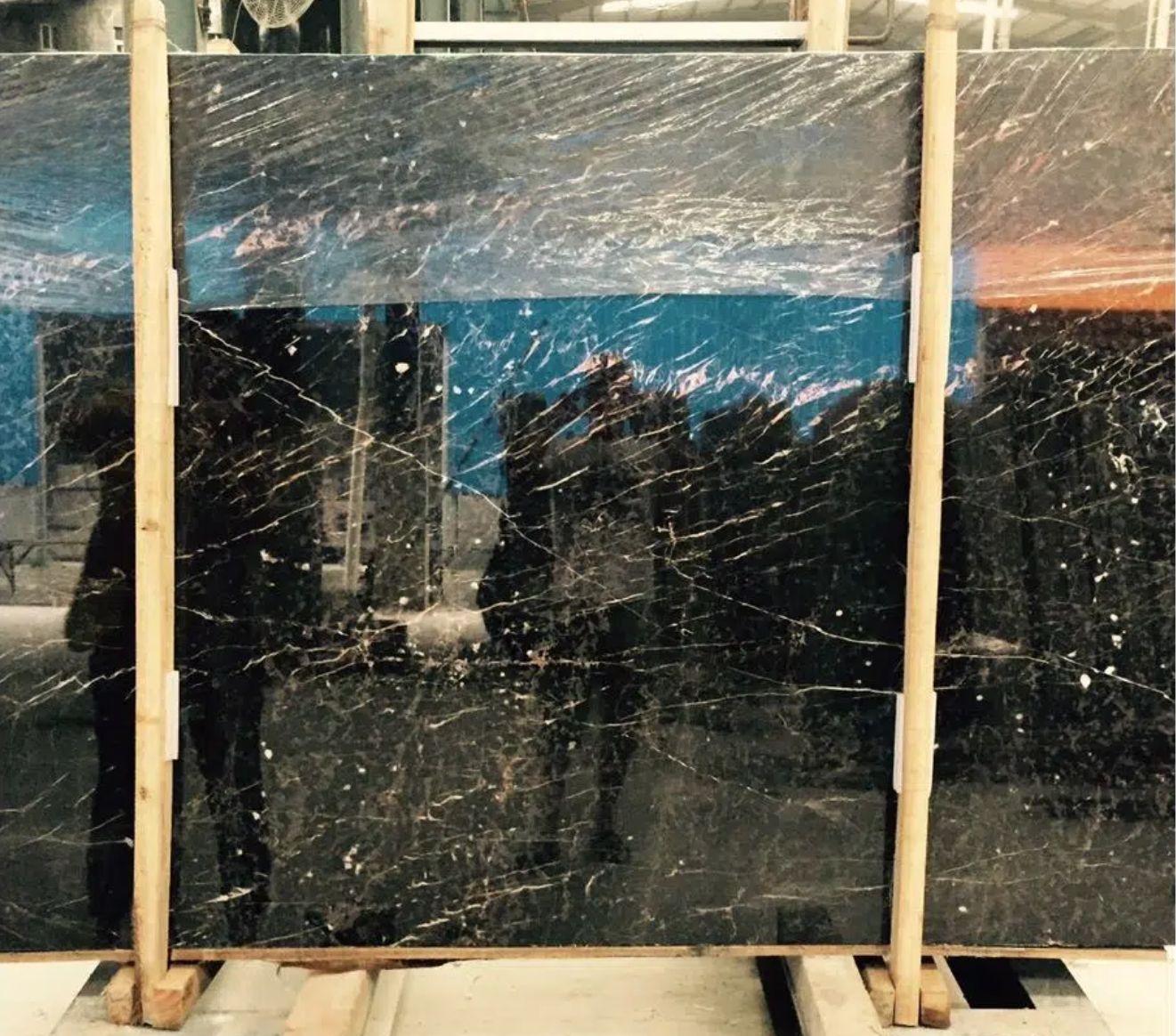
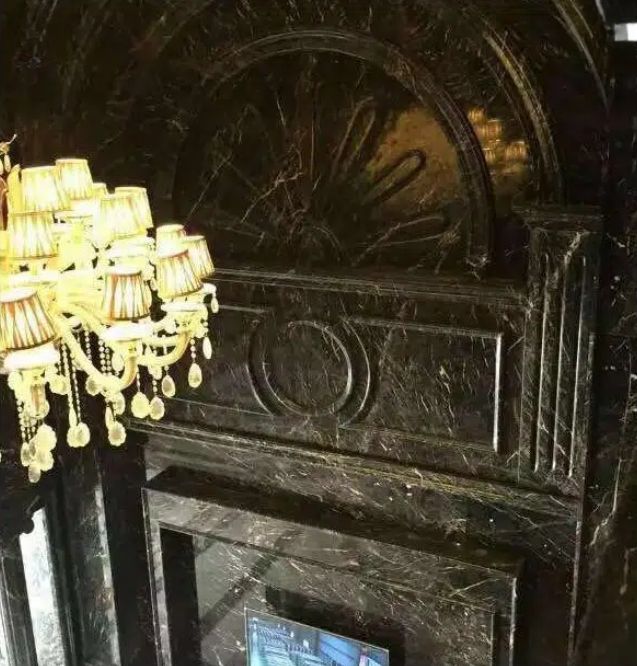
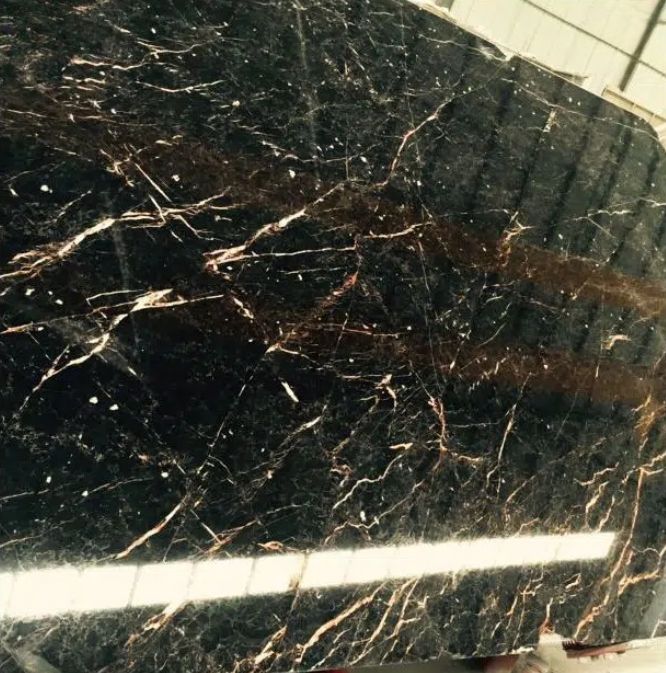
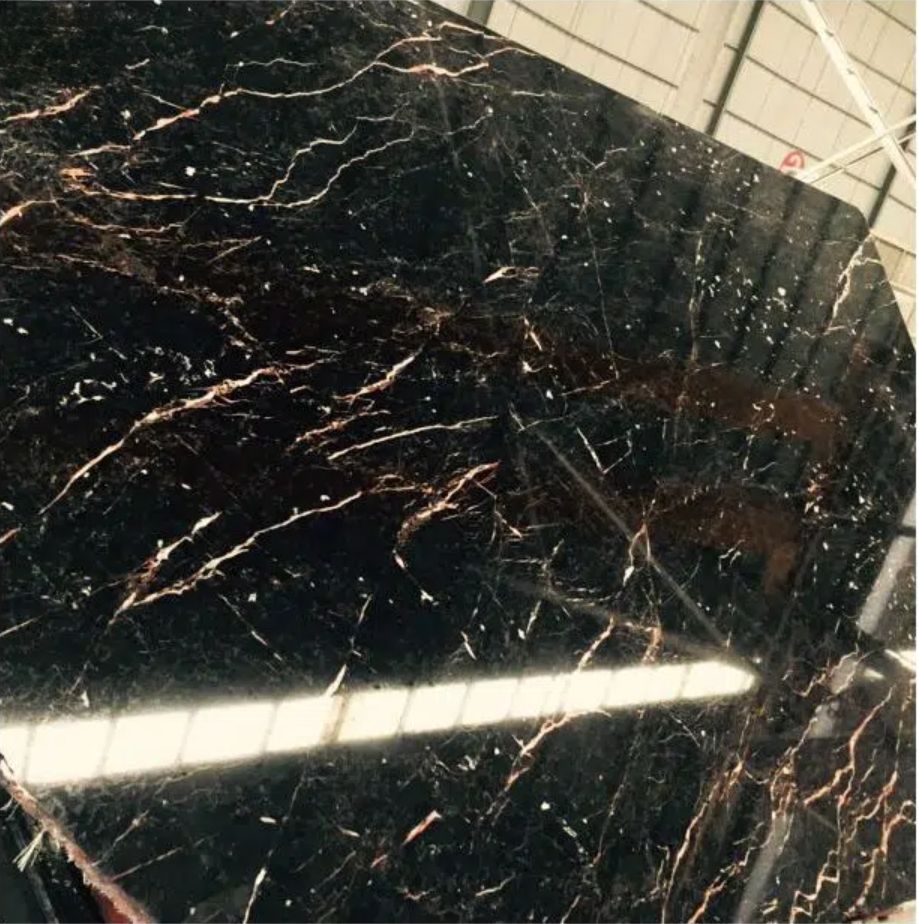
Detailed Specifications
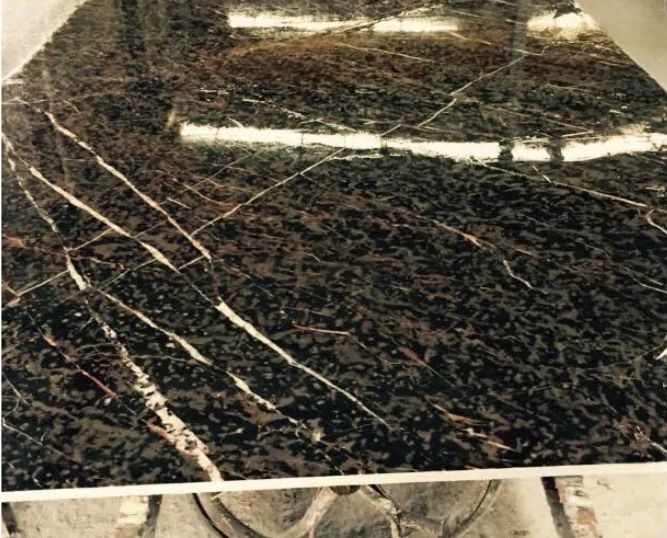
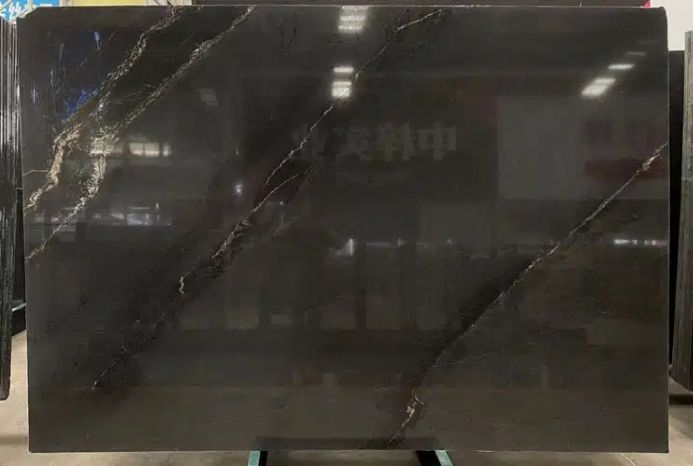
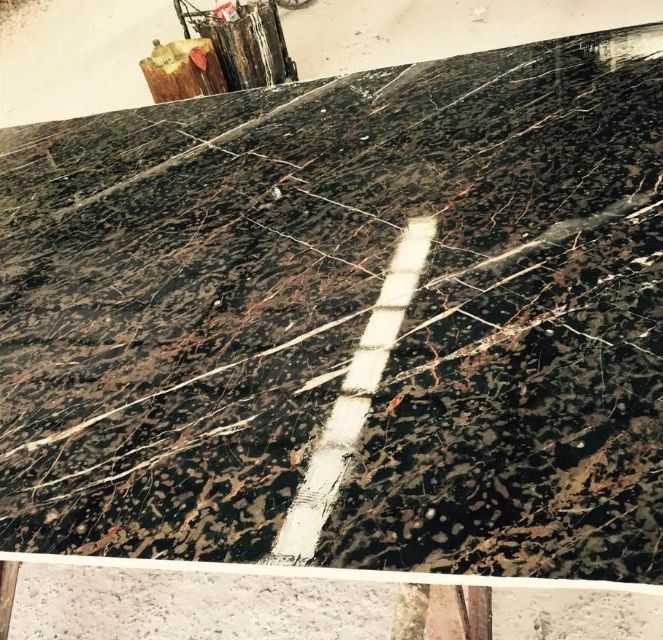
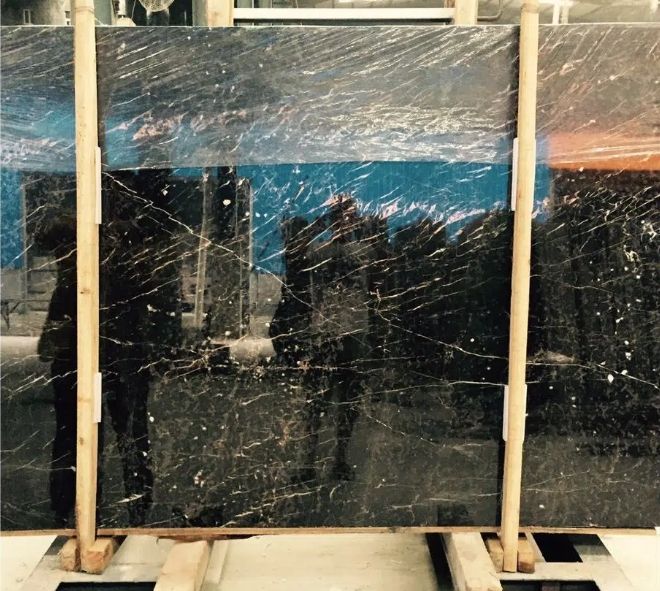
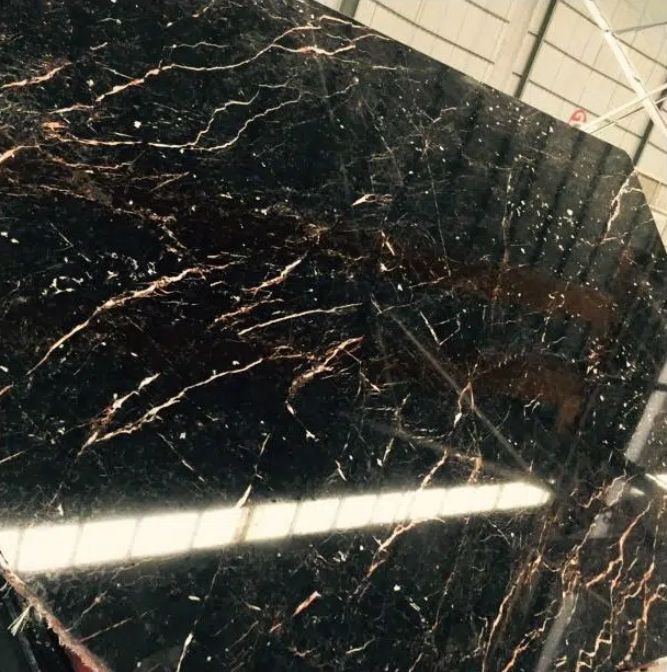
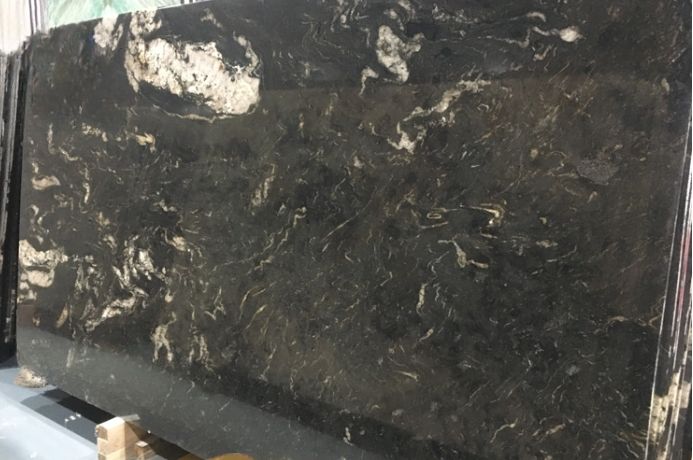
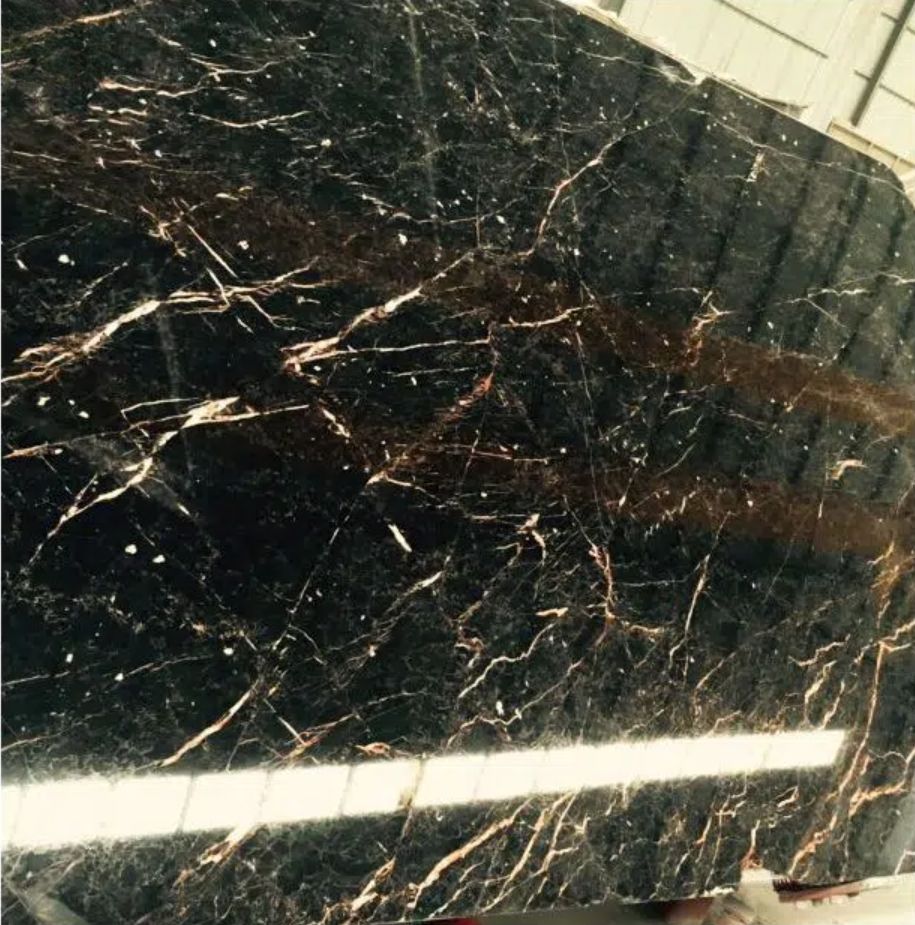
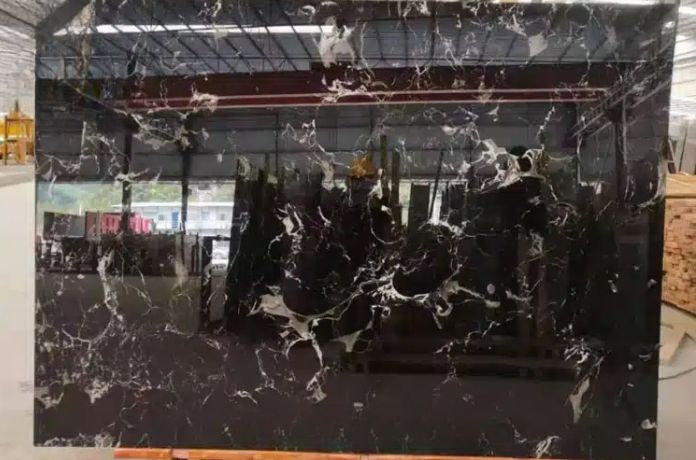
Black Zebra is a banded black marble: a black to blue-black matrix with silver-white calcitic layers running through it in parallel bands. It is sold under a descriptive name rather than a geological one, and the best-attested source is the Chinese ancient wood grain marble of Jiangxi province, worked around Shangrao and Dexing, with similar material attributed to Guangxi, Yunnan, Sichuan and Guizhou, and unrelated black banded marble from India and Namibia also using the name. The most damaging confusion runs the other way: Guizhou black wood grain stone is an iron-rich argillaceous dolomite — sedimentary rock that never metamorphosed — and it is brittle, weak, high in absorption and prone to efflorescence while looking almost identical in a photograph.
Two facts govern how it should be specified. The banding is metamorphic foliation and the silver-white bands are calcite, softer than the black matrix, so the stone is directional and its edges chip along the band boundaries — cut direction, grain direction and sequential numbering are decided at the saw, not on site. And it is a carbonate stone, so it etches on contact with acid. Both are covered in the sections below, along with the Chinese slab standard, the mesh-backing question and how the material behaves against the alternatives.
Specifications
| Specification | Value |
|---|---|
| Material | Natural Marble |
| Geological Type | Banded marble (metamorphic) — confirmed against the sedimentary dolomite lookalike sold under similar names |
| Band Direction | Vein cut, grain direction marked on the tile backs and crate labels; sequential piece numbering for bookmatched runs |
| Flexural Strength | GB/T 19766-2016 floor is ≥7.0 MPa; batch test report supplied with the shipping documents |
| Slab Standard | GB/T 19766-2016: grades A / B / C, specular gloss 90 / 80 / 70, density ≥2.60 g/cm³ |
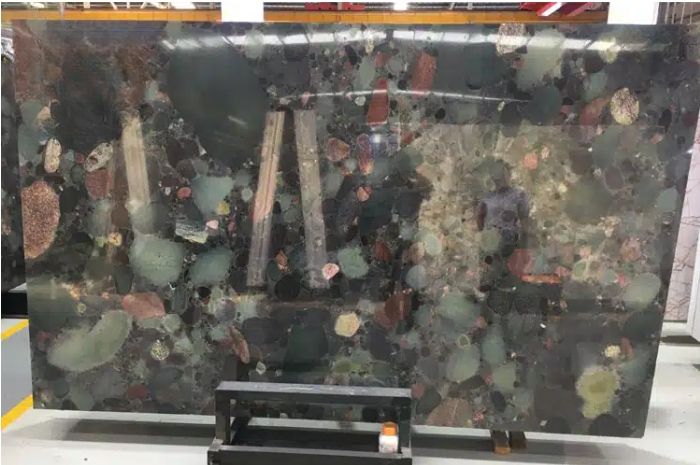
| Color | As shown — each slab features unique natural veining |
| Standard Sizes | Slabs: 2400×1200mm to 3000×2000mm | Tiles: 305×305mm to 600×600mm (custom available) |
| Thickness | 10mm / 12mm / 15mm / 18mm / 20mm / 30mm (custom on request) |
| Thickness Tolerance | ±1mm (standard), ±0.5mm (premium, specify in order) |
| Surface Finish | Polished, Honed, Brushed, Tumbled, Sandblasted |
| Water Absorption | China’s GB/T 19766-2016 limit for marble slabs is ≤0.50%. Published values for this family span 0.06-0.75%, so test the batch to ASTM C97 or GB/T 9966.3 — anything above 0.50% does not meet the standard. |
| Compressive Strength | GB/T 19766-2016 sets a floor of ≥50 MPa. Published supplier figures for this family are much wider, and a sedimentary dolomite lookalike tests lower — test the batch rather than quoting a catalogue. |
| Packing | ISPM-15 fumigated wooden crates. Polished slabs interleaved with protective foam. |
| MOQ | 1 × 20ft container (approx. 400-500 m² slabs or 500-900 m² tiles) |
| Delivery Time | 15-25 days after deposit confirmation |
| Payment Terms | T/T (30% deposit, 70% before shipment), L/C at sight |
Key Takeaways
- Natural marble — density 2,600–2,750 kg/m³, water absorption ≤0.2%, compressive strength ≥52 MPa
- Hardness: 3–5 Mohs, suitable for both interior and exterior applications when properly specified
- Phoenix Power Stone factory-direct supply — 108,000 sqft facility, Shandong, China, 24+ years of export experience
What "Black Zebra" Marble Actually Is — and Which Stone You Are Being Quoted
"Black Zebra" is a descriptive marketing name, not a geological classification or a quarry. Directories apply it to several stones: the Chinese "ancient wood grain" marble of Jiangxi province (古木纹, the best-attested match, worked around Shangrao and Dexing in the Huaiyu Mountains); similar Chinese material attributed variously to Guangxi, Yunnan, Sichuan and Guizhou; an Indian black marble from Rajasthan; and a Precambrian banded marble near Karibib, Namibia. Italian "Zebrino" from Carrara is the inverse — a white marble with dark veins. Two suppliers quoting "Black Zebra" may be quoting two different rocks. "Lawrance" in this product's name is not a recognised synonym for any of them and appears to be a vendor-applied label; do not read it as implying European origin. The names most often confused with it are Noir St Laurent, a black limestone from Laurens in Hérault, France, and 劳伦特黑 (Laurent Black), a black marble with white and gold veining sold under several invented names with conflicting origin claims. To compare with the Spanish classic, see Nero Black Marquina marble and Black Marquina marble slabs.
There is a trap inside these names that costs buyers money. Chinese industry and academic sources describe the Guizhou "black wood grain" (黑木纹, also sold as Royal Black Ebony) as an iron-rich argillaceous dolomite — sedimentary rock that has never been metamorphosed — and draw the consequences plainly: brittle, low in strength, high in water absorption, prone to efflorescence. The Jiangxi material is a true metamorphic marble with microcrystalline crystalloblastic texture and clear banded structure. The two look alike in a photograph and behave nothing alike on a floor. Ask your supplier to state in writing whether the block is metamorphic marble or sedimentary dolomite, and to name the province.
The banding is metamorphic foliation, and the silver-white markings are calcitic layers, softer than the black matrix. That is a fabrication fact, not a geological nicety: blades deflect at those boundaries, so the trade runs black marble of this structure about 10–15% slower than granite, profiles edges in several light passes, and hones wet rather than dry, because dry honing gouges the softer vein material.
Specifying the Order: Cut, Sequence and Grain Control
Banded marble is directional, and direction is decided at the saw, not on site. Specify vein cut — sliced through the layers so the banding runs in parallel lines, which is also the cut that bookmatches. Cross-cut blocks produce a non-directional surface that loses the wood-grain look. From there, control passes to cutting and packing: a grain direction arrow on the setting-out drawing repeated on crate labels and tile backs; sequential piece numbering so the installer follows the intended sequence instead of sorting by eye, since bookmatching needs consecutive slabs from one block kept in order; a dry-lay photograph before packing whenever the pattern runs across more than a few square metres, which costs a few hours of factory time and catches rotation errors before the container closes; and one approved orientation per room, so offcuts that would otherwise be waste are not made acceptable by letting someone on site rotate them.
Application by application: on floors run the grain parallel to the main direction of circulation or to a specified axis; on feature walls bookmatch slab pairs so the bands mirror into a continuous run; on stairs keep the grain continuous along the tread length; on vanities align the grain with the long dimension rather than chopping the banding into short segments around a sink cut-out. Decide the centre line and seam positions at wall scale before cutting, and keep seams tight with colour-matched filler — wide grout lines destroy the mirror of a bookmatch.
Batch matching belongs in the contract. Band width, spacing, direction and background tone change from block to block and bench to bench. If a project ships over more than one container, reserve a single block lot at the outset, require sequential slab numbers within it, and approve production bundles rather than catalogue photographs. Mixing quarry lots is the most common buyer error on banded stone, and a worked-out bench cannot be revisited.
Reading Quality: China's Slab Standard and the Backing Question
China's national standard for natural marble building slabs, GB/T 19766-2016, in force since July 2017, gives you something better than adjectives to negotiate with. It defines three grades — 优等品 (A, excellent), 一等品 (B, first) and 合格品 (C, qualified) — against measured limits: cracks over 10 mm, broken corners, broken edges and colour spots are counted per slab and permitted zero, one or two depending on grade. It also sets performance floors: specular gloss of 90 units for A grade (80 for B, 70 for C), density at least 2.60 g/cm³, compressive strength at least 50 MPa, flexural strength at least 7.0 MPa, and water absorption no more than 0.50% for calcite and dolomite marble alike. Published absorption values for this family span about 0.06% to 0.75% across supplier literature — too wide to describe one rock, and partly the result of pages copying each other rather than testing. Anything above 0.50% does not meet the standard. Ask for a batch test to ASTM C97 or GB/T 9966.3 on the material actually being loaded and make the report part of the shipping documents.
The backing is not packaging — it is part of the specification
Black marble tiles and thin slabs are routinely backed with polyester resin and fibreglass mesh. UK adhesive manufacturer BAL, in technical note TN 18.19, explains why this deserves attention: polyester resin expands far more than the stone, and its waxy styrene-bearing surface blocks adhesion, so the tile adhesive bonds to the backing rather than the stone, and bond strength varies from tile to tile. BS 8000: Part 11 expects mesh and adhesive to obscure no more than 25% of the tile underside unless the stone is mechanically fixed, and BS 5385: Part 2 (2015) states that resin mesh-backed stone tiles should not be used for external wall cladding at all. Our Stone Defects and Inspection Guide shows how to record mesh encapsulation and delamination in an inspection report.
| Inspection point | What good looks like | Why it matters here |
|---|---|---|
| Background tone | Deep black with no grey or brown undertone, checked in daylight not factory lighting | Dark grey reads as black under plant lighting and disappoints on site |
| Band consistency | Band width and spacing stay inside the approved sample range across the crate | Sudden changes mid-crate mean two block sources were mixed |
| Integrity of the white bands | Bands sound and firm, not powdery or crumbling at the edges | Calcitic bands are the softer zone; chips appear there first, white against black |
| Filled cracks and patches | No resin-filled cracks, patch repairs or white filler masking defects | On a polished black face a bad fill shows as a permanent dull streak |
| Spider cracks and flatness | No fine crack network; slab flat rather than bowed, especially at 20 mm and under | Both weaken the slab and show up after fixing |
| Thickness and calibre | ±1 mm is normal commercial tolerance; ±0.5 mm must be specified and paid for | Calibre variation forces wider joints, breaking the banding run |
| Mesh adhesion | Mesh fully encapsulated, not peelable from the tile back with a fingernail | Bond strength between mesh and stone varies tile to tile |
Performance in Service: Acid, Slip, Exteriors and Alternatives
This is a carbonate stone and it will etch. Mineralogy sets how fast: calcite marble reacts with 1 M hydrochloric acid roughly 650 times faster than dolomite marble at 25 °C. A genuinely dolomitic batch therefore resists acid markedly better — but it is still a carbonate, it still etches, and a penetrating sealer does not prevent etching, only staining. Two caveats specific to black stone: etch marks show as pale grey patches and are more visible against black than against white marble, and honing does not camouflage them the way it does on light stone, though it is far less glaring than on a polished face. For worktops or bathrooms cleaned with acidic products, specify honed or leathered.
Slip is a specification issue, not an opinion. ANSI A137.1 requires a wet DCOF of at least 0.42 for floor tile; polished marble typically measures 0.20–0.35 wet, and UK Health and Safety Executive research classes polished marble as high wet-slip potential, with a pendulum friction coefficient around 0.06. Specify honed, leathered, brushed or sandblasted for wet floors and entrances, and require the test result for the finish you are buying rather than the material in general. Exteriors raise a different problem: Carrara marble put through ten freeze-thaw cycles between −17.5 °C and +20 °C showed substantial loss of compressive strength and a very large fall in tangent Young's modulus, and immersion in acid at pH 5 caused progressive degradation. Interior work is the core field for this stone.
Against the alternatives: Spanish Nero Marquina is a black bituminous limestone whose white calcite veins crisscross in a network rather than running parallel — quieter across large areas and easier to match batch to batch, but it cannot produce the wood-grain look and is priced well above the Chinese alternatives. Absolute Black and Shanxi Black granite are acid resistant and roughly 6–7 on the Mohs scale with no pattern at all: right where the surface meets acid, heavy traffic or a worktop, wrong if pattern is the point. Black porcelain tile is dimensionally exact, acid proof and consistent batch to batch, and loses the depth and quarried edge detail — see Stone vs Porcelain and Granite vs Marble.
Published FOB China listings for Black Zebra slabs sit around US$20–40 per m² for standard material and US$40–65 per m² for premium bookmatch-grade, against about US$14 per m² for China Marquina (Guangxi 黑白根) and US$18–22 per m² for Shanxi Black granite tiles in early 2026. The spread is driven by block yield, band selection — blocks with tight regular banding are sorted out and priced higher — thickness, calibre, mesh specification and volume. Shipping to the United States, price the 25% Section 301 duty on Chinese stone products into the landed cost before comparing suppliers; the Marble Price Guide explains how to read a quote.
Further Reading
Related guides: Marble Tiles Buying Guide · Chinese Granite Vs Italian Marble
Standards & references: ASTM C503 Marble Standard · EN 1469 Natural Stone Cladding
Frequently Asked Questions
Is Black Zebra marble a real variety, and where does it come from?
It is a descriptive marketing name rather than a geological variety, applied to several stones from different countries. The best-attested match is the Chinese ancient wood grain marble of Jiangxi province, worked around Shangrao and Dexing; similar material is also attributed to Guangxi, Yunnan, Sichuan and Guizhou. Because the name identifies no single quarry, we name the block source and province on the order and approve a physical sample before production.
How do I know I am not being sold a limestone instead of marble?
Ask the supplier to state in writing whether the block is metamorphic marble or sedimentary dolomite. The Jiangxi material is a true metamorphic marble with microcrystalline crystalloblastic texture and clear banded structure, while Guizhou black wood grain stone is an iron-rich argillaceous dolomite that Chinese sources describe as never having been metamorphosed — brittle, weaker, higher in absorption and prone to efflorescence. The two look alike in photographs and perform very differently.
What specifications should I require, and what should the test report cover?
China's national marble slab standard GB/T 19766-2016 sets the floor: water absorption no more than 0.50%, density at least 2.60 g/cm³, compressive strength at least 50 MPa, flexural strength at least 7.0 MPa and specular gloss of 90 units for A grade. Published supplier figures for this family are much wider, so we test the actual batch to ASTM C97 or GB/T 9966.3 and include the report in the shipping documents.
Can Black Zebra marble tiles be used in a bathroom or kitchen?
Wet walls, vanity tops and bathroom floors in a honed or leathered finish are workable; polished floors in wet areas are not. This is a carbonate stone, so acidic cleaners, wine, vinegar and citrus etch the surface and no sealer prevents etching. Polished marble typically measures a wet DCOF of 0.20–0.35 against the 0.42 that ANSI A137.1 requires, and UK HSE research classes polished marble as high wet-slip potential. For worktops, Absolute Black granite or porcelain is more forgiving.
What is the mesh backing on the tiles, and should I accept it?
It is fibreglass mesh embedded in polyester resin, applied as reinforcement for cutting and transport. Polyester resin expands more than the stone and its waxy surface blocks adhesion, so your adhesive bonds to the backing rather than the stone, and bond strength varies tile to tile. BS 8000: Part 11 expects mesh and adhesive to cover no more than 25% of the tile underside, and BS 5385: Part 2 (2015) rules out resin mesh-backed stone for external cladding.
Will tiles from a later order match the tiles I buy now?
Not reliably. Band width, spacing, direction and background tone change from block to block and bench to bench, and once a bench is worked out the quarry cannot reproduce it. If your project ships over more than one container, reserve a single block lot at the outset and ask for sequential slab numbers within it. We supply vein cut material with grain direction marked and pack against the approved sample.
What is the minimum order quantity, lead time and sample policy?
Standard minimum order is one 20ft container — approximately 400–500 m² for slabs or 500–900 m² for tiles depending on thickness and format — and lead time is normally 15–25 days after deposit. We supply 10×10 cm and 30×30 cm samples by international courier in 3–7 days, and sample costs are credited against the production order.
Related Resources
- Quality Control Standards — ASTM / EN testing and 6-stage inspection process
- Container Loading Guide — Maximize your shipment efficiency
- Request a Quote — Get pricing and availability for this product
Related Products
Inquire About This Product
Contact us for pricing, samples, or custom specifications.
Get a Quote