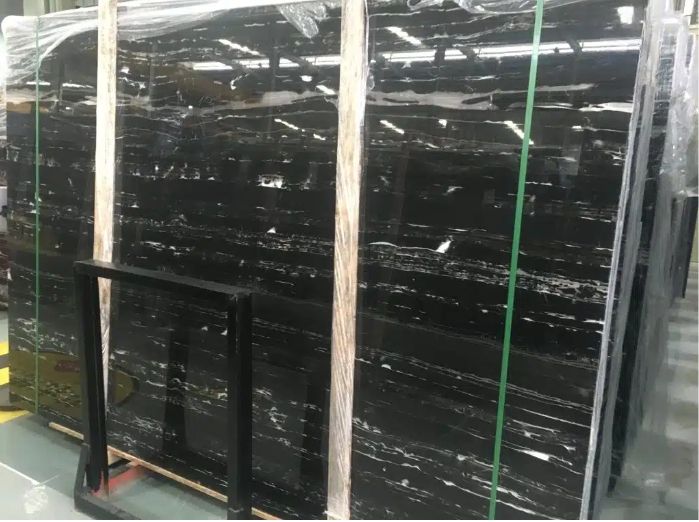
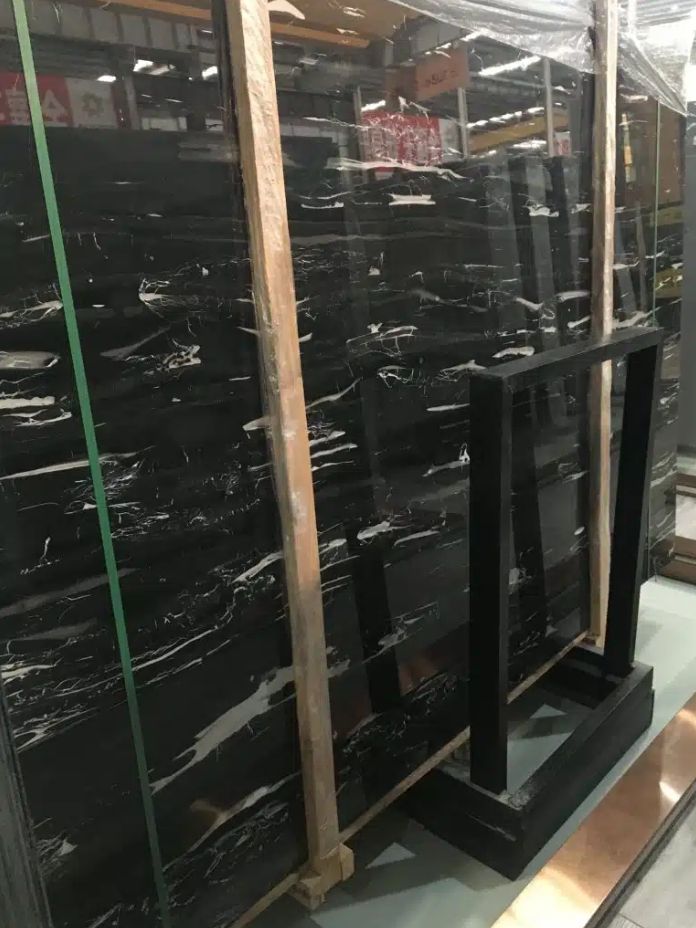
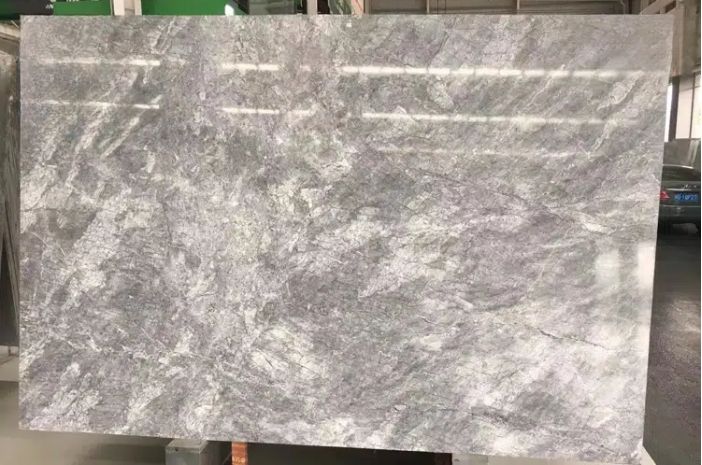
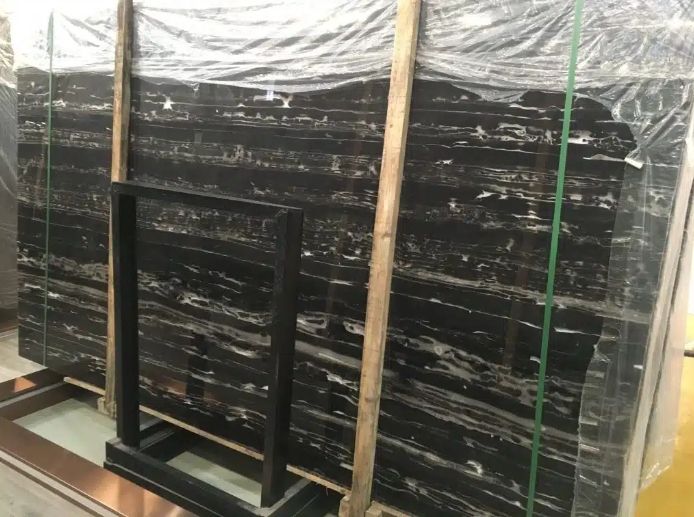
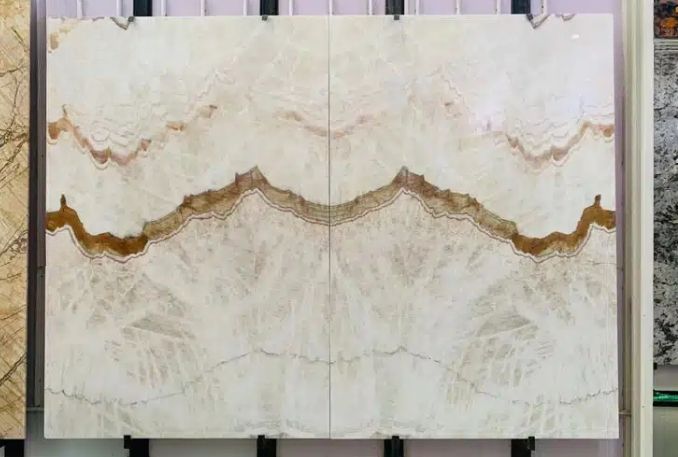
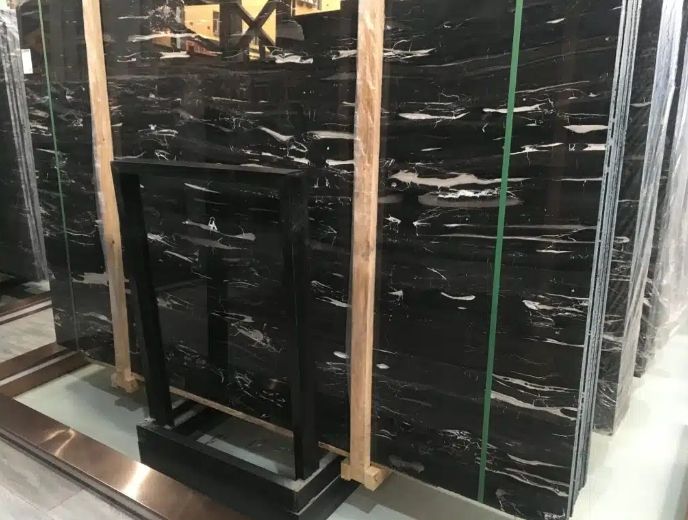
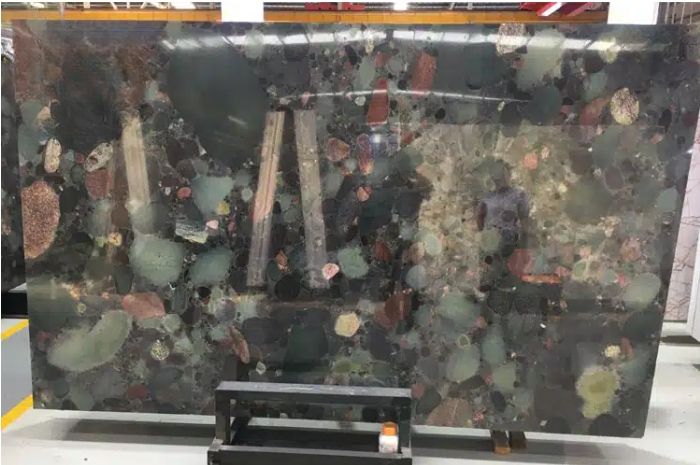
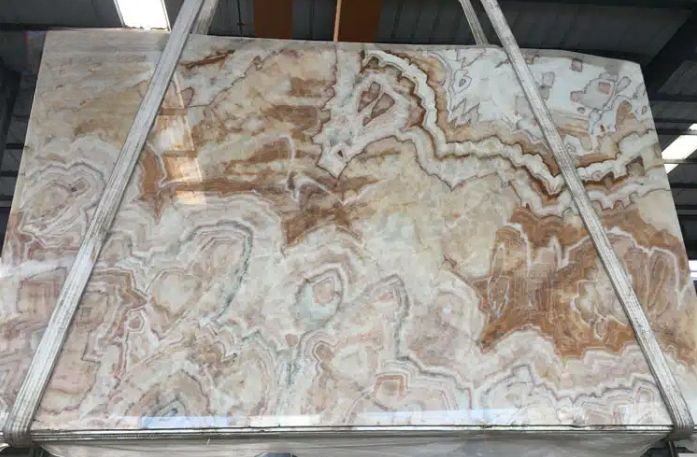
Detailed Specifications
Silver Portoro is the white-veined side of the Portoro family. The Portoro bed lies in the province of La Spezia in Liguria, Italy, and it is a black limestone of roughly 92–94% calcium carbonate rather than a metamorphic marble — the scientific literature itself writes the word "marble" in quotation marks. Within the bed, the white-veined levels lie beneath the golden ones; the horizon that separates Macchia Larga from Macchia Fine is the Nero e Bianco di La Spezia, also called Portargento, "silver port", and that is the material this page describes. The name has since travelled: Chinese 銀白龙 (Silver White Dragon) from Guangxi, and Vietnamese stone, are both sold as Silver Portoro at a fraction of the Italian price.
Two consequences follow for a specification. The veins are calcite that filled fractures in an already heavily fractured deposit, so they are planes of weakness: the stone is worked in small pieces, is not recommended for heavy foot traffic, and belongs in interiors as feature walls, vanities, furniture and inlay. And it is a carbonate stone, so it etches on contact with acid and no sealer prevents that — see the fabrication and service section below.
Key Takeaways
- What it is: the white/silver-veined horizon of the Italian Portoro bed (Portargento), a black limestone of about 92–94% calcium carbonate — not a metamorphic marble
- Reference data: water absorption around 0.09% for Italian Portoro-type material and 0.1–0.3% for Chinese 銀白龙; density 2.6–2.8 g/cm³; compressive strength published from 80–120 MPa (Chinese) to 90–183 MPa (Italian); Mohs 3–4; poor acid resistance
- Grading axis: vein character (bold runs, fine mesh, clouding) and background blackness — the name defines a horizon of the bed, not a grade
- Price reality: Italian Portoro is reported around €650/m² ex-factory in Italy; Chinese Silver Portoro exports at roughly US$17–20/m² FOB Xiamen. Roughly a tenfold gap for a different stone.
Specifications
| Specification | Value |
|---|---|
| Material | Natural Marble |
| Origin | La Spezia province, Liguria, Italy (Portovenere / La Spezia) — or Chinese 银白龙 from Guangxi. Stated on the order. |
| Geological Type | Black limestone (about 92-94% calcium carbonate) — sold commercially as marble; not metamorphic |
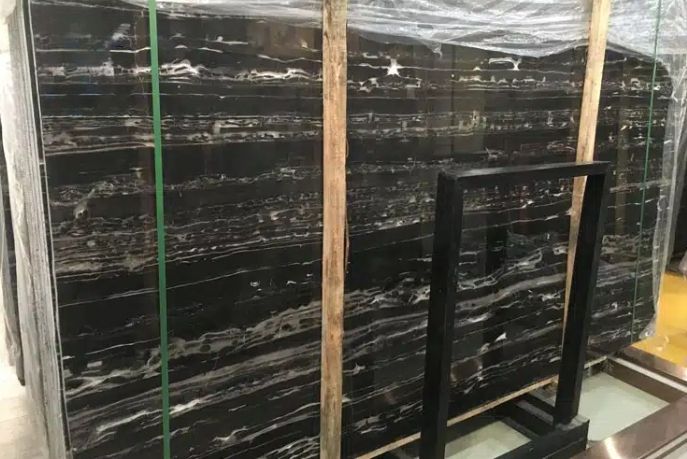
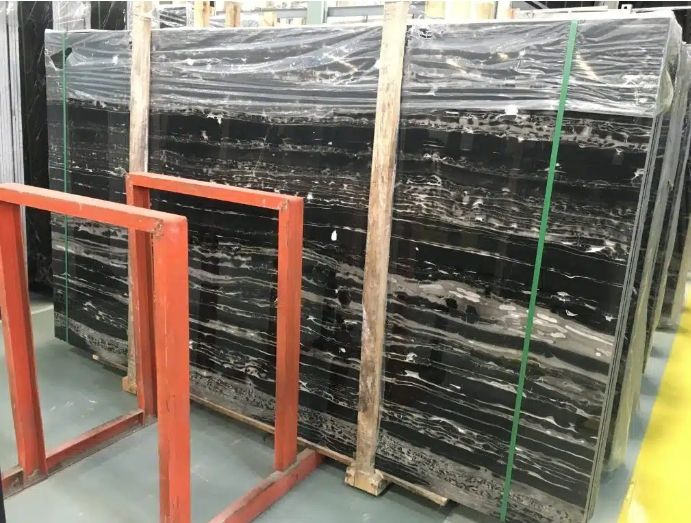
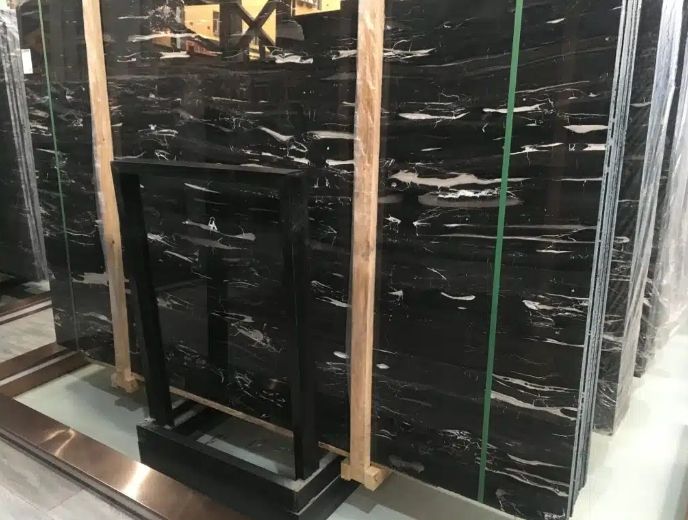
| Vein Character | Silver / white calcite veins on a black ground. Specify the character: bold runs, fine mesh or clouding. |
| Flexural Strength | Published range 8-21.8 MPa (Portoro-type material) — the wide spread is why a batch test matters |
| Bookmatch | Consecutive A/B slabs from one block, sequence preserved through packing. Specify per project. |
| Color | As shown — each slab features unique natural veining |
| Standard Sizes | Slabs: 2400×1200mm to 3000×2000mm | Tiles: 305×305mm to 600×600mm (custom available) |
| Thickness | 10mm / 12mm / 15mm / 18mm / 20mm / 30mm (custom on request) |
| Thickness Tolerance | ±1mm (standard), ±0.5mm (premium, specify in order) |
| Surface Finish | Polished, Honed, Brushed, Tumbled, Sandblasted |
| Water Absorption | Around 0.09% for Italian Portoro-type material, 0.1-0.3% for Chinese Silver Dragon (published reference data). Confirm with a batch test to ASTM C97. |
| Compressive Strength | Published ranges are wide: 80-120 MPa for Chinese Silver Dragon, 90-183 MPa for Italian Portoro. Test the batch. |
| Packing | ISPM-15 fumigated wooden crates. Polished slabs interleaved with protective foam. |
| MOQ | 1 × 20ft container (approx. 400-500 m² slabs or 500-900 m² tiles) |
| Delivery Time | 15-25 days after deposit confirmation |
| Payment Terms | T/T (30% deposit, 70% before shipment), L/C at sight |
Two Different Stones Are Sold as Silver Portoro — Establish Which One You Are Buying
The Portoro bed lies in the province of La Spezia in Liguria, Italy, in the municipalities of Portovenere and La Spezia — on the Castellana slopes and the Santa Croce mountains. Its history is on the islands: the quarries on Palmaria and Tino are all abandoned, and the last one on Palmaria, La Caletta, closed in 1983 because of the environmental damage quarrying was doing to the island. That ground is now the Regional Natural Park of Porto Venere, protected since 1985 and a UNESCO World Heritage Site since 1997, so nothing will be reopened there. Extraction today comes from a very small number of active quarries on the mainland, increasingly worked underground in large chambers supported by pillars precisely to limit damage to the landscape. Even the scientific literature puts the word marble in quotation marks — "Portoro, the black and gold Italian 'marble'" — because it is a black limestone, around 92–94% calcium carbonate. The number of working faces is small even by European standards, and the sources do not agree on exactly how small: a peer-reviewed survey of the deposit counted five quarries still active near La Spezia in 2015, while current trade sources put it at two or three. What is not in dispute is the direction of travel. The most recent concession award, for the Monte Santa Croce site above the city, was made in November 2023 with an annual fee payable even when the quarry is idle, and as of mid-2025 it had still not moved past the exploration-permit stage. This is not a deposit that can scale to meet demand, which is the real reason the price is what it is.
Silver Portoro is not a marketing invention, but it is also not the gold-veined stone most people picture. Within the Portoro sequence the white-veined levels sit beneath the golden ones, and the horizon that separates Macchia Larga from Macchia Fine is the Nero e Bianco di La Spezia, also called Portargento — literally "silver port". That is the material where the veins read white and silver rather than gold, and it is the level the traditional trade rates below the golden Macchia Larga. So a silver-veined Portoro is a genuine horizon of a genuine deposit, and it is also the part of the sequence that has always been the more affordable one.
The name has also migrated to China, and this is where most buyers actually end up. Chinese 银白龙 — Silver White Dragon, or Silver Dragon — is a black marble with white and silver veining quarried in Guangxi, and it is exported as Silver Portoro, China Nero Portoro and Silver White Dragon. English-language listings place the quarries around Hezhou, promoted as China's marble capital, Guilin with a finer texture, and Wuzhou in smaller quantities; Chinese supplier pages point to Xincheng county in Laibin, chiefly the Silian and Datang districts, and to Guanyang near Guilin. Xincheng in Laibin is the best-documented locality, but the sub-locality is contested, so confirm the actual mine rather than the province. Vietnamese material is also sold under the Portoro name. The gap between the Italian and the Asian stones is roughly tenfold on price, and it buys a different stone, not the same stone cheaper.
Two listing patterns are worth knowing before you ask for quotations, because both are common under this name. The first is the specification table that says "Origin: Italy" while the product description further down says the stone is sourced from Guangxi. The second is invented geology: pages offering "Italian Portoro" with the quarries placed in Tuscany, with a formation age given as billions of years, or with volcanic magma somewhere in the story. Portoro occurs in one small area — the province of La Spezia in Liguria, not Tuscany — and it is a sedimentary limestone of roughly 200 million years with no volcanic component at all. When a listing's geology is wrong, its origin claim is worth nothing, whatever the price says.
Grading Portoro-Type Stone: What the Name Promises and What It Does Not
The Portoro deposit is stratified, and the traditional grading follows the bed from top to bottom. The Scalino is the first quality: absolute black carrying at least five golden-yellow veins, in a layer 0.8–1 m thick. Below it the Banco shows at least seven veins, some wider, in 1.2–1.5 m of stone. Then come the Sottobanco and Zoccolo, where the yellow veins narrow and diffused white veins begin to appear, and finally the Sottozoccolo, thickest and whitest and the least valuable. A dolomite-rich facies, the Tarso, is not commercialised at all. Commercially the trade then sorts Macchia Larga and Macchia Fine into four qualities each — eight typologies in total, per Cimmino et al. (2003) — and not all eight are still available on the market. Portoro Extra is the top of the tree: the densest and cleanest, a deep uniform black with no white streaks and continuous gold veining running across the whole slab.
Two conclusions follow for a buyer. First, "Silver Portoro" describes a position in that sequence — the whiter, cheaper end — not a grade, so the name alone tells you nothing about whether the slab in front of you is a clean, uniform, well-veined piece or a grey, cloudy one. Second, the veins are the axis of value in both directions: in the golden grades buyers pay for more gold, in the silver grades they pay for more contrast and less cloudiness. Specify the vein character you want — bold lightning-bolt runs, a fine mesh, or soft clouding — because those are different products at different prices from the same bed.
Vein density is not only a look. These veins are calcite that filled fractures, so they are planes of weakness in a rock that is already intensely fractured by the tectonics that created it. That is why Portoro-type stone is sold in small pieces, why block recovery is low, and why the trade advises against using it in heavy foot-traffic areas: it is an interior stone for feature work, vanities, furniture and inlay, not a shopping-centre floor. The size constraint is real and worth designing around. Italian Portoro blocks are described in the trade as small to medium, with heavy fracturing reported to limit many pieces to around a cubic metre, and the Italian slab trade has settled accordingly on 20 mm thickness and formats smaller than the marble norm. Design to the format that exists rather than the one you would prefer, and check the maximum slab size in writing before you fix a wall layout.
Fabrication, Finish and Performance in Service
Treat this stone as delicate and specify accordingly. It is a carbonate rock, so it etches on contact with acid — wine, vinegar, citrus, tomato and acidic bathroom cleaners all leave dull marks, and a penetrating sealer slows staining but does not stop the chemical reaction that removes the polish. On a black ground the etch shows as a pale, milky patch, more visible than it would be on a light marble, and honing does not hide it the way it hides etches on white stone, though the effect is far less glaring than on a polished face. The practical regime is pH-neutral cleaning, resealing about every 12 months in humid or coastal situations and every 18–24 months inland, no hydrogen-peroxide poultices on a dark stone, and honed or leathered finishes anywhere that will be touched, walked on or cleaned regularly. An etch cannot be polished out chemically; it has to be re-honed with diamond abrasives, in place, which is expensive and disruptive, and a specialist restorer has documented re-polishing the same wet bar twice inside about two years. Treat a bar top or a kitchen worktop in this material as an ongoing maintenance commitment rather than a one-off purchase. See Stone Finishes Compared and the Stone Sealing Guide.
Fabrication has its own rules. Because the calcite veins are the weak planes, edges chip and mitres open unless the fabricator works in light passes and hones wet rather than dry — dry honing gouges the softer vein material and leaves the veins sitting below the polished face. Slabs and thin tiles of this type are normally backed with resin and fibreglass mesh, which is standard rather than a defect, but the mesh raises an installation question: adhesive bonds to the backing rather than to the stone, mesh-backed tiles have been documented debonding at that interface, and wet-set work may require the mesh to be removed unless it has been tested for cement compatibility. BS 5385: Part 2 rules resin mesh-backed stone out for external cladding altogether. For vanities and worktops, specify 20 mm rather than 10–12 mm, and reinforce the edges — the vein planes are where a countertop fails.
Bookmatching is the classic use of this stone and it should be planned at the block, not in the showroom. A book-matched wall needs consecutive A/B slabs cut from the same block and shipped in sequence, and it needs the seam positions and the centre line fixed at wall scale before the slabs are cut. Keep the joint tight and the grout colour matched; a wide grey joint destroys the mirror. Dry-lay and photograph the assembly before packing, and approve that photograph rather than a catalogue image.
Buying Silver Portoro Slabs: What to Verify, and What It Should Cost
Origin first, then grade, then the physical inspection. Ask for the quarry and the province in writing, an origin certificate for Italian material, the vein character and background blackness matched to a sample you have physically approved, the finish and thickness with the calibre tolerance stated as ±1 mm commercial or ±0.5 mm premium, sequential slab numbers within a reserved block lot, and a batch test report for water absorption and flexural strength on the material actually loaded. Approve the bookmatch or dry-lay before packing, and inspect before the container is sealed. Order 5–10% overage, which is normal practice on this material, and at the top of that range if any edge is mitred or radiused, because low flexural strength and calcite vein lines make chipping the main fabrication loss. Name the grade the way the Italian trade does — macchia fine, mezza macchia, macchia grossa — rather than "premium": those words come off the quarry bench, and a supplier who cannot discuss macchia grading is probably not buying at the face. And run an acetone wipe on a hidden corner of each bundle; if the rag pulls black, the material has been dyed, which is common on black carbonates and is a rejection item rather than a cosmetic one.
| Inspection point | What good looks like | Why it matters on this stone |
|---|---|---|
| Origin and vein type | Quarry and province stated in writing; silver/white veining consistent with the approved sample | The name covers Italian, Chinese and Vietnamese stones at tenfold price differences |
| Background blackness | Deep black with no grey or cloudy cast, checked in daylight | Black under factory lighting can read charcoal on site |
| Vein integrity | Veins sound and tight, not crumbly, not open at the surface | Veins are calcite-filled fractures and the first place the stone chips or breaks |
| Fissures and resin fill | No open fissure, no excessive filled cracking, no patch repairs | This deposit is intensely fractured; filler on a polished black face reads as a dull streak |
| Edge chips and corners | Corners intact, edges unchipped | Brittle vein planes make edge damage common in shipping |
| Mesh adhesion and thickness | Mesh fully encapsulated, not peelable with a fingernail; calibre inside tolerance and slabs flat | Mesh-to-stone bond varies tile to tile; bowing becomes lippage once fixed |
| Bookmatch sequence | Consecutive A/B numbers preserved through packing, matching the approved dry-lay photograph | Once the sequence is broken on site the mirror cannot be recovered |
On price, published figures diverge by an order of magnitude because the name covers different rocks. Genuine Italian Portoro is one of the most expensive stones traded. One Italian regional public-works price list (Piemonte, 2026) prices Portoro slabs in the mezza macchia grade at about €308 per m² for 2 cm rising to about €1,168 per m² at 10 cm — bare rates, before the overhead and safety percentages such lists add on top, and a public-works reference rather than a dealer quotation. Trade listings put white- and grey-veined material such as Portargento at roughly €450–750 per m² against €750–1,500 per m² for the finest gold-veined top layer, and a UK retailer has listed a single Nero Portoro Gold slab at £1,680 per m² including VAT. Mid-range Italian material is reported at around €650 per m² ex-factory. Real Italian stock moves in small batches — a UK supplier's lots have been listed as 12 slabs totalling about 70 m² and 22 slabs totalling about 98 m². Chinese 银白龙 exports as Silver Portoro with reference prices around US$17–20 per m² FOB Xiamen at a minimum order of 100 m², and Chinese domestic factory-direct slab prices for the same material are published at roughly 55–95 RMB per m². An Indian listing for "Silver Portoro" starts around US$42 per m². Treat each as a reference price from a listing rather than a negotiated quotation, and remember that what sets your price is origin, vein character, slab size, calibre, finish and whether a specific block lot is reserved. Shipping to the United States, price the 25% Section 301 duty on Chinese stone products into the landed cost. The Marble Price Guide explains how to read a quote structured this way and Negotiating with Stone Suppliers covers the commercial levers.
Further Reading
Related guides: Marble Tiles Buying Guide · Chinese Granite Vs Italian Marble
Standards & references: ASTM C503 Marble Standard · EN 1469 Natural Stone Cladding
Frequently Asked Questions
Is Silver Portoro the same stone as Portoro?
It is the same deposit and a different horizon of it. Portoro is the black limestone of the La Spezia province in Liguria, Italy, and the sequence within the bed runs from golden-veined levels at the top — Macchia Larga and the premium Portoro Extra — down through narrower veins to whiter, more diffused material. The level between Macchia Larga and Macchia Fine is the Nero e Bianco di La Spezia, also called Portargento, literally "silver port", and that white-veined horizon is what silver Portoro describes. It is genuine Portoro, and traditionally it is the part of the bed the trade has rated below the golden grades.
Where does genuine Italian Portoro come from, and why is it so expensive?
From the municipalities of Portovenere and La Spezia in Liguria, on the Castellana slopes and the Santa Croce mountains. The historic quarries on the islands of Palmaria and Tino are all abandoned — the last on Palmaria, La Caletta, closed in 1983 because of environmental damage — and that ground is now the Regional Natural Park of Porto Venere and a UNESCO World Heritage Site, so it will not reopen. Extraction today comes from a very small number of mainland quarries, increasingly worked underground in pillar-supported chambers to limit landscape damage. Only a handful of active faces, a heavily fractured deposit and low recovery is why the stone is reported at around €650 per m² ex-factory in Italy and why real Italian lots move in batches of a dozen to two dozen slabs.
Is Chinese Silver Portoro the same as the Italian stone?
No. Chinese 银白龙 — Silver White Dragon or Silver Dragon — is a black marble with white and silver veining quarried in Guangxi, exported as Silver Portoro, China Nero Portoro and Silver White Dragon, and Vietnamese material is also sold under the Portoro name. English-language listings place the Guangxi quarries around Hezhou, Guilin and Wuzhou, while Chinese supplier pages point to Xincheng county in Laibin — chiefly the Silian and Datang districts — and to Guanyang near Guilin; the sub-locality is contested, so confirm the actual mine rather than the province. Chinese material is published at 0.1–0.3% water absorption, 2.6–2.8 g/cm³ density and Mohs 3–4, and the price gap against Italian Portoro is roughly tenfold — it buys a different stone, not the same stone cheaper.
How is Portoro graded?
Traditionally by position in the bed. The Scalino is first quality: absolute black with at least five golden veins in a layer 0.8–1 m thick. Below it the Banco shows at least seven veins over 1.2–1.5 m. Then come the Sottobanco and Zoccolo, where the yellow veins narrow and diffused white veins appear, and the Sottozoccolo, the whitest and least valuable. A dolomite-rich facies called Tarso is not commercialised at all. Commercially, Macchia Larga and Macchia Fine are each sorted into four qualities — eight typologies in total per Cimmino et al. (2003) — and not all are still available. Portoro Extra, the densest and cleanest with a uniform black background and continuous gold veining, sits at the top. For silver-veined material, specify vein character — bold runs, fine mesh or clouding — and background blackness, because the name alone does not define a grade.
Will Silver Portoro etch, and can sealing prevent it?
It will etch, and sealing cannot prevent it. Portoro is a black limestone of roughly 92–94% calcium carbonate, so wine, vinegar, citrus, tomato and acidic cleaners all leave dull marks, and a penetrating sealer slows staining without stopping the reaction that removes the polish. On a black ground an etch appears as a pale, milky patch and is more visible than on white marble. Clean with pH-neutral products, reseal about every 12 months in humid or coastal environments and every 18–24 months inland, and avoid hydrogen-peroxide poultices on dark stone because they lighten it.
Can it be used on floors, in kitchens or outside?
The trade position is that Portoro-type stone is delicate, expensive and not recommended for heavy foot traffic — it belongs in interiors as feature walls, vanity tops, furniture, fireplace surrounds and inlay work. The deposit is intensely fractured, and the calcite veins that give the stone its character are also planes of weakness, so it chips at edges and opens along veins. Honed or leathered finishes are the workable choice anywhere that will be touched or cleaned regularly; polished is for walls and low-contact surfaces. For a working kitchen, Absolute Black granite or an engineered quartz replica will survive what this stone will not. Resin mesh-backed stone is excluded from external cladding by BS 5385: Part 2.
How should bookmatched slabs be ordered?
At the block, not from a showroom image. Bookmatching needs consecutive A/B slabs cut from the same block, kept in sequence through packing and shipping — once the sequence is broken the mirror cannot be recovered on site. Fix the centre line and the seam positions at wall scale before cutting, keep the joints tight with colour-matched grout, and require a dry-lay photograph of the assembled pattern before packing, which costs a few hours of factory time and catches rotation errors before the container closes.
What should the purchase order and inspection cover, and what is the minimum order?
In writing: quarry and province (plus an origin certificate for Italian material); vein character and background blackness matched to a physically approved sample; finish and thickness with tolerance stated as ±1 mm commercial or ±0.5 mm premium; sequential slab numbers within a reserved block lot; bookmatch sequence preserved through packing; and a batch test report for absorption and flexural strength on the material loaded. The minimum order is one 20ft container, approximately 400–500 m² of slabs depending on thickness and format, with lead time normally 15–25 days after deposit; samples ship by courier in 3–7 days and are credited against the production order.
Related Resources
- Quality Control Standards — ASTM / EN testing and 6-stage inspection process
- Container Loading Guide — Maximize your shipment efficiency
- Request a Quote — Get pricing and availability for this product
Related Products
- Silver Portoro Marble Quarry Blocks — the block trade, yield and block inspection
- Nero Marquina Marble — the Spanish black marble with white veining, compared
- Black Marquina Marble Slab
- Double Ring Hexagon Mosaic, Thassos White Hexagon
- White Marble Wall Panel Bianco Sivec White Slab
- Panda Marble White China Manufacturer Hot Sale
Inquire About This Product
Contact us for pricing, samples, or custom specifications.
Get a Quote