Detailed Specifications
Key Takeaways
- Natural marble — density 2,600–2,750 kg/m³, water absorption ≤0.2%, compressive strength ≥52 MPa
- Hardness: 3–5 Mohs, suitable for both interior and exterior applications when properly specified
- Phoenix Power Stone factory-direct supply — 108,000 sqft facility, Shandong, China, 24+ years of export experience
Whether you’re designing a luxurious penthouse, a chic boutique, or an inviting restaurant, this marble promises to leave a lasting impression on all who encounter it. Sahara Noir has been quarried in northern Tunisia for decades and remains a small-volume material. Easy Maintenance: Despite its regal appearance, Sahara Noir Marble is surprisingly easy to maintain.
With proper care and sealing, it will retain its luster and grace for years to come. This makes it not only an aesthetic investment but a practical one as well. Order Your Sahara Noir Marble Slab Today: Phoenix power stone is your trusted source for premium quality Sahara Noir Marble Slabs. We offer competitive prices and worldwide shipping to ensure that your dream design becomes a reality, no matter where you are. Contact us today to discuss your project, and our expert team will guide you through the selection and ordering process. In Summary Sahara Noir Marble Slab from Phoenix power stone is more than just a material; it’s a work of art that can transform your space into a timeless masterpiece. Each block yields a limited number of slabs, so confirm availability before specifying it across a large project. Contact us today and let us help you turn your design dreams into reality with Sahara Noir Marble.Sahara Noir Is Tunisian — and Petrographically It Is a Limestone
Two facts about this stone cause more disputes than anything else, so start here.
Origin. Sahara Noir is quarried in the Djebel Aziz (Jebel Aziz) area near El Fahs, in the Zaghouan Governorate of northern Tunisia — roughly 60 km south of Tunis. The synonym "Noir Aziza" refers to the height of Djebel Aziz. It is not a Moroccan stone despite the name, and listings that place it in Turkey, Italy or China are almost always describing look-alike or simply mislabelled material. The material is catalogued internationally as DNSA #5013 (NOIR AZIZA) and INSK 61.19. A very large share of what is sold worldwide has been cut in China, where the market name for it is 劳伦黑金 ("Lauren Black Gold"), also written Saint Laurent Black Gold. Knowing that name is genuinely useful when you are comparing quotations from Chinese processors, because the same slab may be quoted under three different names in the same week.
Rock type. It is traded as marble — an accepted trade convention for any carbonate that takes a polish — but it is petrographically a Palaeozoic limestone, laid down in a shallow, warm sea and subsequently affected by heat and pressure. Published mineralogy is approximately calcite 88%, dolomite 5%, quartz 3%, serpentine 2%. Practically, that means three things for your specification:
- Mohs hardness around 3–4 (calcite-dominated). It scratches and abrades more readily than granite or quartzite.
- Acid-sensitive. Citrus, vinegar, wine, tomato and acidic cleaners etch the polish. That is chemistry, not a quality complaint, and it applies to every polished carbonate.
- Water absorption above the marble norm. The DNSA entry reports roughly 0.66–0.92%; at least one supplier listing quotes 0.4%. Sources differ, but any figure in this band is high for a stone sold as marble, which makes impregnation a real specification item rather than a sales add-on.
Other trade names you will meet for the same material: Noir Aziza, Nero Aziza, Black Aziza, Nero Tunisi and Marmo Nero Tunisi, Nero Dorato, Nero Laurent, Sahara Black, Black Sahara, Black Khenifra, Lauren Black Gold.
Rectilinear Veining: Bookmatching Is Both Its Best Use and Its Biggest Risk
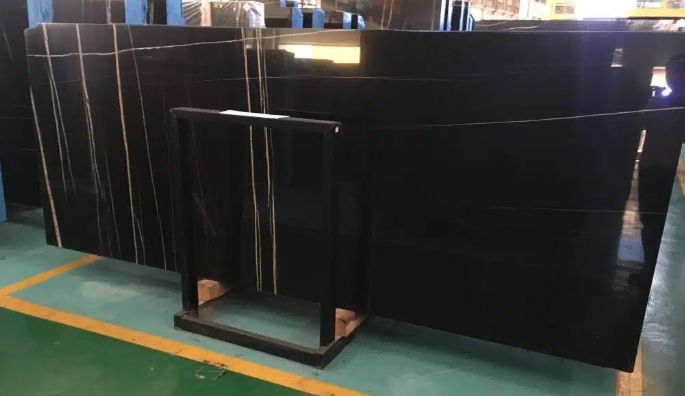
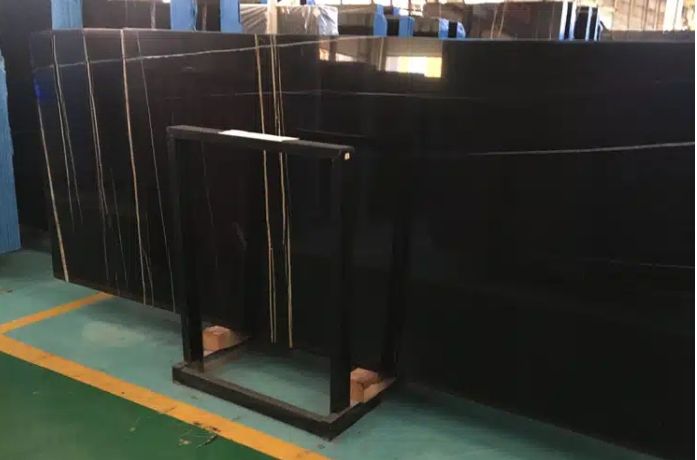
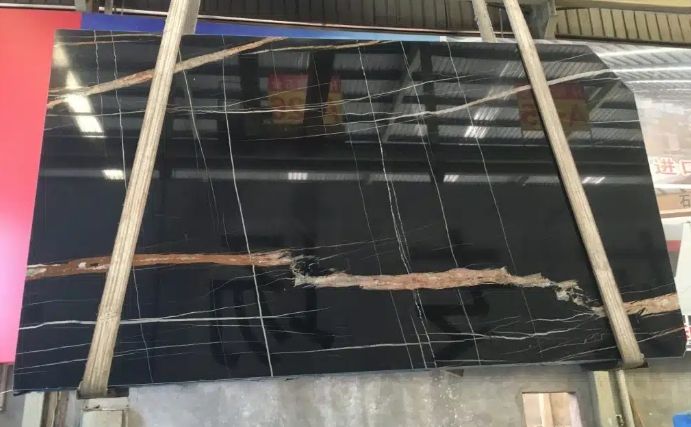
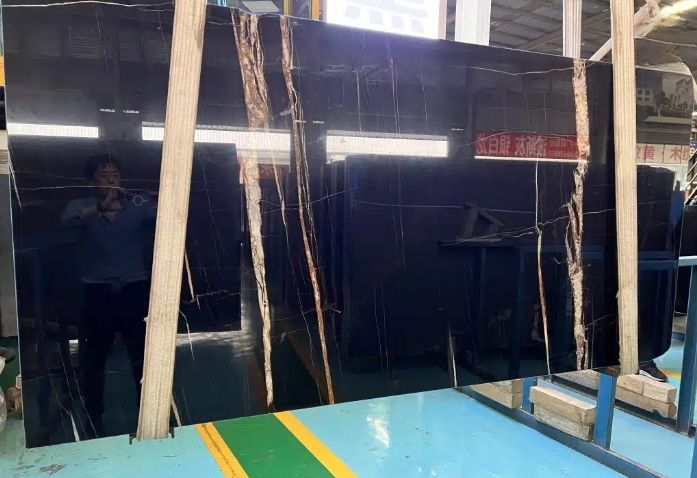
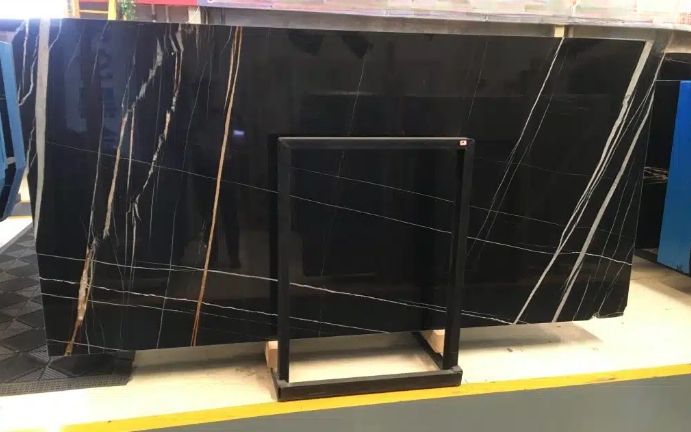
Sahara Noir's veins are unusually straight and rectilinear, frequently crossing at close to right angles; buyers describe the pattern as Mondrian-like. The gold-to-bronze colouring comes from secondary calcite and iron-oxide mineralisation along tectonic zones of weakness, with occasional white calcite accents. The deep black ground is attributed to organic content and fine pyrite in a low-oxygen carbonate deposit.
That geometry is exactly why the stone is a classic for four-way diamond bookmatched feature walls, reception desks and bar fronts: four consecutive slabs arranged 2 × 2 with the veins meeting at a central crossing point. It is also why misalignment is so visible. A cloudy, flowing marble hides a 3 mm seam error. A straight gold line crossing a seam at ninety degrees does not.
The procurement rules that make or break the job
- Sequential slabs from one block. Bookmatching requires consecutive slabs from a single gang-saw run, with every second slab flipped during polishing so the faces mirror. Slabs from different blocks — or a bundle with one slab missing — will not match.
- Buy the whole elevation from one block. Mixing blocks in one viewing plane is the most common cause of a rejected installation.
- Number everything. Block number and slab sequence on the proforma invoice, on the crate labels, and carried through to site.
- Approve a dry-lay before crating. Insist on photographs, or a video walk-through, of the numbered pieces laid out as they will be installed. On a stone with linear veining this is the highest-value check available, and "no photo, no payment release" is normal practice rather than an unusual demand.
Budget the wastage before you quote the client
Independent sourcing guides give consistent figures: bookmatched layouts carry 12–20% wastage against 5–8% for standard layouts, and require a 20–30% overage allowance against 10–15% for running match. Bookmatched fabrication typically runs 20–40% above a running-match order and material cost can reach 1.5–2× a plain layout. On Sahara Noir the extra material goes specifically into cutting around resolved vein junctions so the centre point of a diamond match actually lines up.
Resin, Mesh and Handling: What the Back of the Slab Tells You
Fine-grained black limestones with calcite veining split along the vein boundaries, so factory resin reinforcement and fibreglass mesh backing are normal and expected on Sahara Noir, particularly on 2 cm slabs and on any bookmatched bundle. Their presence is not a defect. How they are applied tells you a great deal about the processor:
- Resin should be drawn into the fissures and cured flat. Glossy resin pooling on the face, or a patchy wavy sheen, signals a heavily filled slab — a common marker of lower-grade material.
- Mesh is typically fibreglass around 160 g/m² bonded with epoxy. Wire mesh on a marble back is a different and less reassuring sign: it often indicates soft or fractured stock rather than a deliberately stabilised slab.
- Ask for photographs of the back as well as the face. It costs the supplier nothing and it is the fastest way to see how the slab was stabilised.
- Request the batch test report, not the brochure. Published strength figures for this stone vary between sources — the DNSA entry gives compressive strength of 92 MPa, while a supplier listing quotes 72.108 MPa. That gap is exactly why batch-specific numbers matter. Our stone defects and inspection guide shows what to record.
Handling points that matter at the port and on site:
- Density is about 2,720 kg/m³, so a 3.2 × 1.6 m 2 cm slab is heavy. A-frame crating is the packing to insist on; flat stacking invites flexing on a mesh-backed slab.
- Edge chipping concentrates on the vein lines and resin-filled edges. Specify corner protection and inspect crate corners on arrival, before the installer has opened everything.
- A polished black surface reveals every scratch, fingerprint and smear of sealer. For high-touch surfaces — vanity tops, bar counters, door push plates — honed is usually the better commercial choice, even though polished photographs better.
Interior Only: Where Sahara Noir Earns Its Price
Every published source on this stone reaches the same conclusion: magnificent indoors, wrong material outdoors. Polished carbonate surfaces are not stable under open weathering, and the stone's own technical guidance recommends interior applications — wall cladding, lobby and feature walls, bar counters, fireplace surrounds, vanities, tables and decorative work. One source puts it bluntly: for exterior use, specify granite or a volcanic stone instead.
Quoted price bands vary enormously with origin claims and trade level. Chinese supplier listings for slab sit in the region of US$30–50/m² reference pricing, while a Middle-East retail slab catalogue prices Sahara Noir at 365–680 AED/m² depending on size and finish. Those are different markets, not different stones — but a sub-US$30 offer should trigger an origin question, because the honest answer is usually "Chinese black marble sold under a Sahara Noir label" rather than Tunisian block. For the machinery of landed cost, see our marble price guide.
Compared with the mainstream alternative
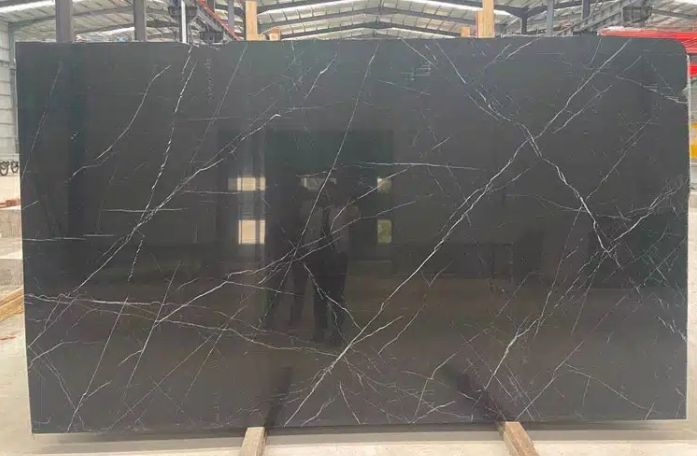
- Against Nero Marquina (Spain). Marquina is the other black-with-white-veining benchmark, better documented geologically and more consistently available across lots. Sahara Noir wins on warm gold veining and rectilinear geometry; Marquina wins on batch repeatability and depth of stock. If the design does not specifically need gold, Marquina is the lower-risk specification.
- Against Absolute Black granite. Genuinely exterior-grade, harder at Mohs 6–7, effectively non-absorbent — and completely without veining. If the surface is exterior or hard-use, granite is the correct answer, and no sealer turns Sahara Noir into granite.
- Against porcelain or sintered slab. Printed porcelain reproduces the black-and-gold look, resists acids and can be used outside. It cannot reproduce the depth of polished limestone or a genuine bookmatched mineral. For a hotel with a reorder horizon measured in years, that trade-off is worth pricing explicitly. See granite vs marble vs quartz and hotel lobby marble design.
Specifications
| Specification | Value |
|---|---|
| Material | Natural Marble |
| Color | As shown — each slab features unique natural veining |
| Standard Sizes | Slabs: 2400×1200mm to 3000×2000mm | Tiles: 305×305mm to 600×600mm (custom available) |
| Thickness | 10mm / 12mm / 15mm / 18mm / 20mm / 30mm (custom on request) |
| Thickness Tolerance | ±1mm (standard), ±0.5mm (premium, specify in order) |
| Surface Finish | Polished, Honed, Brushed, Tumbled, Sandblasted |
| Water Absorption | 0.3-1.5% (ASTM C97) |
| Compressive Strength | ≥80 MPa (varies by variety) |
| Packing | ISPM-15 fumigated wooden crates. Polished slabs interleaved with protective foam. |
| MOQ | 1 × 20ft container (approx. 400-500 m² slabs or 500-900 m² tiles) |
| Delivery Time | 15-25 days after deposit confirmation |
| Payment Terms | T/T (30% deposit, 70% before shipment), L/C at sight |
Further Reading
Related guides: Marble Tiles Buying Guide · Chinese Granite Vs Italian Marble
Standards & references: ASTM C503 Marble Standard · EN 1469 Natural Stone Cladding
Frequently Asked Questions
Is Sahara Noir marble from Morocco?
No. Despite the name, Sahara Noir is quarried in Tunisia - specifically in the Djebel Aziz (Jebel Aziz) area near El Fahs in the Zaghouan Governorate of northern Tunisia, about 60 km south of Tunis. The synonym Noir Aziza refers to the height of Djebel Aziz. The material is catalogued internationally as DNSA 5013, Noir Aziza. Listings that place it in Morocco, Turkey, Italy or China are usually describing look-alike or mislabelled stock. If documented provenance matters for your project, ask the supplier to name the quarry and the block number on the proforma invoice, and compare that against the block photographs.
Is Sahara Noir a marble or a limestone, and does it matter?
It is traded as marble - an accepted trade convention for any carbonate that takes a polish - but petrographically it is a Palaeozoic limestone, with published mineralogy of roughly 88% calcite, 5% dolomite, 3% quartz and 2% serpentine. It matters because the physical behaviour follows the mineralogy, not the label. Expect Mohs hardness of about 3 to 4, acid sensitivity that makes citrus, vinegar and wine etch the polish, and water absorption of roughly 0.66 to 0.92% in the DNSA entry - well above the marble average, which makes impregnation a genuine specification item rather than an optional extra.
Can Sahara Noir be used outdoors?
We do not recommend it. Polished carbonate surfaces are not stable under open weathering, and the stone's own technical guidance points to interior applications: wall cladding, lobby and feature walls, bar counters, fireplace surrounds, vanities and table tops. Acid rain dulls the polish and the calcite veins weather first. For exterior or hard-use surfaces, granite or quartzite is the right material. If the application is a covered and drained vertical wall, an epoxy-set honed installation is achievable, but it should be a deliberate decision with the client's expectation set in writing.
Why is my Sahara Noir slab resin-backed and mesh-backed?
Because that is how this stone is normally prepared, and it is not a defect. Fine-grained black limestones with calcite veining split along the vein boundaries, so factories resin-fill the fissures and bond a fibreglass mesh - typically around 160 g/m2 with epoxy - to the back to stabilise the slab, especially at 2 cm thickness and on bookmatched bundles. What is worth checking is how well it was done: resin should be drawn into the fissures and cured flat, not pooled on the face in glossy patches, which usually signals a heavily filled, lower-grade slab. Ask for photographs of the back as well as the face.
How much overage should I budget for a four-way bookmatched Sahara Noir wall?
Published sourcing guides put bookmatched layouts at 12-20% wastage against 5-8% for standard layouts, and recommend a 20-30% overage allowance against 10-15% for running match. Budget fabrication at 20-40% above a running-match order, with material cost reaching 1.5-2 times a plain layout. On Sahara Noir the extra material is consumed cutting around resolved vein junctions so the centre crossing point of the diamond actually aligns. Reserve it at order time: a slab bought later from another block will not match, and on a rectilinear pattern the mismatch is immediately visible.
Related Resources
- Quality Control Standards — ASTM / EN testing and 6-stage inspection process
- Container Loading Guide — Maximize your shipment efficiency
- Request a Quote — Get pricing and availability for this product
Related Products
Inquire About This Product
Contact us for pricing, samples, or custom specifications.
Get a Quote