Detailed Specifications
Title: Unveiling Elegance: Calacatta Gray Marble Quarry Blocks from Phoenix power stone Introduction: Phoenix power stone, a revered name in marble and granite, stands as a prominent supplier in China. Phoenix Power Stone sources blocks through partner quarries in Guangxi, Yunnan and Sichuan. Our expertise spans marble mining, sales of exquisite marble blocks, slabs, and precisely cut marble tiles.
Key Takeaways
- "Calacatta Gray" is a Chinese trade name, not an Italian quarry. The family is known domestically as 鱼肚灰 (Yuduhui, "fish belly grey") and sold internationally under at least six aliases. No public source names a specific quarry for it.
- Marble blocks run 18–28 tonnes each and are quoted per tonne, not per square metre. One 20ft heavy-duty container typically carries 24–28 tonnes, with a single block generally capped at about 20 tonnes.
- Usable slab yield sits 10–15% below gross block area after cutting waste, seams and vein matching. Buying blocks transfers that yield risk to you — inspect the block faces for open fractures before you commit.
What "Calacatta Gray" Is — and What the Name Does Not Tell You
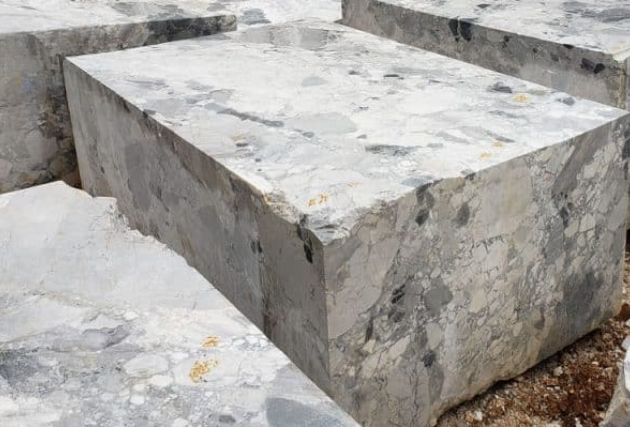
Calacatta Gray (also written Calacatta Grey) is a trade name used in the Chinese and export markets for a fine-grained grey marble with flowing white-to-silver veining. It is not a Carrara material and it is not the same stone as Calacatta. In the Chinese domestic market the family is traded as 鱼肚灰 (Yuduhui, "fish belly grey"), and the same or closely related material appears internationally under a long list of aliases: Allure Bleu / Allure Silver, Armani Silver / Armani Grey, Silver Statuario, Statuario Grey, and Italy Silver Grey. At least one Chinese supplier markets a closely related grey marble as "Da Vinci marble".
Visually, the material has a cool grey to silver ground — sometimes with a blue cast — crossed by white, silver-grey and occasionally blue-grey veining that flows in fine, layered bands. Suppliers describe the structure as dense, fine-grained and high-gloss polishable; honed, leathered and brushed finishes are also produced. Polished is the finish most of the trade uses, because the density of the stone takes a high gloss well.
Two things we could not verify, and you should not accept on trust either. First, no named quarry for "Calacatta Gray" could be established from public sources. Supplier pages state "China" as the country of origin without naming a quarry; at least one claims "premium quarries" without saying where. Second, the name is unregistered and shared, which means two suppliers quoting "Calacatta Gray blocks" may be quoting different stones from different quarries, or from different countries entirely. That ambiguity matters far more for blocks than for tiles, because with a block you are buying the whole risk of what is inside it.
If you are comparing this material against better-documented grey marbles, our Carrara Gray marble quarry blocks and Dark Emperador quarry blocks listings show the format and specification detail you should be asking for on any block quote.
Buying Marble Quarry Blocks: What You Are Actually Paying For
A block purchase transfers yield risk to the buyer. That single sentence is the whole economics of the raw block trade, and it is what separates a block price from a slab price.
- Block weight. Marble blocks typically run 18–28 tonnes each. Loading guidance for a 20ft container generally caps a single block at around 20 tonnes.
- MOQ. One full container load, commonly 24–28 tonnes, in a 20ft heavy-duty container.
- Price basis. Blocks are quoted per tonne, not per square metre. The rate depends on grade, weight, size, vein quality, total tonnage and Incoterms, which is why block pricing is always quotation-based rather than list-based. Published references for machine-cut Grade A blocks run into the hundreds of US dollars per tonne; treat any single figure as indicative only.
- The risk you accept. Hairline fractures, micro-fissures and deep-seated staining lines are frequently invisible on the dusty exterior of a raw block. Slabs cut from a cracked block can shear under gang-saw tension, which reduces usable yield and raises the effective cost per square metre of everything you do produce. If the block contains a fault you did not see, you own the loss.
Yield. Actual usable material runs 10–15% below gross slab area once cutting waste, seams, sink and outlet cutouts, and pattern matching are accounted for:
| Nominal slab size | Gross area | Usable at ~12% waste |
|---|---|---|
| 260 × 150 cm | 3.90 m² | ~3.4 m² |
| 280 × 160 cm | 4.48 m² | ~3.9 m² |
| 300 × 170 cm | 5.10 m² | ~4.5 m² |
| 320 × 180 cm | 5.76 m² | ~5.1 m² |
Plan any large-format or book-matched job on usable yield, never on gross area, or the project comes up short mid-installation. Note also that a 20 mm slab varying by more than about 1.5 mm across its face creates downstream fabrication problems, so thickness consistency is worth writing into the block agreement.
If you do not own a processing plant, the alternative to buying blocks is buying finished slabs from a processor: MOQ around one container of polished slabs (roughly 400–500 m²), lead time of 6–8 weeks, and the processor absorbs the yield risk. Blocks are cheaper per tonne and higher risk; finished slabs cost more per square metre and remove the surprise. Our procurement timeline guide compares the two routes stage by stage.
Inspecting a Calacatta Gray Block Before You Commit
Ask for block-specific material, not a stock photograph of a finished slab. Photographs, video, dimensions, weight and grade should be supplied before order confirmation, and the block should have been selected for vein direction, soundness, geometry and cutting yield. Six things to look at:
- Face photographs in raking light, from at least two sides. Flat, overcast lighting hides surface fissures, which is precisely why a single soft-lit photo is the most common way buyers get caught out.
- Open fractures versus healed veining. Distinguish between them deliberately. A natural healed vein is part of the stone; an open fracture crossing the block face will open further on the gang saw.
- Weathering and sap. Soft, friable or discoloured zones reduce usable yield and are usually concentrated near the block's exposed face.
- Slab orientation. Vein direction determines whether the block cuts into book-matchable pairs or into a run of unrelated slabs. This decides the block's value to you more than its weight does, and it is the one thing a per-tonne price hides completely.
- Stabilisation history. High-value marble blocks are frequently wrapped in reinforcing fibreglass mesh or vacuum-treated with epoxy before cutting. Ask whether the block has been treated and with what — over-application of resin can mask voids.
- Squareness and geometry. A block with an irregular shape wastes more in the first saw pass. "Square block" is a real category in the blockyards, not a marketing phrase.
Loading matters as much as the block. A badly secured block is a total loss, and the requirements are specific: the block must be centred in the container near its centre of gravity and must not sit directly on the container floor — it lays on long timbers, roughly 4 m of timber per 20-tonne block. Maximum floor weight is about 5 tonnes per linear metre. Wedging or chokes should be at least 10% of block height, one wedge per 0.5 m, evenly on all sides, with lashing used in addition to wedging. Use a 20ft general-purpose container preferably no more than six years old, and obtain a stuffing and lashing certificate. Our container loading guide covers the full checklist, and the stone blocks range page shows the block formats we handle.
Grading, Naming and Price Risk in the Chinese Block Market
"Grade A" on a Chinese block quotation is normally self-certified by the supplier. There is no independent authority that assigns it. Where a grade system exists it typically separates premium or A grade (uniform colour, minimal vein variation) from standard grade (natural variation, lower cost) — a genuine and useful distinction, but only ever as good as the supplier's own inspection. For a block, the grade is a statement about the face you can see, not a warranty about the interior you cannot.
The larger risk with a name like Calacatta Gray is not grade inflation, it is identity. Because the family is sold under at least six aliases and more than one country of origin is claimed for it, a three-supplier quote comparison can easily be a comparison across three different stones. Practical protection:
- Fix the name in writing and have the supplier acknowledge the alias list, so a substitution becomes a contractual failure rather than an argument after the container lands.
- Require the block number and photographs of that specific block, and check the number against the packing list and the certificate of origin.
- Compare on usable yield, not on price per tonne. A cheaper block with 15% more waste is not cheaper.
- Confirm the processing chain. China both quarries marble domestically and imports raw blocks from Italy, Turkey, Greece, Spain and Iran for processing and re-export. Processing location does not establish quarry origin, and a certificate that names only the processing plant establishes nothing.
- Third-party inspection is worth commissioning on orders above roughly US$30,000. SGS, Bureau Veritas and Intertek all inspect stone, typically for a few hundred US dollars, and the report is a far cheaper dispute-resolution tool than a rejected container.
China's marble sector is concentrated in Shuitou (Nan'an, Fujian), the main export hub, where blockyards hold thousands of tonnes of square blocks for buyer selection. FOB ports for this material are Xiamen and Shuitou. Lead times quoted by Chinese suppliers for blocks typically run 15–30 days after deposit, though availability is lot-dependent and can be much longer for a specific block. Our supplier verification checklist and the stone defects guide cover the documents and the defect vocabulary to use at this stage.
Specifications
| Specification | Value |
|---|---|
| Material | Natural marble, calcite-dominant, fine-grained crystalline |
| Trade names | Calacatta Gray / Calacatta Grey. Chinese domestic name 鱼肚灰 (Yuduhui, "fish belly grey"). Aliases in use: Allure Bleu, Allure Silver, Armani Silver, Armani Grey, Silver Statuario, Statuario Grey, Italy Silver Grey |
| Colour | Cool grey to silver ground, sometimes with a blue cast; white, silver-grey and occasionally blue-grey veining in fine layered bands |
| Block format | Individual blocks typically 18–28 tonnes. A single block is generally capped at ~20 tonnes for container loading |
| Price basis | Quoted per tonne, not per m². Rate depends on grade, weight, block size, vein quality, total tonnage and Incoterms |
| Usable yield | 10–15% below gross slab area after cutting waste, seams, cutouts and pattern matching |
| Thickness consistency | Slabs cut from the block should hold within ~1.5 mm across the face; beyond that downstream fabrication risk rises sharply |
| Surface Finish | Polished (most common — the density takes a high gloss), Honed, Leathered, Brushed |
| MOQ | 1 × 20ft heavy-duty container of blocks, typically 24–28 tonnes |
| Container loading | Block centred, on timber bearers (approx. 4 m timber per 20 t block), max floor weight ~5 t per linear metre; wedges ≥10% of block height at 1 per 0.5 m; lashing plus stuffing/lashing certificate |
| Loading port | Xiamen / Shuitou, Fujian, China |
| Delivery Time | 15–30 days after deposit for stock blocks. A specific block cut to order takes longer — confirm availability before committing to a project programme |
| Payment Terms | T/T (30% deposit, 70% before shipment), L/C at sight |
Further Reading
Related guides: Marble Tiles Buying Guide · Chinese Granite Vs Italian Marble
Standards & references: ASTM C503 Marble Standard · EN 1469 Natural Stone Cladding
Frequently Asked Questions
How much does a marble quarry block cost?
Blocks are quoted per tonne, not per square metre, and the rate depends on grade, weight, block size, vein quality, total tonnage and Incoterms, so there is no meaningful list price. Published references for machine-cut Grade A blocks run into the hundreds of US dollars per tonne. What you should actually compare is cost per usable square metre: a block at a lower price per tonne with 15% more waste is not the cheaper block. We quote per specific block, against photographs and dimensions.
How heavy is a marble block, and how many fit in a 20ft container?
Marble blocks typically weigh 18–28 tonnes each. One 20ft heavy-duty container usually carries 24–28 tonnes in total, and loading guidance generally caps a single block at around 20 tonnes. The block must sit on timber bearers rather than directly on the container floor, with maximum floor loading of about 5 tonnes per linear metre, wedging of at least 10% of block height, and lashing in addition to wedging.
What yield should I expect from a marble block?
Budget 10–15% below gross slab area. A nominal 300 × 170 cm slab (5.10 m² gross) yields roughly 4.5 m² usable at 12% waste; a 320 × 180 cm slab (5.76 m² gross) yields about 5.1 m². Pattern matching and book-matching push waste higher still. Plan book-matched elevations on usable area, or the job runs short mid-installation.
Is Calacatta Gray quarried in Italy or China?
The name is Italian in style but the material sold under it is a Chinese grey marble, known domestically as Yuduhui. We were unable to verify any specific named quarry for it from public sources, and some listings claim a Turkish origin for closely related material. Because the name is unregistered, we recommend asking any supplier for the quarry name and location, the block number, and the certificate of origin — and treating a vague answer as a real answer.
How do I check a marble block for cracks before buying?
Ask for face photographs in raking light from at least two sides — flat, soft lighting hides fissures. Separate healed natural veining from open fractures, since an open fracture crossing the face will open further on the gang saw. Check for soft, friable or discoloured weathering zones, ask whether the block has been mesh-wrapped or vacuum epoxy-treated (over-applied resin can mask voids), and confirm the block number will appear on the packing list and certificate of origin.
What does 'Grade A block' mean on a Chinese quotation?
It is normally a self-certified grade, not an independent certification. Where a grade system exists it usually separates premium or A grade (uniform colour, minimal vein variation) from standard grade. It is a genuine distinction and worth paying for, but it describes the face the supplier has photographed, not the interior of the block. If the value of the order justifies it, commission a third-party pre-shipment inspection from SGS, Bureau Veritas or Intertek.
Related Resources
- Quality Control Standards — ASTM / EN testing and 6-stage inspection process
- Container Loading Guide — Maximize your shipment efficiency
- Request a Quote — Get pricing and availability for this product
Related Products
Inquire About This Product
Contact us for pricing, samples, or custom specifications.
Get a Quote