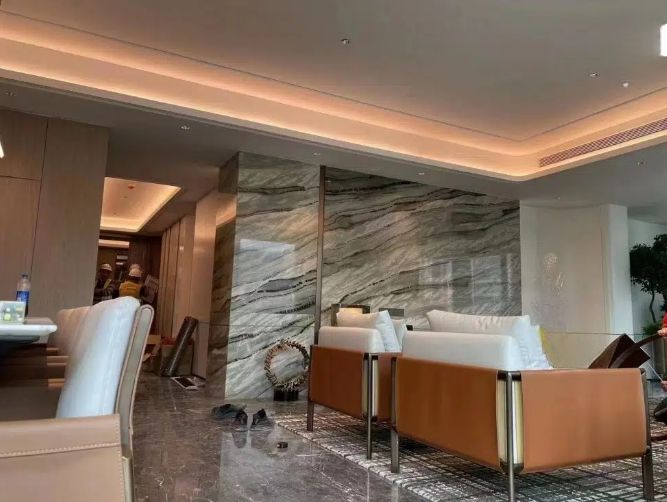
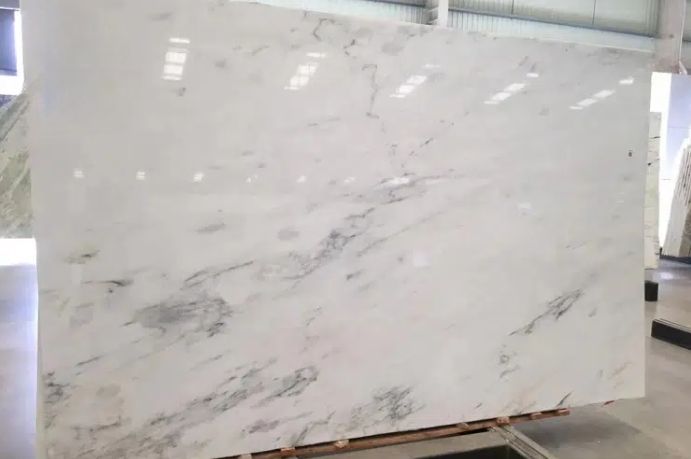
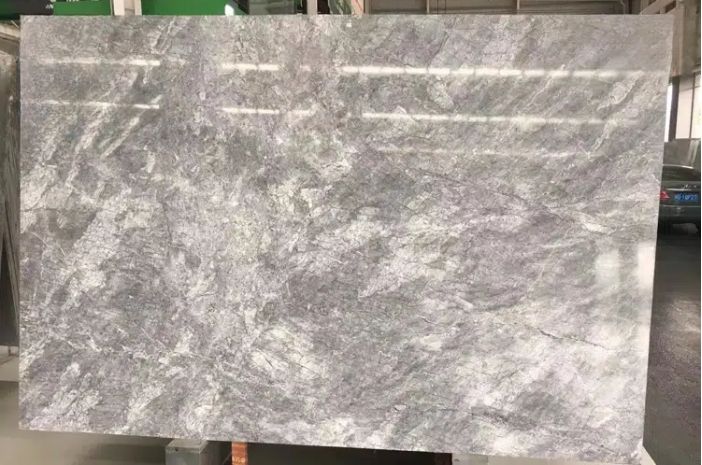
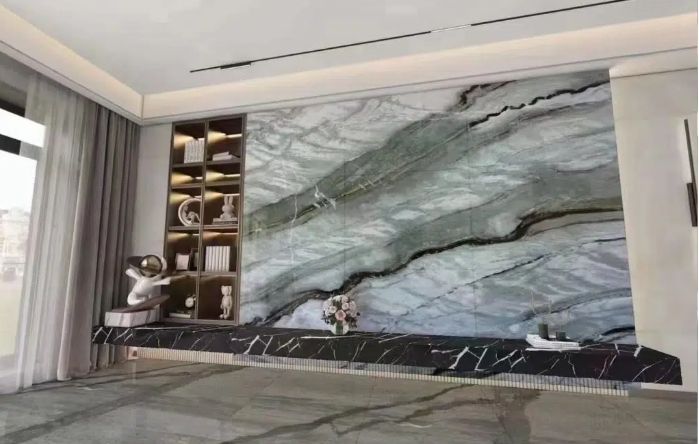
Detailed Specifications
Key Takeaways
- Natural marble — density 2,600–2,750 kg/m³, water absorption ≤0.2%, compressive strength ≥52 MPa
- Hardness: 3–5 Mohs, suitable for both interior and exterior applications when properly specified
- Phoenix Power Stone factory-direct supply — 108,000 sqft facility, Shandong, China, 24+ years of export experience
River Jade, Jade Frost, Liaoning Green: One Name Is Not One Stone
"River Jade" is a marketing name, not a quarry designation. In Chinese export catalogues the same stone also appears as Jade Frost, China Green, Celadon Marble and Green Wood Grain; northern suppliers sell it as Liaoning Green or China Verde Larissa. Regional origin is genuinely disputed across sources: some listings place the quarry in Liaoning in north-east China, others in Sichuan, others again in Yunnan, and many simply say "China." We have not found a supplier publishing a named quarry for this material, and the sources conflict. That is worth stating plainly rather than inventing a locality.
The same confusion runs through the neighbouring green marbles — Amazon Green, Cloud Jade, Peacock Green, Dandong Green / Verde Ming — which overlap in appearance and are routinely sold under one another's names. This is not fraud; it is what happens when a stone is traded by colour impression rather than by deposit.
Why it matters commercially. If you buy "River Jade" on name alone you may receive stone from a different province with a different hardness, a different absorption and a different price basis. Listed prices show the size of the gap: a Grade A polished 2 cm River Jade slab has been listed at roughly US$120–130/m², while a neighbouring northern Chinese green (Verde Ming / Dandong Green, Grade A, 2 cm polished) is listed at roughly US$40–45/m². A threefold spread sitting under one shared colour impression is a naming risk, not a quality difference you can see in a thumbnail.
How to de-risk it in the paperwork
- Require the quarry province and the block number on the proforma invoice, not just the trade name.
- Approve photographs of the exact bundle you are buying — the slabs themselves, not a stock image or a 10 × 10 cm chip.
- Ask for batch-specific physical test values (density, water absorption to ASTM C97) rather than the generic marble figures recycled across listings. Our supplier verification checklist sets out the documents to request.
- Compare quotes on a named sample: send the same physical swatch to each supplier and require the returned quotation to reference it.
The "River" Pattern Is a Sawing Decision, Not Only a Deposit Feature
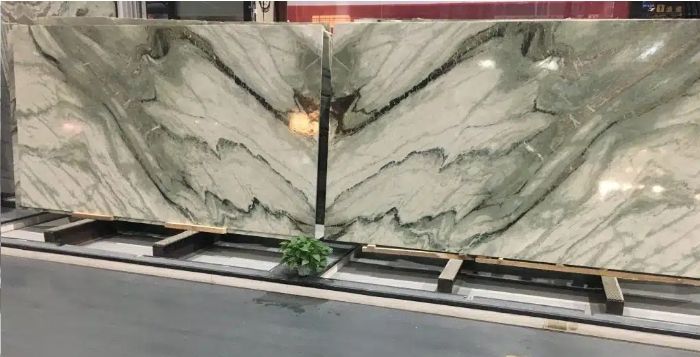
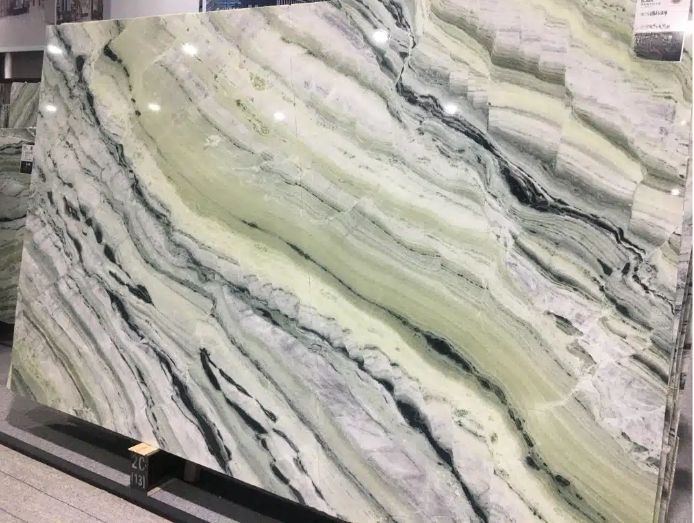
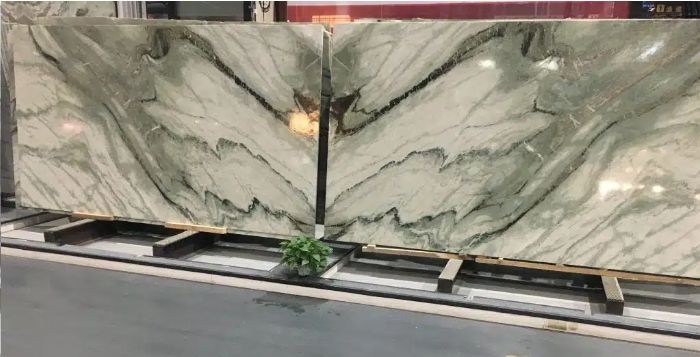
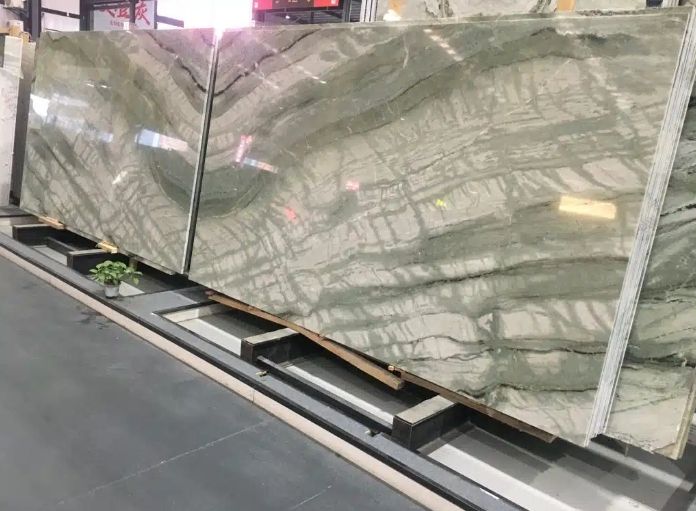
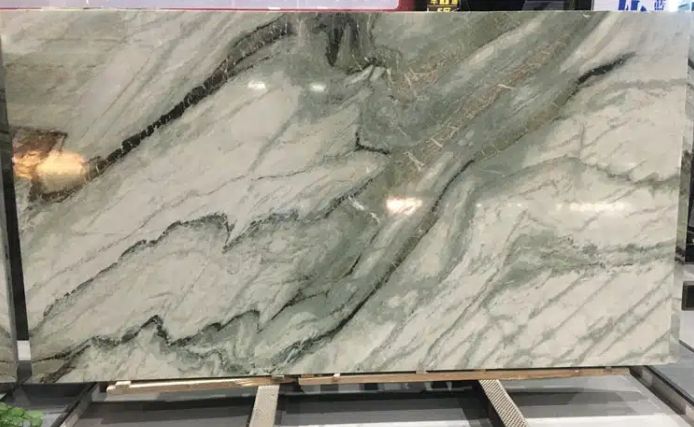
River Jade reads as a flowing, watercolour green: a white to cream ground carrying jade-green, light-green and dark-grey bands that drift across the slab. That directional look is partly geology and partly how the block was cut. The same block yields two quite different faces:
- Vein cut — the block sawn parallel to the bedding. This produces the long, continuous bands the name promises, and it is the format buyers expect from "River Jade."
- Cross cut — the block sawn across the bedding. This produces a mottled, cloud-like face with much shorter flow. It is the same stone, sold under the same name, and it will not match a vein-cut sample.
Write the cut direction into the order. It is not something that can be corrected after the slabs are sawn, and it is one of the most common reasons a container "does not look like the sample."
Matching: running, book and end match
- Running match — slabs laid in sequence. The default and the cheapest, and for a flowing stone it gives the most natural result across a long elevation.
- Book match — mirrored pairs for a symmetrical "butterfly" feature. River Jade's soft, cloudy veining bookmatches subtly rather than graphically; the effect is quiet, not high-contrast.
- End match and four-way match — for floor layouts and full-height wall elevations, where four slabs from one bundle must meet at a centre point.
Because the stone is directional, tile grain direction has to be fixed at shop-drawing stage. Lay every tile the same way for a uniform floor, or alternate them deliberately for a woven effect. Deciding this on site produces a floor that looks like an error.
Green Marble and Water: The Adhesive Rule to Put in the Tender
Green stones are the classic moisture-sensitive family in the stone trade. Many are serpentinites — magnesium silicate rocks rather than calcium carbonate — whose minerals take water into their crystal lattice. When the back of such a tile absorbs water from a cement-based adhesive while the face stays dry, the differential expansion cups the tile upward, and the failure typically appears weeks after installation rather than on the day. Once curled, the tile usually cannot be flattened: grinding introduces more water and the stone warps again.
Whether River Jade is serpentinitic is not something the available sources settle. Chinese green stones are sold as "marble" on the trade convention that any carbonate taking a polish qualifies, and green stones sold under that convention may be serpentine-bearing, or may be dolomite or limestone coloured by chlorite and epidote. Assume nothing; test the sample and write the specification to cover the risk.
Test before you fix the specification
- Stand a tile in a shallow tray with water about a quarter of the way up for two days, dry it, and check the face with a straightedge. A faster variant is to lay a tile face-up on a damp towel overnight.
- Run the test on a tile from your lot. The behaviour is mineralogical and can differ between blocks of the same stone.
Write this into the installation specification
- No water-based thin-set. Specify a 100% epoxy adhesive to ANSI A118.3, or a polyurethane adhesive. Adhesive manufacturers publish this rule specifically for green stone: LATICRETE names green marble and serpentine among the substrates for which its LATAPOXY 300 epoxy adhesive is recommended.
- Do not back-seal with silicone, and do not apply a proprietary sealer to the back hoping to waterproof it. Both create a bond-breaker. Manufacturers warn that untested back-sealing can fail adhesion with cement-class adhesives.
- Seal the face after fixing with a breathable impregnator, and maintain with pH-neutral cleaners only. The green mineral fraction reacts to acids and aggressive cleaners before the white ground does.
- For exterior work, an ANSI A118.3 epoxy adhesive is the specified route, with a honed or textured finish. A polished face will not hold up to weathering.
Where River Jade Performs, and How It Compares With the Mainstream Alternative
River Jade is a soft, acid-sensitive carbonate — Mohs hardness in the 3–5 band, with listed compressive strength around 70–90 MPa. Its commercial value is visual: it delivers a green that no neutral stone provides. Specify it where that colour does the work.
| Application | Verdict | Reason |
|---|---|---|
| Interior feature walls and reception panels | Excellent | No wear surface; the pattern carries the room |
| Bathroom vanities and shower walls | Good | Epoxy-set, impregnated, pH-neutral maintenance only |
| Stair treads, tabletops, counter fronts | Good | Specify honed on any surface a hand will touch; protect nosings |
| Residential flooring, low traffic | Acceptable | Honed finish for slip resistance; expect a soft stone to acquire patina |
| Kitchen worktops | Use with caution | Citrus, vinegar and wine etch the polish. Honed plus impregnating sealer if the client accepts the maintenance regime |
| High-traffic commercial flooring | Not recommended | Abrasion resistance is far below granite or porcelain |
| Exterior vertical cladding, covered | Acceptable | Honed finish and epoxy fixing; expect colour shift over time |
| Exterior paving and horizontal surfaces | Not recommended | Weathering dulls the surface and the green minerals change first |
Compared with the mainstream alternative
- Against white Carrara or Calacatta. River Jade is more individual and far more colourful, and it is a Chinese-origin material with a shorter, cheaper supply chain than Italian white. The whites are better documented geologically, more consistently available across lots and better proven in commercial flooring. Our Chinese stone versus Italian marble comparison covers the supply-chain side.
- Against porcelain or engineered slab. Porcelain is repeatable, non-porous, exterior-rated and roughly a third of the maintenance conversation. It cannot reproduce the depth of a polished green marble, but it wins decisively on lead time, batch repeatability and acid resistance. If the client may need to extend the floor in three years, porcelain is the safer specification — see natural stone versus porcelain.
- Against a green quartzite. Quartzite is harder and far more acid-resistant, and is the right answer when the surface is exterior or hard-use. It rarely delivers the same even, jade-like green. Our quartzite countertops guide explains where that trade-off lands.
Budget the matching allowance before you quote
Independent sourcing guides give consistent figures for patterned stones: bookmatched layouts carry 12–20% wastage against 5–8% for standard layouts, and require a 20–30% overage allowance against 10–15% for running match. Bookmatched fabrication typically runs 20–40% above a running-match order and material can reach 1.5–2× a plain layout. Because River Jade is directional, add a further allowance for the fact that every tile cut from a slab inherits a grain direction: pieces cut against the flow are effectively waste on a laid-out floor.
Specifications
| Specification | Value |
|---|---|
| Material | Natural Marble |
| Color | As shown — each slab features unique natural veining |
| Standard Sizes | Slabs: 2400×1200mm to 3000×2000mm | Tiles: 305×305mm to 600×600mm (custom available) |
| Thickness | 10mm / 12mm / 15mm / 18mm / 20mm / 30mm (custom on request) |
| Thickness Tolerance | ±1mm (standard), ±0.5mm (premium, specify in order) |
| Surface Finish | Polished, Honed, Brushed, Tumbled, Sandblasted |
| Water Absorption | 0.3-1.5% (ASTM C97) |
| Compressive Strength | ≥80 MPa (varies by variety) |
| Packing | ISPM-15 fumigated wooden crates. Polished slabs interleaved with protective foam. |
| MOQ | 1 × 20ft container (approx. 400-500 m² slabs or 500-900 m² tiles) |
| Delivery Time | 15-25 days after deposit confirmation |
| Payment Terms | T/T (30% deposit, 70% before shipment), L/C at sight |
Further Reading
Related guides: Marble Tiles Buying Guide · Chinese Granite Vs Italian Marble
Standards & references: ASTM C503 Marble Standard · EN 1469 Natural Stone Cladding
Frequently Asked Questions
Is River Jade marble the same as Jade Frost, Liaoning Green or China Green?
Very likely, but treat it as unconfirmed until your supplier puts it in writing. River Jade is a trade name rather than a quarry designation, and the same Chinese green marble is sold as Jade Frost, China Green, Celadon Marble, Green Wood Grain, Liaoning Green and China Verde Larissa. Sources also disagree on the region of origin, naming Liaoning, Sichuan and Yunnan in different listings. Because the neighbouring green marbles Amazon Green, Cloud Jade and Dandong Green overlap in appearance and are often sold under one another's names, approve a physical sample and require the quarry province and block number on the proforma invoice rather than buying on the name.
Where is River Jade marble quarried?
Published sources conflict. Some list Liaoning province in north-east China, particularly the listings that use the synonym Liaoning Green; others state Sichuan; others again say Yunnan, or simply China. We have not found any supplier publishing a named quarry or mine for this material, so we describe the origin as China with regional claims unverified. If your project requires documented provenance, ask the supplier to state the quarry province and block number on the invoice and to support it with quarry photographs. Where we cannot verify a claim, we say so rather than repeat it.
Does River Jade marble need a special adhesive?
Yes, plan for one. Green stones are the classic moisture-sensitive family in the stone trade because many are serpentinites whose minerals absorb water into their crystal lattice. Fixed over a water-based cement adhesive, such a tile can cup or curl weeks after installation, and once curled it usually cannot be flattened. Specify a 100% epoxy adhesive to ANSI A118.3 or a polyurethane adhesive, never a water-based thin-set. Do not back-seal with silicone, which acts as a bond-breaker. Confirm the behaviour of your own lot first with a simple test: stand a tile in a shallow tray of water for two days, dry it, and check with a straightedge.
Can River Jade marble be used outdoors?
Only with care, and never as paving. River Jade is an acid-sensitive carbonate with a Mohs hardness around 3 to 5, so acid rain and weathering dull the surface, and the green mineral fraction changes colour before the white ground does. Covered vertical cladding in a honed finish with an epoxy adhesive is achievable. Horizontal exterior surfaces, exterior paving and fully exposed elevations are not recommended - if the surface is outside and hard-wearing, granite or quartzite is the correct material, and no sealer converts a carbonate into one.
Do you supply bookmatched River Jade slabs, and how much overage should I budget?
Yes. Bookmatching requires consecutive slabs from a single gang-saw run with every second slab flipped at polishing, so we reserve the sequential bundle and will not cherry-pick individual slabs out of it. Budget from published industry figures: 12-20% wastage for bookmatched layouts against 5-8% for standard ones, and a 20-30% overage allowance against 10-15% for running match, with fabrication running 20-40% higher. Note that because River Jade is directional, running match in a single cut direction is often the better-value specification, and we will tell you when that is the case for your layout.
Related Resources
- Quality Control Standards — ASTM / EN testing and 6-stage inspection process
- Container Loading Guide — Maximize your shipment efficiency
- Request a Quote — Get pricing and availability for this product
Related Products
Inquire About This Product
Contact us for pricing, samples, or custom specifications.
Get a Quote