
Detailed Specifications
Jilin White Tombstone Hot Sell Poland Monument — a factory-direct Jilin White granite memorial set built to Polish cemetery drawings, with the high-mass elements in Jilin White and the focal elements available in Beida Black. The sections below cover the stone's measured properties, what Polish cemeteries actually require, how a Polish monument set is put together, and what to put in your RFQ.
Specifications
| Specification | Value |
|---|---|
| Material | Natural Granite |
| Color | As shown — multiple color options available |
| Standard Sizes | Slabs: 2400×1200mm to 3000×2000mm | Tiles: 305×305mm to 600×600mm (custom available) |
| Thickness | 10mm / 12mm / 15mm / 18mm / 20mm / 30mm (custom on request) |
| Thickness Tolerance | ±1mm (standard), ±0.5mm (premium, specify in order) |
| Surface Finish | Polished, Honed, Flamed, Bush-Hammered, Flamed + Brushed, Sandblasted |
| Water Absorption | Jilin White: published 0.13–0.37% (ASTM C97). Specify ≤0.4% for frost resistance |
| Density | ≈2.63–2.80 g/cm³ (Jilin White granite) |
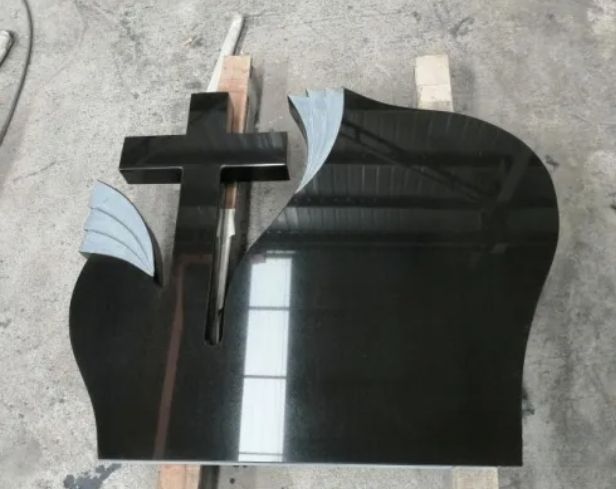
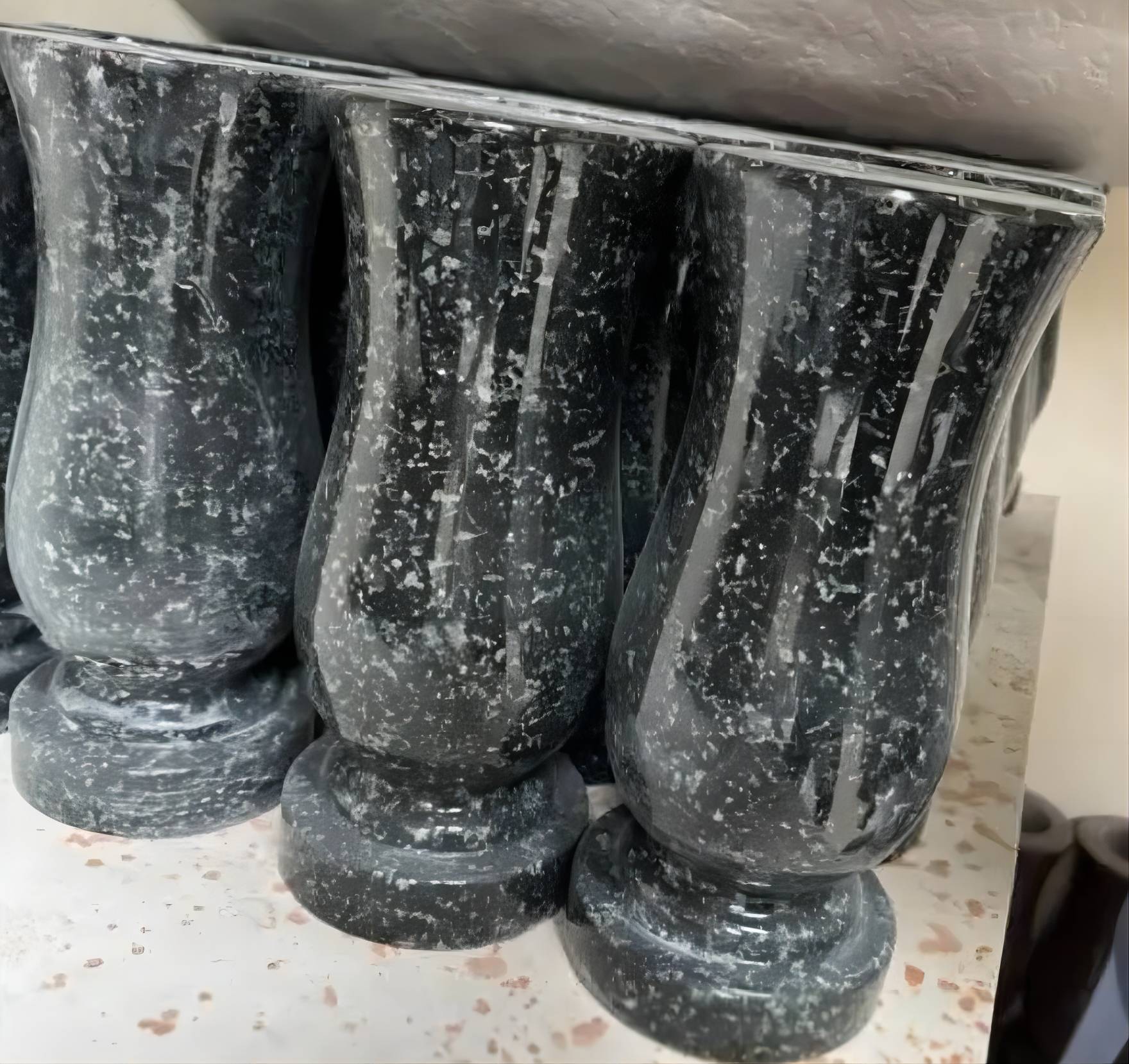
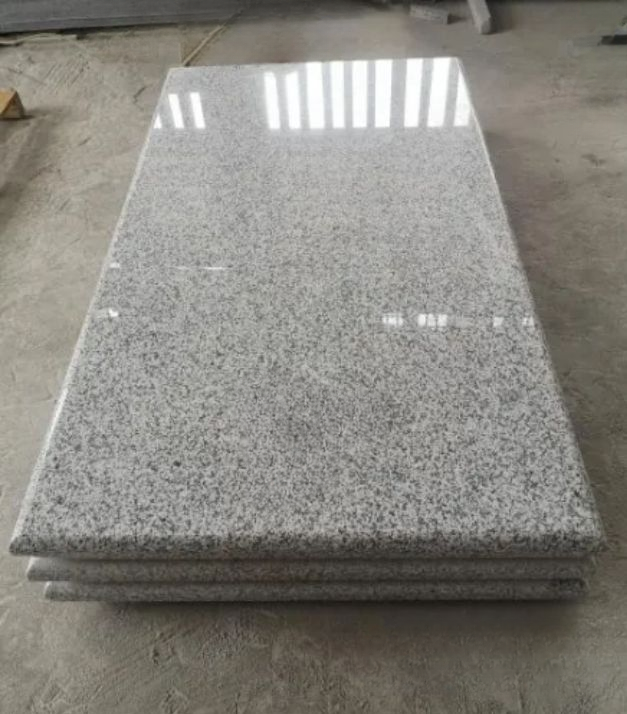
| Monument Elements | Slab / ledger, tablet, plinth (cokół), base, cross, vase, borders, inlays — sized to the buyer's metric drawing |
| Compressive Strength | ≥130 MPa (ASTM C170) |
| Packing | ISPM-15 fumigated wooden crates / pallets. Polished faces interleaved with protective sheets. |
| MOQ | 1 × 20ft container (approx. 400-500 m² slabs or 500-1,100 m² tiles) |
| Delivery Time | 15-25 days after deposit confirmation |
| Payment Terms | T/T (30% deposit, 70% before shipment), L/C at sight |
Key Takeaways
- Jilin White granite (G2701, also sold as "Jilin 603" / "New G603") — density published at 2.63–2.80 g/cm³, water absorption 0.13–0.37% depending on source, compressive strength 143.9–175.2 MPa. Verify per batch.
- Quarried in Jilin Province, north-east China (Jiaohe / Changbai Mountain west) — a different supply base from the Fujian and Shandong quarries that supply most Chinese granite exports.
- Polish monuments are approved per cemetery by the parish office, so every order is cut from the buyer's metric drawing rather than a fixed catalogue size.
Jilin White Granite: Identity, Quarry, and the G603 Confusion
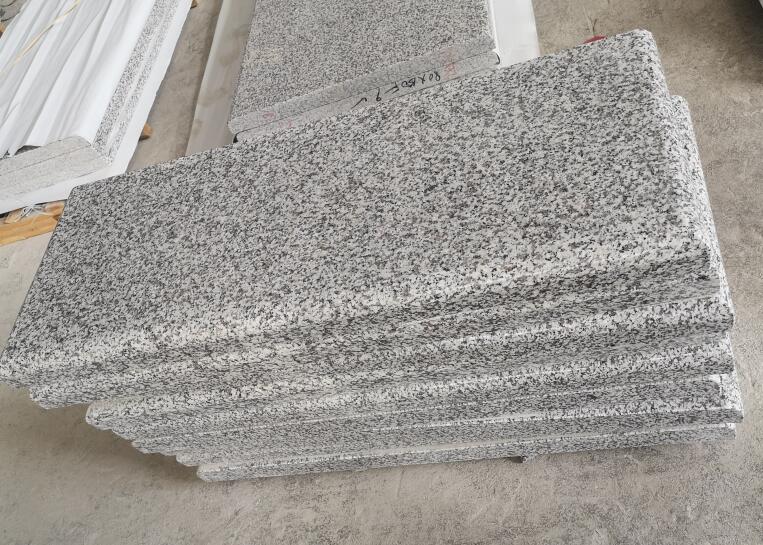
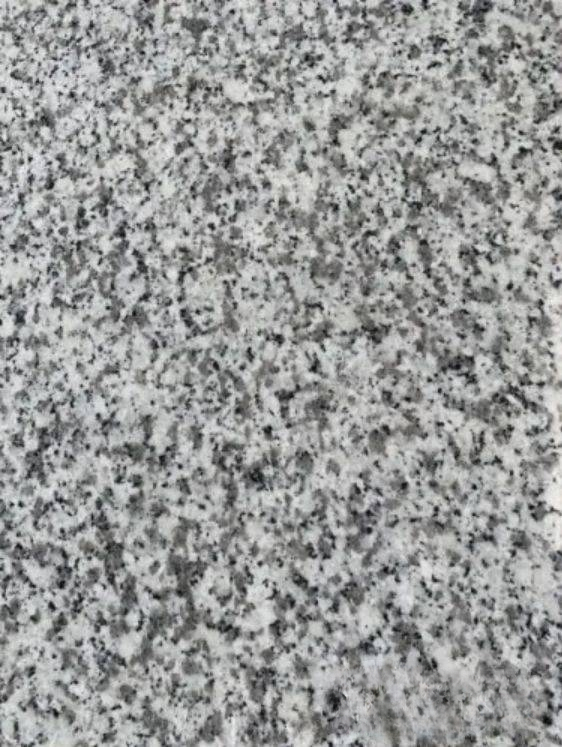
Jilin White is quarried in Jilin Province in north-east China, in the Changbai Mountain west area around Jiaohe — a long way from the Fujian and Shandong quarrying districts that supply most Chinese granite exports, and a different supply chain to plan around. It is a fine-grained granite with a white to very light grey background carrying small grey and black flecks, and it takes a high mechanical polish.
The naming is where buyers get caught. The same material is sold as G2701, G2201, Jiaohe White, Tiangang White, Jilin Bai and Xiangyun White, and also as "Jilin 603" or "New G603" because it sits close to G603 Padang Light in appearance. G603 and Jilin White look nearly identical in a polished tablet but are different materials with different test data. If the specification or the cemetery drawing says G603, confirm which quarry the quotation is based on before comparing prices.
| Property | Commonly published | Range across sources |
|---|---|---|
| Water absorption (ASTM C97) | 0.13% | 0.13–0.37% |
| Density | 2.80 g/cm³ | 2.63–2.80 g/cm³ |
| Compressive strength | 143.9–175.2 MPa | Sources broadly agree |
| Flexural strength | 11.2–16.5 MPa | Varies by variant |
| Hardness | 113 HSD (Mohs 6.5–7) | Sources broadly agree |
| Polish | >90° gloss achievable | Mechanical abrasive polish, no wax |
Note the water absorption spread: supplier data sheets publish 0.13% to 0.37% for what is described as the same stone. Both come from supplier literature rather than independent laboratory testing, so treat the number as a specification to be verified rather than a fact to quote to your customer. We issue batch test reports for exactly this reason.
What the Polish Market Actually Specifies — and Why There Is No Single Standard
Poland is one of the most standards-driven memorial markets in Europe, and the standard is local. The national baseline comes from the Regulation of the Minister of Infrastructure of 7 March 2008: a grave is 2.0 m long, 1.0 m wide and 1.7 m deep, and a monument may not extend beyond the grave area. Everything above that baseline is set by the cemetery administrator — which in most of Poland means the parish.
- Sizes in practice. Single graves are most commonly worked to 190 × 90 cm; double graves to 190 × 140 cm, 200 × 160 cm or 180 × 180 cm.
- Parish limits vary widely. Parishes in the Kielce diocese commonly cap the monument at 2.4 × 1.1 m; Kazimierza Wielka allows 2.5 × 1.2 m; Ślesin caps width at 1.6 m and length at 1.8 m. The parish of Tur works to 200 × 100 cm for a single earth grave, 230 × 120 cm for a family grave, 120 × 60 cm for a child and 50 × 50 or 100 × 100 cm for urn graves.
- Written approval, per monument. Dimensions, shape, materials and the inscription text must be approved by the parish office before installation. Approval attaches to the individual monument, not to the supplier or the model.
- Fees and tenure. Parishes charge for the right to erect — Pobiedziska, for example, charges 250 zł for a single and 500 zł for a double. Grave rights typically run 20 years and are renewable.
The commercial consequence is direct: there is no "Poland standard" monument set that can be built to stock. Two orders from the same customer in the same month can legally require different tablet widths because the cemeteries differ. That is why suppliers who serve Poland work from the buyer's metric drawing, confirming length, width, thickness, joint width, edge profile, fall, fixing holes and lettering position for every element. If a supplier offers a fixed "Poland model" without asking for a drawing, treat that as a warning sign rather than a convenience.
Anatomy of a Polish Monument: Elements, Thickness, and the Two-Tone Build
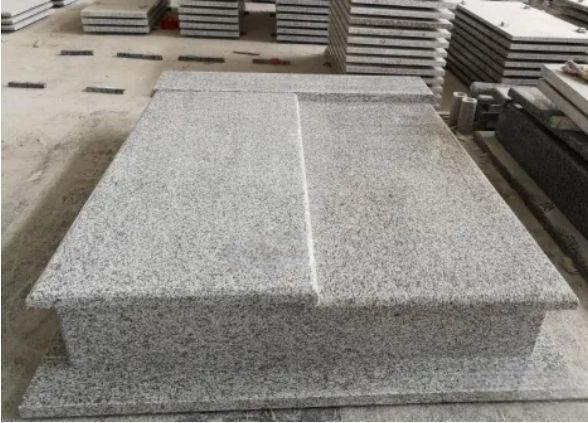
A Polish grave monument is a set rather than a headstone, and the elements are ordered together: the reinforced concrete foundation (fundament), the plinth or base course (cokół), the horizontal ledger slab over the grave (płyta wierzchnia), the vertical tablet carrying the inscription (tablica), an optional border around a gravel field (obwódka), and the accessories (galanteria) — cross, lantern, vase and photograph frame.
Typical proportions for a single monument, from Polish stonemasonry trade guidance: overall footprint around 200 × 100 cm; tablet around 100 × 60 cm; slab thickness 6 cm, with 4 cm and 8 cm as the alternatives; plinth height 15–25 cm; overall height 90–120 cm. Two pieces of trade advice are worth passing on to your own customers. Reducing the slab from 6 cm to 4 cm saves only a few percent of the price but materially raises the risk of cracking, so it is the wrong place to economise. And the foundation is the most frequent cause of a monument leaning years later — Polish practice is a reinforced concrete foundation taken down a minimum of 80 cm, deeper on clay or peat.
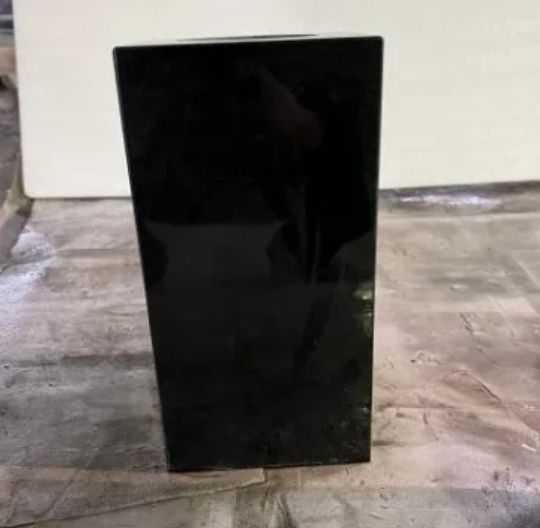
Two-tone builds. The most common configuration for this market pairs Jilin White on the high-mass elements — base, ledger, thick sub-base — with Beida Black on the focal elements: tablet, cross, inlays and accent lines. The commercial logic is container weight. Black granite runs about 3.0 t/m³ against roughly 2.8 t/m³ for Jilin White, so at the same payload you ship about 7% more volume in white than in black. Pairing the two gives the black-and-white appearance Polish buyers ask for while keeping the freight cost per set below that of a solid black monument. Light-coloured stone is also the established preference in Polish Catholic cemeteries, which is why Chinese light greys such as G439 White Pearl and G603 Padang Light have become regular lines with Polish importers.
One caution on thickness. We have not found a published national convention that fixes element thickness at 8 cm or 10 cm; Polish and Chinese sources alike describe thickness as a per-drawing decision confirmed element by element. Treat a supplier's fixed thickness table as a starting point for the conversation, not as a standard.
Freeze-Thaw, Finish, and What to Put in Your RFQ
Poland freezes hard, and a monument that takes up water and then freezes will spall — the failure shows as staining and edge loss long before the stone actually breaks. The usual industry marker for frost resistance is water absorption at or below 0.4% (ASTM C97). Jilin White is published between 0.13% and 0.37%, comfortably inside the marker at the low end and close to it at the high end, which is why water absorption is the single number worth pinning down per batch before committing to a container.
Finish interacts with that. Polished is standard for tablets because it cleans easily and holds lettering crisply, but Polish trade guidance notes that polished faces can highlight micro-cracks as they develop. Flamed reduces absorption and discolouration but needs regular brushing and is not what most Polish cemeteries expect on a tablet face. A practical compromise is polished on the tablet and ledger, and flamed or honed on the base and on horizontal surfaces that hold standing water. After installation, a breathable penetrating sealer reduces water uptake and efflorescence; film-forming sealers trap moisture and should be avoided.
What to put in the RFQ. Send the metric drawing per cemetery (or per model if several cemeteries are involved), the granite names for each element, the finish schedule element by element, the lettering artwork and whether it is to be sandblasted and painted or laser-etched, quantities per model, the destination port and the road weight limit that applies at your end. Monument containers are planned by weight rather than volume, and Poland's road transport limit for container cargo is roughly a 24 t gross ceiling — below what a 20 ft container can carry at sea. We build the loading plan to the lower of the two limits so the container can leave Gdańsk or Gdynia without a permit problem.
On duty. Worked granite enters the EU under HS 6802.23, and as of the sources reviewed for 2026 there is no granite-specific EU anti-dumping duty — early-2026 EU trade-defence activity was concentrated on ceramics, not stone. Classification still drives the rate, so verify the CN/TARIC code for your exact product form in the Commission's Access2Markets tool.
Further Reading
Related guides: Tombstone Granite Guide · Tombstone & Monument Buying Guide · Natural Stone Price Guide 2026 · Stone Import Duties & Tariffs 2026
Related products: G664 Granite Tombstone, Poland Market · G648 Granite Tombstone, Poland Market · Beida Qing Headstone · Poland-Style Headstone
Standards & references: ISO 9001 Quality Management · ASTM C97 Water Absorption
Frequently Asked Questions
What sizes does a Polish single-grave monument need to be?
The national baseline (Regulation of the Minister of Infrastructure, 7 March 2008) is a grave 2.0 m long, 1.0 m wide and 1.7 m deep, with the monument not extending beyond the grave area. In practice single graves are usually worked to 190 × 90 cm and doubles to 190 × 140, 200 × 160 or 180 × 180 cm, but parish rules override those figures — caps as tight as 2.4 × 1.1 m are common in some dioceses. Confirm with the buyer's cemetery before cutting.
Does my customer need parish approval, and how does it affect my order?
Yes. In most Polish cemeteries the parish office must approve a written project — dimensions, shape, materials and inscription text — before installation, and approval is granted per monument. The dimensions on your cutting list therefore have to come from the buyer's approved drawing rather than a general size chart, which is why we quote from metric drawings instead of a stock model list.
Why is Jilin White often paired with Beida Black?
Jilin White carries the high-mass elements — base, ledger and thick sub-base — while Beida Black is used for the tablet, cross, inlays and accent lines. Black granite is denser (about 3.0 t/m³ against roughly 2.8 t/m³ for Jilin White), so a solid black set consumes a container's payload faster. Pairing the two gives the black-and-white appearance Polish buyers want while keeping freight cost per set down.
What water absorption should I specify for Polish winters?
Aim for 0.4% or below (ASTM C97), the usual industry marker for frost-resistant stone. Published figures for Jilin White span 0.13% to 0.37% depending on quarry and variant, and sources conflict on the figure, so treat it as a per-batch specification rather than a material constant and ask for the test report to travel with the container.
What thickness should the tablet and the ledger be?
Polish trade guidance puts the slab at 6 cm as standard, with 4 cm and 8 cm as alternatives, and advises against dropping to 4 cm: the saving is a few percent of price and the cracking risk rises materially. Typical single-monument proportions are a 200 × 100 cm footprint, a tablet around 100 × 60 cm, a plinth of 15–25 cm and an overall height of 90–120 cm. Element thickness is confirmed per drawing; we have not found a published national convention that fixes it.
How many monument sets fit in a 20ft container?
A monument container is planned by weight, not by volume. Jilin White runs about 2.8 t/m³, and Poland's road transport limit for container cargo is roughly a 24 t gross ceiling — below what a 20 ft container can carry at sea. Send us the drawing and the set count and we will return a loading plan built to the Polish road limit rather than the ocean limit.
Related Resources
- Quality Control Standards — ASTM / EN testing and 6-stage inspection process
- Container Loading Guide — Maximize your shipment efficiency
- Request a Quote — Get pricing and availability for this product
Related Products
Inquire About This Product
Contact us for pricing, samples, or custom specifications.
Get a Quote